
Main points
- Scientists have confirmed that Silverpit Crater was formed by an asteroid impact about 43 to 46 million years ago.
- The latest imaging and analysis methods of the samples confirmed the presence of characteristic features of impact craters, including shock quartz and feldspar.
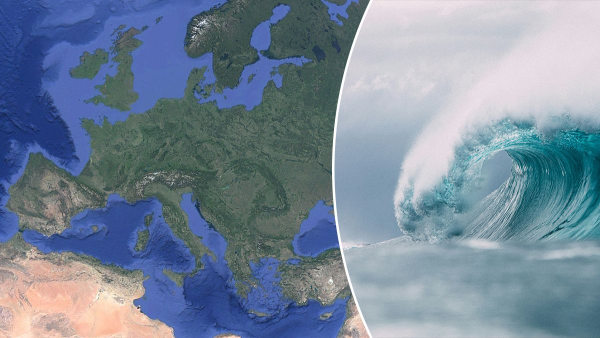
Scientists confirm catastrophic collision in prehistoric North Atlantic / Collage by Channel 24/Unsplash
The North Sea hides beneath its waters the scar of a catastrophe of unimaginable magnitude. For decades, scientists have debated the origin of the giant structure on the seabed, attributing it to volcanoes or the movement of salt. But new imaging technologies and unique minerals have finally allowed us to reconstruct the events of the day our planet suffered an impact of incredible power.
What secrets did Silverpit Crater hide?
The scientific debate surrounding the so-called Silverpit crater, located about 700 meters below the seabed, has finally come to an end. A research team led by Dr. Wisden Nicholson from Heriot-Watt University has presented irrefutable evidence that the structure is the result of a cosmic body impact, writes ScienceDaily.
Using advanced 3D seismic scanning techniques and analysis of rock samples, scientists have confirmed that around 43 to 46 million years ago, an asteroid measuring around 160 metres hit the seabed around 130 kilometres off the coast of what is now Yorkshire.
The discovery puts an end to a long-standing debate within the scientific community. Although the structure itself was discovered in 2002, many geologists were skeptical of the collision theory. In 2009, a public vote was even held, during which most experts rejected the idea of an asteroid impact, leaning towards versions of subsidence of salt layers or volcanic activity.
However, recent seismic tomography data have revealed a clear structure of the central uplift, annular trench, and deformation zone, which is characteristic of impact craters. The final confirmation was the discovery of rare crystals of so-called shock quartz and feldspar in a nearby oil well.
Dr. Nicholson compared the search for this microscopic evidence to looking for a needle in a haystack, as they are only formed under extreme pressure that cannot be replicated by any other natural process on Earth.
How was it?
The reconstruction of the events of that time paints a picture of a true apocalypse on a regional scale:
- The asteroid entered the atmosphere and hit the seabed at a sharp angle from the west.
- Within minutes of contact, a colossal column of water and rock debris about 1.5 kilometers high shot into the sky.
- When this curtain of water collapsed back into the sea, it generated a megatsunami, the height of the waves of which exceeded 100 meters.
- The waves spread over vast distances, changing the coastline of Europe at the time.
The study found that the impact was so powerful that it caused thermal decomposition of Cretaceous sediments on the seafloor. Scientists estimate that the instantaneous heating and evaporation of carbonates released between 0.9 and 2.2 cubic kilometers of rock as carbon dioxide and steam.
This process caused the formation of specific “holes” on the floor of the crater, which were previously thought to be the result of gas leaking from deep below. In addition, Silverpit became the first place on Earth where secondary craters were recorded – smaller depressions up to 150 meters in diameter, formed by the fall of large debris thrown up during the main impact.
What does this give us?
Silverpit is now officially on the list of rare marine impact craters, of which only about 33 are known in the world. It joins such famous sites as the Chicxulub crater in Mexico, which is associated with the extinction of the dinosaurs, and the recently discovered Nadir crater off the coast of West Africa.
Professor Gareth Collins of Imperial College London, who was involved in the mathematical modelling of the event, said: “Confirming Silverpit's impact origin opens up new possibilities for studying how such collisions shape planetary surfaces. This data is critical not only for understanding our planet's past, but also for predicting the consequences of possible asteroid threats in the future.”
The study can be read in full in the journal Nature Communications.