
Main points
- Scientists from the University of Science and Technology of China have created a strontium optical clock with an accuracy of one second in 30 billion years.
- This clock has potential applications in relativistic geodesy, crustal monitoring, and dark matter research.
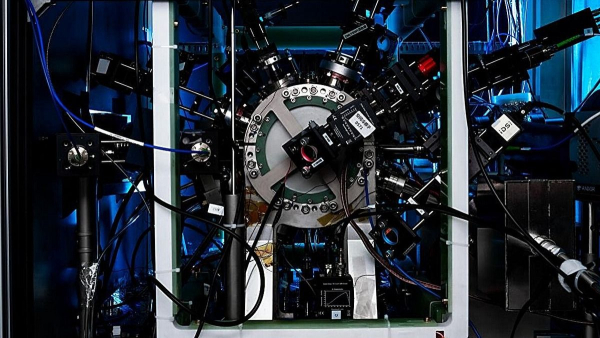
Chinese physicists have created the most reliable watch in history / CMG
Scientists at the University of Science and Technology of China have made a breakthrough in quantum metrology by creating a next-generation strontium optical clock. Its characteristics allow it to measure the passage of time with an accuracy that was previously thought unattainable. The device is so stable that its potential error is less than one second over a period that is twice the age of our universe.
How was such measurement accuracy achieved?
A group of researchers led by Zhi-Peng Jia has demonstrated the operation of the USTC Sr1 clock, the systematic uncertainty of which is only 9.2 in 10-19. This achievement puts the Chinese development on a par with devices from leading world institutes, such as the US National Institute of Standards and Technology, and opens a direct path to revising the international definition of a second in the SI system of units, writes Phys.org.
The main component of the system is strontium-87 atoms, fixed in a one-dimensional optical lattice, where their state is checked by an ultrastable laser at a wavelength of 698 nanometers.
To achieve this level of precision, the scientists developed innovative methods to combat factors that typically distort atomic vibrations. The most challenging task was to compensate for the light shift of the crystal lattice, according to the study in the journal Metrologia.
Particular attention was paid to magnetic effects. The use of magnetically insensitive transitions allowed to reduce the influence of the external field by a factor of 22.4 compared to standard methods. Thanks to careful calibration, the error from magnetic shifts was limited to a minimum. The system also demonstrates impressive frequency stability, confirming the durability of the watch for such long-term use.
What is this for science?
The capabilities of such a device go far beyond conventional chronometry. High sensitivity to gravitational potential allows the Sr1 to be used for relativistic geodesy, in particular for measuring altitude with millimeter accuracy.
This opens up prospects for monitoring deformations of the Earth's crust, changes in groundwater levels and volcanic activity. In addition, ultra-precise optical clocks are becoming new tools for searching for dark matter and registering low-frequency gravitational waves, capturing microscopic fluctuations in physical constants that were previously impossible to detect.