
Main points
- Artificial intelligence has helped archaeologists discover 303 new Nazca Lines geoglyphs in Peru, doubling the known number of these drawings.
- Algorithms analyzed satellite and drone images, revealing new figures that were then confirmed by archaeologists on the ground.
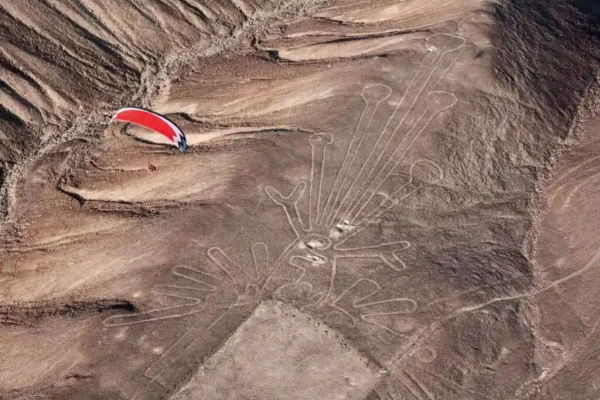
AI reveals new Nazca geoglyphs that were hidden for centuries / ALAMY
Artificial intelligence has helped archaeologists make one of the biggest discoveries in the study of the Nazca Lines in Peru. In six months, scientists have found more than 300 new geoglyphs that had remained unnoticed for centuries due to the vastness of the desert and the limitations of traditional research methods.
An international team of archaeologists has significantly expanded the map of the famous Nazca Lines in Peru. Using artificial intelligence, the researchers have discovered 303 new geoglyphs in the country's coastal desert, effectively doubling the known number of these ancient drawings. Futura reports.
How did artificial intelligence help find new Nazca lines?
The work was carried out by experts from Yamagata University's Nazca Institute together with researchers from IBM. The project leader, archaeologist Masato Sakai , confirmed that the discovery was one of the fastest breakthroughs in the study of this site.
The Nazca Lines are huge drawings on the desert surface, created between approximately 200 BC and 650 AD. They depict animals, plants, and geometric shapes, and some of them stretch for hundreds of meters.
Many of these images have gone unnoticed due to the vast expanse of desert. Traditionally, archaeologists have explored the region through aerial photography, field expeditions, and detailed hand-drawn maps.
According to Sciencefocus, the new approach used artificial intelligence algorithms trained on thousands of aerial photographs. The system analyzed terabytes of high-resolution satellite and drone images and found faint lines and geometric shapes that are difficult for the human eye to see.
After the algorithm identified possible new geoglyphs, archaeologists verified these sites directly on the ground. This combination of automated analysis and field research significantly accelerated the work.
Among the new images, researchers found figures of cats, birds, fish and various abstract shapes. Many of them maintain almost perfect symmetry despite their large size, indicating a deep understanding of geometry among the ancient Nazca culture.
Scientists have also received new clues about the purpose of these geoglyphs. The research team believes that some of the drawings may have been part of ceremonial routes – special paths that people took during ritual processions related to religious beliefs.
This version resonates with the research of German mathematician and astronomer Maria Reiche , who studied the Nazca Lines for many years and documented their geometry in detail.
The project in Peru is just one example of how artificial intelligence is changing archaeology. Modern algorithms are already helping to find ancient burial mounds in Europe, detect settlements under dense forests, and even search for sunken ships at the bottom of the oceans.
For example, at the Saruq Al Hadid archaeological site in the United Arab Emirates, researchers used satellite data analysis to identify patterns in the distribution of artifacts, allowing them to more precisely pinpoint excavation sites.
Archaeologists emphasize that artificial intelligence does not replace human work. Algorithms can find potential objects, but each find must be confirmed during field research, as the system sometimes makes mistakes.
But technology is speeding up the process . What used to take years of fieldwork can now be done in a few days of data analysis. For the Nazca Lines, this means gradually uncovering an even bigger picture of a culture that existed more than 1,500 years ago.