
Main points
- David J. Farber, recognized as the “grandfather of the Internet,” has died at the age of 91.
- He played an important role in the establishment of the CSNET and NSFNET networks, which became the basis for the global Internet.
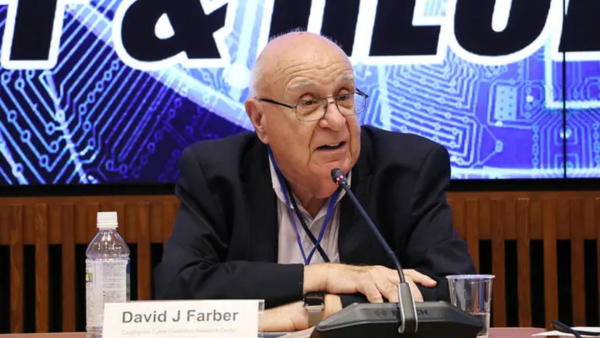
Scientist David J. Farber has died / Photo by Keio University Global Research Institute
American computer scientist David J. Farber of the United States passed away on Saturday, March 7. He was 91. During his life, Farber was a participant in key network projects and a mentor to a number of Internet pioneers.
He was remembered as the grandfather of the Internet. The tragic news of the scientist's death was reported in The Wall Street Journal.
What is known about the life and death of David J. Farber?
Although the scientist did not invent any of the fundamental technologies of the Internet, he played a key role in its formation through mentoring, organizing research groups, and bringing talented people together around joint projects.
In 1996, President Bill Clinton officially named him an “Internet pioneer.” The nickname “grandfather of the Internet” stuck to him primarily due to the enormous influence he had on subsequent generations of engineers. Among his students and colleagues were, in particular, Dave Crocker (one of the creators of email standards) and Paul Mokapetris (author of the domain name system).
Farber attended Stevens Institute of Technology, where he earned a bachelor's degree in engineering and a master's degree in mathematics. In 1956, he joined Bell Laboratories, where he helped create one of the first string-processing programming languages (SNOBOL). It was there that he met fellow programmer Gloria Jumusis, who would later become his wife.
In 1970, Farber moved to academia at the University of California, Irvine, where his group implemented one of the world's first working distributed computer networks, where multiple machines could work together to solve complex problems.
Later, at the University of Delaware, he led the development of the CSNET and NSFNET networks – two critically important projects that connected universities and research centers in the United States and later became the basis for the transition to the commercial global Internet.
Throughout his life, Farber taught at several leading universities (Carnegie Mellon, University of Pennsylvania, etc.), consulted for large companies and government agencies, acted as an expert in court cases (in particular, in the antitrust case against Microsoft), and also served as the chief technology advisor to the US Federal Communications Commission (FCC) for a year.
At the time of his death, he was a professor at Keio University in Tokyo and continued to teach. His last lecture was on January 22.
Farber also ran the legendary Interesting People (IP) mailing list for many years, where he shared news, ideas, discussions, and technology predictions. He personally moderated the list, invited new members, and published the most interesting emails, making the mailing list one of the most influential platforms for exchanging ideas in the tech community.
Who else among the prominent scientists has passed away recently?
-
On October 1, 2025, at the age of 92, prominent British primatologist and ethologist Jane Goodall died. She made revolutionary discoveries in the study of chimpanzee behavior, demonstrating their ability to use tools, complex social relationships, and emotional lives.
-
Jane Goodall founded the Institute of the same name, which is dedicated to the conservation of great apes, nature protection, and environmental education around the world.
-
Its global youth program Roots & Shoots has united millions of teenagers and students in more than 70 countries, motivating them to take active action to preserve the environment, protect animals, and promote sustainable development.