
Main points
- Scientists have discovered a new type of nematode roundworm in the sediments of the Great Salt Lake in Utah that had previously gone unnoticed.
- These nematodes live in a hypersaline environment, suggesting more complex ecological processes beneath the lake bottom than previously thought.
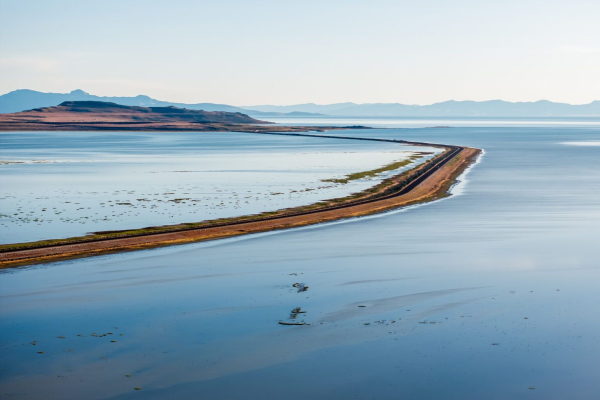
A new life form has been found under the bottom of the Great Salt Lake / Utah News Dispatch
Scientists have discovered a new type of animal in the sediments of the Great Salt Lake in Utah for the first time. The microscopic roundworms lived among silt particles and salt crystals, remaining unnoticed despite decades of research into this unusual body of water.
The shores of the Great Salt Lake in Utah seem almost lifeless at first glance. Wide stretches of salt mud stretch along the water, and the surface of the lake looks calm and almost empty. Due to the extremely high salinity, this environment has long been considered biologically simple. This is what Dailygalaxy writes.
What new life form was found in a hypersaline lake?
For decades, scientists have described the lake's ecosystem as one where only a limited number of species survive. The bulk of the living organisms are represented by two well-known inhabitants. The first is the tiny crustacean Artemia franciscana, commonly called brine shrimp. They form huge seasonal clusters in the water. The second is the brine fly, whose larvae develop in dense dark masses along the shoreline.
Together, these species support millions of migratory birds, for whom the lake is an important resting and feeding site during migrations.
However, as it turned out, there was another life form beneath the surface of the silt that no one had noticed before.
Researchers analyzing sediment samples found microscopic roundworms, a group of nematodes, one of the most common types of animals on the planet , hidden among grains of silt and salt crystals in the lake's bottom layer.
The discovery was made by a team from the University of Utah, led by biologist Byron Adams, who studies microscopic animals that can survive in extreme conditions. The scientists took several samples of bottom sediments from different parts of the lake and analyzed them in the laboratory .
Under a microscope, the researchers saw thin, threadlike worms just a fraction of a millimeter long. Genetic analysis confirmed that they were nematodes, organisms found in almost every ecosystem in the world, from soils and oceans to underground environments.
Despite their global distribution, no one had previously confirmed the existence of nematodes specifically in the Great Salt Lake. It was thought that such high salt concentrations might be too challenging for many animals to survive.
The results of the study were published in the Journal of Nematology . The paper describes several types of roundworms living in the lake's bottom sediments, including a new species, Diplolaimelloides woaabi.
Living in this environment presents serious challenges. In some parts of the lake, the salt concentration in the water is several times higher than that of the ocean. These conditions disrupt the water balance of cells, making it impossible for most organisms to survive there.
Animals that do survive in such conditions have special adaptations . For example, brine shrimp regulate the salt level in their bodies and feed on microscopic algae. Salt flies spend their larval stage in dense coastal layers, where they feed on bacteria and algae.
Nematodes occupy a different niche. They don't swim in open water , but live directly in bottom sediments. There, they move through microscopic gaps between silt particles.
These microenvironments accumulate organic matter and a large number of microbes. It is likely that these worms feed on bacteria, microalgae, and remnants of organic material.
During detailed analysis, the scientists noticed that the nematodes were not found singly in the samples. In several samples, there were quite a few of them, indicating a stable population, rather than a random occurrence.
In addition, the researchers discovered several different types of roundworms . This means that several species were able to adapt to the conditions of the lake at once, which can occupy different ecological niches in the bottom environment.
Nematodes play an important role in many ecosystems. They feed on microorganisms and help break down organic matter, which aids in nutrient recycling. Their movement also stirs up thin layers of bottom sediment, affecting the distribution of oxygen and nutrients.
The fact that these organisms exist in the Great Salt Lake suggests more complex ecological processes beneath its bottom than previously thought.
For decades, descriptions of the lake's ecosystem have been based largely on visible organisms living in the water or near the shore. The discovery of nematodes has revealed that there is a hidden part of the biodiversity in the sedimentary layers.
Scientists say further studies of the bottom sediments could uncover even more unknown microscopic species. Many extreme environments often form unique organisms that have evolved to survive in challenging chemical conditions.