
Main points
- Asteroid 2024 YR4, which was initially considered a threat to the Earth and Moon, will fly past the satellite at a safe distance.
- Scientists plan additional observations of the asteroid in 2028 to improve planetary defense models.
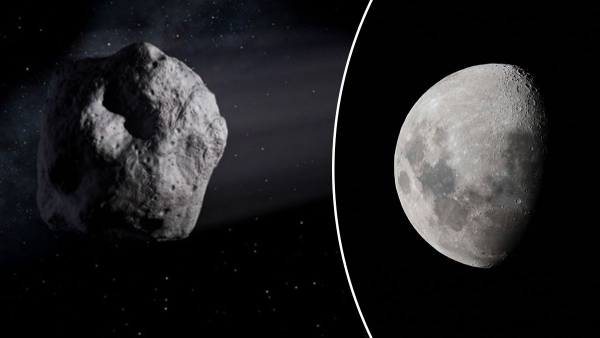
The mystery of the “city killer”: astronomers have clarified the flight trajectory of the mysterious asteroid 2024 YR4 / Collage of Channel 24/Unsplash/NASA
For over a year, the world has been watching the movement of an asteroid that has earned a reputation as one of the most dangerous objects in the solar system. Calculations indicated the likelihood of a catastrophic collision first with the Earth and then with the Moon. However, the latest data obtained with the help of the most powerful space observatory indicate otherwise.
What new data has been obtained about 2024 YR4?
Asteroid 2024 YR4 was first detected on December 27, 2024, by the NASA-funded ATLAS system, which specializes in detecting dangerous space objects. For a short time, this object became the most threatening of all known asteroids, writes ScienceAlert.
Experts have determined that its diameter is approximately 60 meters, which is comparable to the height of a 15-story building or the Leaning Tower of Pisa. Because of such dimensions, the rock received the unofficial name “city killer”, because if it fell to Earth, it could wipe out an entire metropolis or cause a devastating tsunami.
- Initial calculations indicated that there was a non-zero chance of an object colliding with our planet on December 22, 2032.
- Later, the earthly threat was eliminated, but a new reason for concern appeared: the probability of a strike on the Moon was estimated at 4.3 percent.
This uncertainty arose because the asteroid's orbit around the Sun was not studied with sufficient accuracy. The situation was complicated by the fact that since the spring of 2025 the object has become too dim to be observed by most ground-based and space-based instruments.
New data provided by James Webb
The breakthrough came thanks to the efforts of specialists at the Johns Hopkins University Applied Physics Laboratory, who developed a plan to use the James Webb Space Telescope. Between February 18 and 26, 2026, the observatory was able to record 2024 YR4 as it moved against a background of distant stars whose positions were measured with the utmost precision by the European Space Agency's Gaia mission.
It was one of the most challenging observations in the telescope's history, as the asteroid turned out to be one of the dimmest targets it had ever tracked.
The data obtained allowed astronomers to finally rule out the possibility of a catastrophe. Instead of a collision, the asteroid will fly past the Moon at a safe distance of approximately 21,200 kilometers, writes Space.
Although this is a very close distance by cosmic standards – even smaller than the orbits of some artificial Earth satellites – there is no longer any direct danger.
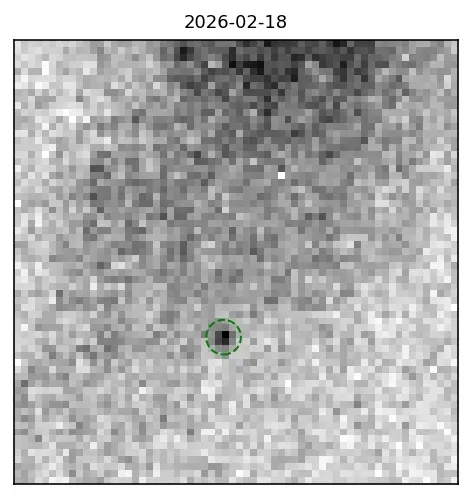
2024 YR4 in the lens of the James Webb Space Telescope / Photo by NASA
What would happen if a collision occurred?
If the collision did occur, the consequences would be enormous. The impact energy would be about 6 million tons of TNT equivalent, which is comparable to the explosion of a powerful nuclear bomb. A new crater about 1 kilometer in diameter would form on the surface of the Moon. Observers on Earth could see a bright flash even with the naked eye, Live Science notes.
In addition to the visual effects, such an explosion would have thrown a huge amount of debris into space. Some of it could cause a meteor shower in the Earth's atmosphere that would last for several days, but at the same time it would have created a serious threat to satellites in low-Earth orbit.
This case is in many ways reminiscent of the story of the famous asteroid Apophis, which after its discovery in 2004 was also considered potentially dangerous to Earth, but was later found to be safe after more detailed studies.
What will happen next?
Scientists plan to conduct another series of observations of 2024 YR4 in 2028 to further study its trajectory. This will help improve planetary defense models and prepare for possible encounters with other celestial bodies in the future.