
Main points
- Antarctica has lost almost 13,000 square kilometers of ice over the past three decades due to warming ocean waters.
- The study found that about 77% of Antarctica's coastline remained stable, but in West Antarctica, glaciers had retreated significantly, including by 42 km in some places.
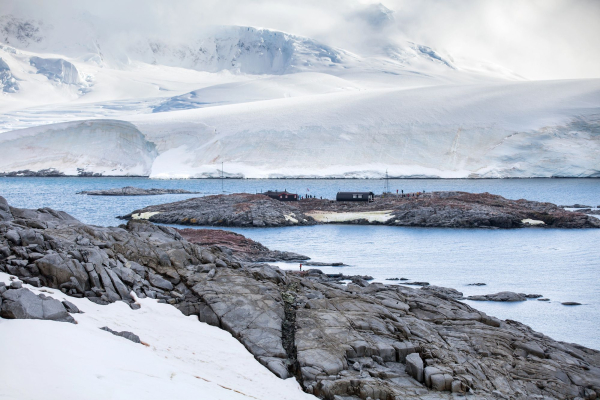
Warm ocean waters are destroying Antarctica's glaciers / Depositphotos
A new analysis of satellite observations has shown that over the past three decades, Antarctica has lost almost 13,000 square kilometers of so-called “fixed ice,” the glaciers that rest on the bottom of the continent.
Scientists believe that the main cause of the changes is warming ocean waters, which wash away the ice masses from below, reports Space.com.
Why is Antarctic ice retreating and what have satellites shown?
An international team of researchers led by scientists from the University of California, Irvine, analyzed satellite data from 1992 to 2025. During this time, approximately 12,950 km2 of ice, previously fixed to the rocky bottom of Antarctica, has disappeared from the continent.
The researchers focused on the so-called ice grounding line, the boundary where land-based ice masses begin to float on the ocean surface. This zone is critically important for climate research: it is after its retreat that the ice begins to directly influence the rise in global sea levels.
According to study leader Eric Rignault, scientists have known about the importance of this boundary for decades, but for the first time, they have managed to compile a complete map of its changes for the entire Antarctic over 30 years of observations.
Satellites helped understand the scale of the problem
To get these results, the team used data from a large number of satellite missions from space agencies in Europe, Canada, Japan, Italy, Germany and Argentina. Radar instruments allowed them to track how floating ice shelves rise and fall with the tides. The ice lying on the bottom of the continent does not move with the tides – this is what helped to accurately determine the changes in the position of the grounding line.
The analysis showed that about 77% of Antarctica's coastline has remained stable since at least 1996. However, in some regions the situation is much more alarming. The greatest glacier retreat was recorded in West Antarctica, especially along the coast of the Amundsen Sea and in the Goetz Sector. In some places, the grounding line has shifted by 42 kilometers.
Why is this happening?
Scientists say the main reason for this process is warm ocean currents that penetrate under the ice shelves through deep underwater channels. The warm water erodes the ice from below, making it thinner and weaker. Because of this, the ice shelves are less able to hold back glaciers located on land.
Rignault explains the situation with a simple analogy: continental ice is like a balloon that is not completely punctured, but where damage does appear, it can be very deep.
The northeastern part of the Antarctic Peninsula poses a particular mystery for scientists. In this region, several large ice shelves collapsed before the beginning of the studied period, and glaciers continue to retreat rapidly. However, the researchers have not found convincing evidence that warm ocean water plays a key role here.
This means that other factors that are still not fully understood may be influencing ice change.
In addition to capturing changes that have already occurred, the new study has important implications for climate predictions. The 30-year set of observations allows us to test computer models used to predict sea level rise.
According to the researchers, any climate model must reproduce these real changes for its predictions to be considered reliable.
While much of the continent remains stable, scientists warn that the current balance may not hold forever. If the ice retreat accelerates, the consequences for the world's oceans could become much more serious.
The results of the study were published on March 2 in the scientific journal Proceedings of the National Academy of Sciences.