
Main points
- Russia is considering using balloons and its own satellites to replace Starlink.
- At the same time, experts doubt the effectiveness of these alternatives due to technological limitations.
- 1 What is known about the Russian “Barrage-1”?
- 2 Can a balloon replace Starlink and what about Russian satellite communications?
- 1 What is known about the Russian “Barrage-1”?
- 2 Can a balloon replace Starlink and what about Russian satellite communications?
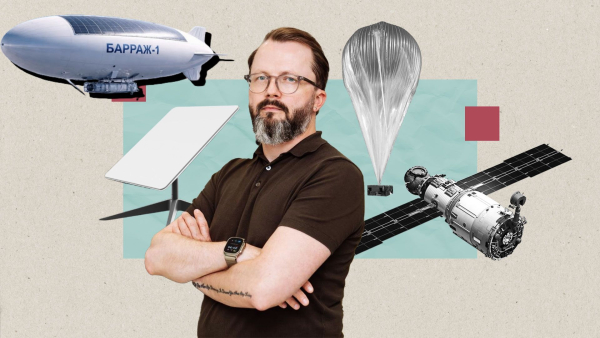
Russia has announced the testing of an unmanned stratospheric platform called Barrage-1, which can reach heights of up to 20 kilometers and carry communications equipment. The developers present it as an option for areas where it is difficult or too expensive to build ground-based infrastructure.
The prerequisite for this event was the blocking of access to Starlink by the Russian occupiers in Ukraine, which was arranged by the Minister of Defense of Ukraine Mykhailo Fedorov together with Elon Musk thanks to “white lists”. After that, for the enemy, the question of alternatives turns into a purely applied task – to find another way to get stable communication at the necessary points.
Channel 24 spoke with aviation expert and defense enterprise development director Anatoly Khrapchinsky about whether the balloon will become a replacement for the “Starlinks” for the Russians and whether it is even possible to replace Musk's technology with the LBZ.
What is known about the Russian “Barrage-1”?
In mid-February, Russia conducted its first flight of the Barrage-1. This is a light, unmanned, aerostat-type device that operates at an altitude of up to 20 kilometers and, according to statements, can stay there for a long time. The key characteristic that the developers emphasize is precisely the altitude and duration of operation, that is, the ability to maintain a communication medium in the stratosphere for a long time.
How the Russian “Barrage-1” works: watch the video
The declared payload is up to 100 kilograms. This platform is planned to be used to install equipment for 5G and other communication systems, that is, to use it as a lift and repeater for telecom infrastructure. The wording about 5G in this case appears not as a detail for the future, but as a direct explanation of what purpose is being laid in the project.
The project is being led by the Foundation for Advanced Studies together with the Bauman Moscow State Technical University and the Aerodrommash enterprise from Veliky Novgorod. The developers separately emphasize that the device is assembled from Russian components – this is presented as confirmation of the project's autonomy from imported components.
The concept described by the authors boils down to a simple principle: instead of building towers or launching satellites, take communications into the stratosphere. According to their logic, one such device is capable of covering a large area and does not require complex ground infrastructure.
At the same time, “Barrage-1” itself remains an experimental development – tests are ongoing, and its possible application is currently being formulated as an option for hard-to-reach regions and places where building networks on the ground is too expensive.
Can a balloon replace Starlink and what about Russian satellite communications?
According to aviation expert Anatoly Khrapchinsky, the enemy is really looking for a replacement for Starlink, and is betting on solutions that give an “easy” result in terms of deployment. For him, Starlink in this logic is a small station that provided high-quality communication without complicated procedures, and this is what made it a convenient tool.
Khrapchinsky explains why the enemy cannot simply switch to other, more cumbersome solutions. According to him, Russia cannot use large radio relay communication systems on the front line , because it is difficult to organize, it is a different scale of infrastructure. He also emphasizes the problematic nature of satellite communication in the classical version – the antennas must be open, they are visible, in particular through visual reconnaissance, and this creates additional risks and limitations during use.
Against this background, the idea of deploying balloons with repeaters at an altitude of 20 kilometers, which will provide 5G communication, in his opinion, looks more practical than ground-based construction – this will significantly simplify base stations on the ground that will be able to receive such a signal.

Anatoly Khrapchinsky
Aviation expert, director of defense enterprise development
This looks promising for the Russians. Such capabilities are even used by the Israeli Armed Forces for early warning systems – for radars that are in the air in a fixed place. And they can stay there for a long time without any restrictions. There are some systems that require, for example, direct tethering to the ground – in particular, balls that use a cable to the ground, to a base station, or to power.
The expert separately ties the perspective to the scale of coverage – a large area where you can get high-quality communication without the need to install ground nodes. In the case of what the Russians are practicing and what has been shown, Khrapchinsky speaks of an independent system that is in the air without such a tie.
As for whether the Russians can use this on the front line or launch it somewhere further, to Kyiv, the expert says that they can do this to provide communication to the “Shaheeds”, but the general logic, in his opinion, is more about using it in the LBZ zone. At the same time, as Khrapchinsky says, it will be possible to “work out” the bullet.
Khrapchinsky then links the topic to recent airstrikes along Ukraine's northern border — along the border between Ukraine and Belarus — and to recorded drone flights in this area, where there is a link to mesh communication on Belarusian territory. This, he says, may indicate a return of the enemy to the development of mesh communication technology to provide systems with communication and that the enemy is returning to previously developed solutions.
It is worth mentioning separately about Russian satellite systems – in particular, “Yamal” – can they be an analogue of Starlink? Khrapchinsky answers unequivocally: these are not analogues, but systems with significant limitations on the amount of information transmitted. He recalls that from the very first day the enemy has been using satellite communications – including military ones, as well as mobile satellite phones – but in practice these are rather tools for quick decisions and short, mainly voice tasks.
According to the expert, the key difference is not only in bandwidth, but also in how the user interacts with the technology in war.

Anatoly Khrapchinsky
Aviation expert, director of defense enterprise development
Nowadays, many personnel are involved in the war, who did not undergo training in military academies and are used to using a regular mobile phone. Against this background, Starlink has become a plug-and-play system for many – simple to deploy and operate, which allows you to strengthen your capabilities in operations. In contrast, classic satellite communication with a “dish” requires other actions: it must be deployed, oriented at the right angle, and a place to install it – and this, according to him, is a different level of complexity.
Khrapchinsky then expands on this idea to alternatives that are sometimes offered as a replacement: Wi-Fi bridges, he says, are also problematic because they involve radio electronics, configuration, and building open communication channels. Theoretically, you can “throw” fiber and provide communication that way, but that also has limitations.
As a result, says Khrapchinsky, such decisions significantly burden ordinary military personnel in terms of working with technology and return to the need for trained personnel who have studied and understand the construction of communication channels using military means.