
Main points
- New research has shown that tyrannosaurs could run on tiptoe, similar to modern large birds, which changes the idea of their speed and maneuverability.
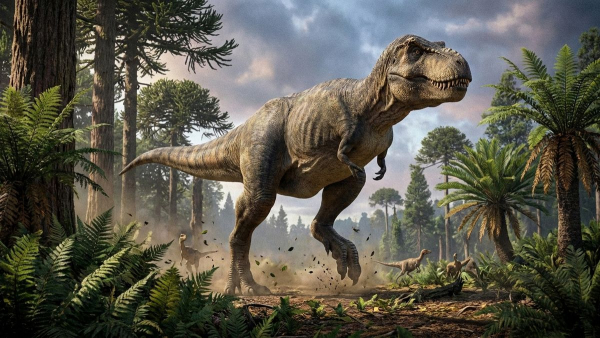
Tyrannosaurus ran on tiptoe – new model changes the idea of the predator / Gemini
For years, the image of the Tyrannosaurus rex has been associated with a roaring thump and devastating force. However, new calculations suggest that this giant moved differently than previously thought. Researchers have reviewed the predator's anatomy, tracks and biomechanics – and come to unexpected conclusions.
Could T. Rex run like a large bird?
A team of researchers from the College of the Atlantic conducted a detailed analysis of Tyrannosaurus rex locomotion, combining three key sources of data – fossil tracks, the structure of the dinosaur’s foot, and the kinematics of modern birds. The results of the study were published February 25 in the journal Royal Society Open Science.
According to the model, Tyrannosaurus probably didn't stand on its heel, as is often depicted in movies like Jurassic Park. Instead, the front of its toes made contact with the ground first. This “toe-like” foot position is closer to how large terrestrial birds move.
The researchers reconstructed the mechanics of the footprint formation and concluded that the characteristic shape of the footprints is consistent with this scenario. This means that the distal parts of the fingers took the main load during the step, notes The New York Times.
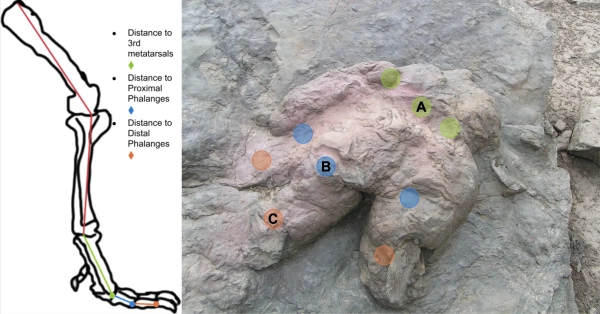
Tyrannosaurus footprint and diagram of possible foot position / Image by Adrian Tussell Boyer
Faster and more maneuverable
The revision of the gait model has also changed the estimate of the predator's maximum speed. While previously its movements were considered relatively slow due to its massive body, the new calculations give higher figures.
According to the authors, the upper limit of speed could be approximately 5-11 meters per second. In conversion, this is about 39.6 kilometers per hour. For comparison, the record speed among humans was demonstrated by Usain Bolt – 44.72 kilometers per hour, writes the Daily Mail.
The model also indicates a relatively short stride length at high frequency, a strategy that may have provided stability and better control of the massive body during locomotion.
Even harder than imagined
In parallel with these findings, other studies from 2024 suggest that Tyrannosaurus could have been 70 percent heavier than previously thought. The maximum mass could have reached 15 tons. This complicates the reconstruction of biomechanics, as the load on the bones and joints increases.
Some studies also suggest that Tyrannosaurus rex's teeth may have had an iron-containing coating on their serrated edges, similar to that found in modern Komodo dragons. This feature enhanced cutting ability and helped tear apart prey.
Taken together, the new data suggests that the image of T. rex as a slow, lumbering “tank” is gradually changing. Despite its gigantic size, this predator likely had a more sophisticated and efficient locomotion system than previously thought.