
Main points
- In Ukraine, there are many restrictions on the privatization of land, including public land, under railways, roads, objects of the nature reserve fund, water fund, etc.
- Water fund lands are provided for permanent use to water management organizations and other enterprises with relevant specialized services.
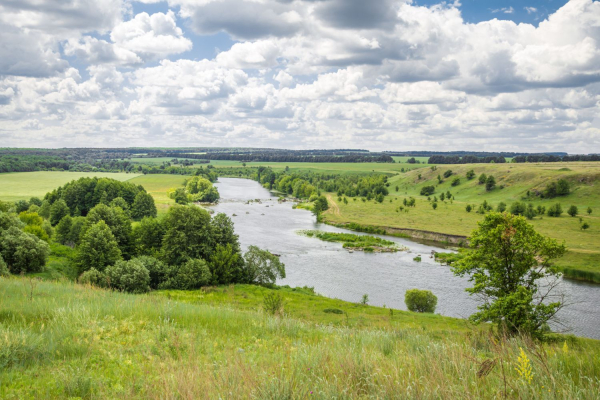
Land near the river / Photo Freepik
Ukrainians can receive and privatize land plots. However, there are also types of land for which privatization is prohibited under any conditions.
What types of land are not subject to privatization?
Lawyers from the Arzinger law firm, Maryna Sharapa and Olena Yurets, told Channel 24 in a comment that there are currently quite a few restrictions on the transfer of land to private ownership.
According to the provisions of the legislation, communal and state-owned lands that cannot be privatized include:
- public lands of settlements (streets, embankments, beaches, parks, squares, boulevards, cemeteries, etc.);
- land under railways, roads, air and pipeline transport;
- lands under objects of the nature reserve fund, for example, dendrological parks and zoological parks created before the adoption of the Law of Ukraine “On the Nature Reserve Fund”, historical, cultural and health-improving purposes, which have special ecological, health-improving, scientific, aesthetic and historical-cultural value;
- forestry lands, except for the transfer of ownership to citizens and legal entities of closed land plots with a total area of up to 5 hectares as part of peasant, farm and other farm lands;
- water fund lands, except for the transfer of ownership to citizens and legal entities of closed natural water bodies with a total area of up to 3 hectares;
- land plots used to support the activities of state authorities and local self-government bodies;
- artificially created land plots;
- lands of nuclear energy and space systems;
- defense lands;
- land plots in the exclusion and unconditional resettlement zones contaminated as a result of the Chernobyl disaster;
- land plots assigned to state institutions of vocational education, professional pre-higher education, higher education, in particular sectoral academies of sciences.

Marina Sharapa
Partner, Co-Head of the Transport and Infrastructure Practice at Arzinger Law Firm
Along with this, we draw your attention to the fact that during martial law, the free transfer of state and municipal land to private ownership is prohibited.
However, as an exception, there are the following cases of free transfer of land plots into private ownership:
- to owners of real estate objects (buildings, structures) located on such land plots;
- to citizens of Ukraine to whom such land plots were transferred for use before January 1, 2002.
Is it possible to obtain land use rights for coastal protection zones?
To protect water bodies from pollution and clogging and preserve their water quality along rivers, seas and around lakes, reservoirs and other water bodies within water protection zones, land plots are allocated for coastal protective strips, reports “Ecology is the Right of Man.”
What is a coastal protection strip?
This is a part of a water protection zone of appropriate width along a river, sea, or around water bodies, where a stricter regime of economic activity is established than in the rest of the water protection zone.
Land occupied by coastal protection strips along seas, rivers and around water bodies belongs to the water fund lands.
Water fund lands are provided for permanent use to specialized water management organizations, other enterprises, institutions and organizations that have established specialized services for the care of water bodies, coastal protection strips, diversion strips, coastal strips of waterways, and hydraulic structures and maintaining them in proper condition.
Important! The right to permanent use of water fund lands is certified by a state act, which is issued and registered by village, settlement, and city councils.
Is it permissible to register ownership of land without the consent of neighbors?
-
Privatization of a land plot requires agreement on the boundaries with neighbors, but their refusal to sign is not a legal basis for refusing privatization.
-
The local government has the right to approve technical documentation and transfer land ownership even without the signature of neighbors.