
Main points
- The remains of the dinosaur Nigersaurus taqueti were discovered in the Sahara, which had a unique dental system with more than 500 teeth that were replaced every 14 to 30 days.
- Nigersaurus had a lightweight skeleton with pneumatic bones, which allowed it to have a long neck and specialize in feeding on low-growing vegetation, occupying a different ecological niche than the classic “tall” sauropods.
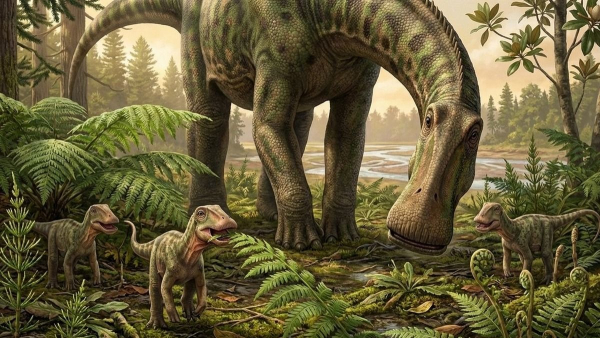
Nigersaurus – the strangest sauropod with a “conveyor belt” of teeth / DinosaurPictures.org
In the Sahara Desert, paleontologists have found the remains of a dinosaur that has shattered the notion of how giants of the Mesozoic Era ate. Its skull was so fragile and its teeth so numerous that the find forced us to reconsider the classic model of “tall herbivorous” sauropods.
What do we know about Nigersaurus taqueti?
The species was officially described in 2007 after a detailed analysis of fossils found in what is now Niger. A team led by Paul Sereno used computed tomography to reconstruct the structure of the extremely thin skull. Some bones were less than 2 millimeters thick, which explains why the remains were preserved in fragmentary form, writes Forbes.
The most impressive thing was the dental system. The upper jaw had 60 vertical columns of teeth, and the lower jaw had at least 68. In total, this was more than 500 teeth at a time. They were grouped into so-called “dental batteries” – columns where several spare teeth were placed under the working tooth. When the upper one was worn out, the next one immediately took its place.
The replacement rate was record-breaking for dinosaurs, about once every 14 to 30 days, suggesting constant contact with abrasive vegetation and probably sand near the soil surface.
The muzzle as a tool for “mowing”
The skull of Nigersaurus was unusual: wide, almost rectangular in front, with teeth arranged strictly along the front edge of the jaw. This configuration allowed it not to select individual shoots, but to literally “cut” vegetation in a wide strip – similar to what modern herbivores do.
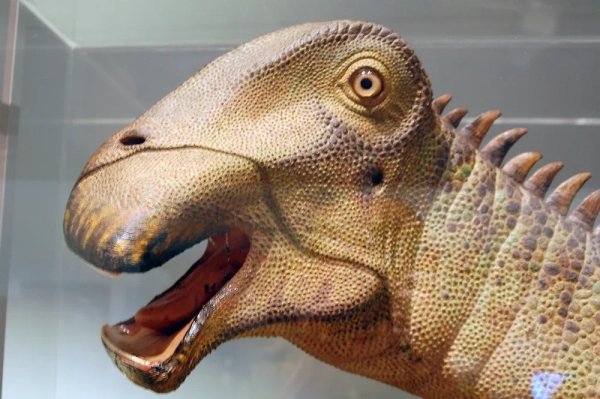
Nigersaurus taqueti / Photo by Matt Martyniuk
Studies of the inner ear have shown that the animal's head was usually tilted downward at an angle of about 67 degrees. This means that Nigersaurus kept its snout close to the ground at all times and fed on ferns, horsetails and other low-growing plants of the middle Cretaceous period – about 110 million years ago.
Thus, it occupied a different ecological niche than the classic “tall” sauropods, which are often compared to giraffes.
Lightweight skeleton for a large body
Despite being about 9 meters long and weighing as much as a modern African elephant, Nigersaurus was relatively small among sauropods, with some members of the group reaching lengths of over 30 meters.
Its vertebrae contained large air cavities – so-called pneumatic bones, similar to those found in birds. By volume, some vertebrae contained more air than bone tissue. This allowed for a reduction in skeletal weight while still supporting a long neck.
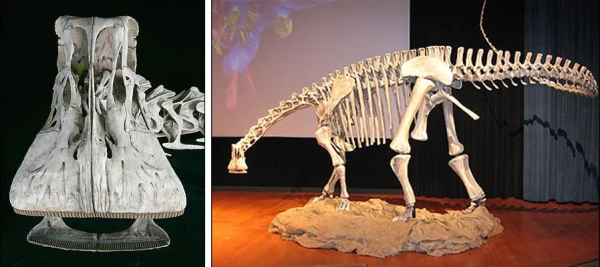
Nigersaurus taqueti / Channel 24 Collage/Mike Hettwer/Christopher Joyce/Project Exploration/National Geographic/NPR
Why is this important for science?
The find demonstrated that herbivorous dinosaurs were much more diverse than previously thought, and the “tall sauropod-top predator” model was overly simplistic.
Nigersaurus is an example of extreme specialization. Its skull, dentition, and head position were precise evolutionary solutions for living in the competitive environment of the Cretaceous period. It did not compete with the giants that ate the treetops, but dominated its own zone – at ground level.
It is because of this way of eating that it was nicknamed the “cow Mesozoic.” And this is not an exaggeration, but a fairly accurate ecological analogy.