
Main points
- A new hypothesis suggests that the center of the Milky Way may not be a black hole, but a superdense clump of dark matter, which explains the motion of stars and the dynamics of the galaxy.
- Computer simulations show that the dark matter model is able to reproduce the same photo that was taken a few years ago.
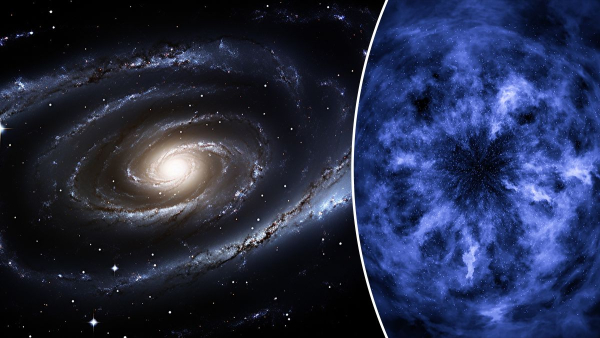
Astronomers suggest a different nature of the core of our galaxy / Collage 24 Channel / Freepik
The idea of the heart of our galaxy has seemed settled for decades, but a new hypothesis is forcing scientists to rethink basic assumptions. Researchers offer an alternative explanation for what drives the motion of stars and the shape of the Milky Way, combining two key mysteries of cosmology into one.
What is at the center of the Milky Way?
Traditionally, the Milky Way is thought to be home to a supermassive black hole, known as Sagittarius A*. Its gravity, according to the classical model, explains the extreme orbits of so-called S-stars, which move near the core at speeds of several thousand kilometers per second, writes the Daily Mail.
In parallel, it is believed that there is a diffuse halo of dark matter around the galaxy, which keeps the stellar disk from disintegrating and explains the nearly uniform rotation speed at large distances from the center.
However, a team from the Institute of Astrophysics of La Plata proposes a different scenario. According to a study published in the Proceedings of the Royal Astronomical Society, the galaxy may not be orbiting a black hole, but rather a superdense clump of dark matter. In this model, the central compact object and the extended halo are parts of a single structure formed from the same substance.
A key role in the hypothesis is played by a special type of dark matter, consisting of fermions – extremely light subatomic particles. Theoretically, they can form a dense core with colossal gravity, surrounded by a rarefied halo. The inner part of such a structure could explain the rapid motion of stars near the center, and the outer part – the dynamics of the entire galaxy.
According to study co-author Carlos Argüelles, it is not a simple matter of replacing the black hole with another exotic object. The idea is that the central massive object and the dark matter halo are different manifestations of the same continuous medium. According to the researchers, this is the first time that a dark matter model has been able to reconcile processes on such different scales – from the orbits of individual stars to the rotation of an entire galaxy.
What about the photo of the black hole we got earlier?
The authors pay particular attention to observations from 2022, when the Event Horizon Telescope Collaboration obtained the first image of the center of the Milky Way. It shows a dark region surrounded by a bright ring of radiation, which was interpreted as the “shadow” of a black hole.
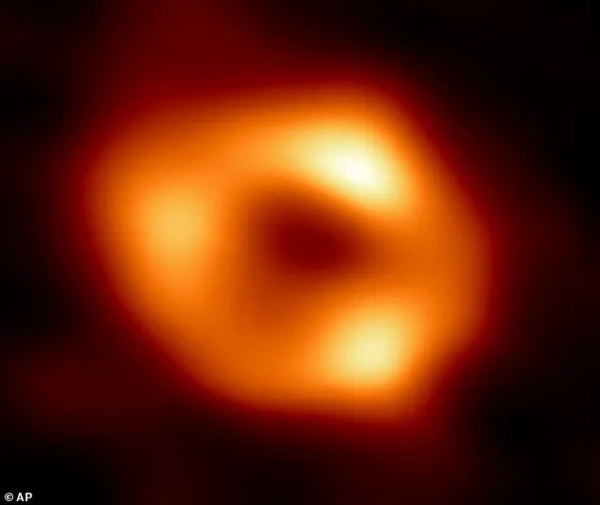
Scientists have previously obtained this image of the center of our galaxy / Photo by Event Horizon Telescope
Critically, the authors of the new work note, their model involving dark matter is also able to reproduce a similar picture, according to a brief review of the study on the website of the Institute of Astrophysics of La Plata. Computer simulations show that matter orbiting a dense core of dark matter can bend light so strongly that an almost identical halo of light is formed.
Lead author Valentina Crespi notes that it is not possible to clearly distinguish a black hole from a fermionic core of dark matter from the available data. The orbits of stars at the center of the galaxy currently agree equally well with both models.
The advantage of the alternative hypothesis lies in its universality, as it explains the structure of the galaxy by a single physical mechanism, rather than by two separate components.
Future observations are likely to provide the final answer. Ultrasensitive instruments could detect so-called photon rings, specific features of the event horizon that should be unique to black holes. Their absence would be a strong argument in favor of the dark matter scenario.