
Main points
- Researcher Matthew LaCroix has discovered repeating symbols, such as T-shapes and stepped pyramids, in ancient monuments around the world that may indicate the existence of an advanced civilization 38,000 to 40,000 years ago, which everyone then imitated.
- Traditional archaeologists disagree with these dates, as there is no official evidence to support the existence of a global civilization before the Ice Age.
This photo is illustrative and does not reflect a specific real discovery / Freepik
An independent researcher claims to have found evidence of an advanced civilization that lived 38,000 to 40,000 years ago. According to him, this culture left a complex code through the geometry, symbols and architecture of monuments on different continents.
The discovery is based on repeating symbols found in Turkey, Egypt, South America and Cambodia. Researcher Matthew LaCroix has dedicated years to studying ancient monuments, writes the Daily Mail.
Where have traces of ancient civilization been found?
The discovery began with the discovery of repeating giant T-shapes, three-stepped notches, and step pyramids carved into ancient stones around the world.
These specific symbols, constructed on various scales, are found in places that, according to the official version, had no cultural connections with each other. The symbols are found in locations from the Lake Van region of Turkey to South America and Cambodia.
According to Matthew LaCroix, the source of this global system is eastern Turkey, specifically the Lake Van region where the site of Ionis is located. He describes this site as the earliest source of symbols, architecture, and teachings of civilization, dating it back approximately 40,000 years.
The researcher claims that Yonis preserves the original plan, which was later transferred to places such as Giza and Tiahuanaco.
What symbols indicate a lost civilization?
Recurring motifs – giant T-shapes, step pyramids, inverted pyramids, lions and sacred geometry – appear in Jonis in its most concentrated form before being repeated in remote areas around the world.
Nearby is the Kefkalesi site, which displays one of the most striking examples of these symbols in stone. The one meter twenty centimeters by one meter twenty centimeters basalt carving, known as the Kefkalesi relief, contains complex iconography that reflects symbols found at Ionian, Giza, and South American sites.
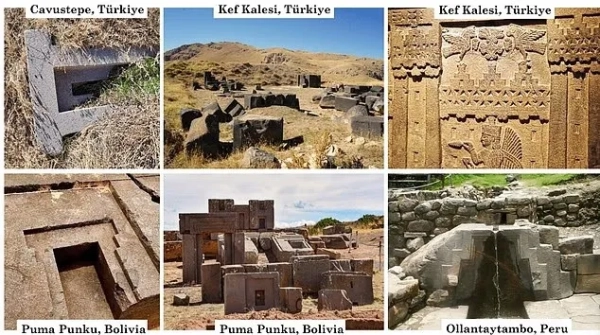
Patterns discovered by scientists / Photo by Matthew LaCroix
LaCroix explained that this relief has become one of the most important artifacts for his research. It connects Egypt to this region and allows us to trace the global pattern in reverse.
The researcher pointed out recurring motifs: T-shaped shapes repeated over and over again, a stepped pyramid with three doors, and a lion. These same elements appear repeatedly at sites around the world.
Regarding the lion, he added that the symbol acts as a guardian and its placement helps explain the structure of the code. The relief strengthened the researcher's interpretation of the symbols and accelerated his analysis of similar structures at the Sphinx Temple in Egypt.
What is the meaning of the revealed symbols?
The turning point in the researcher's work came in November 2025, when he looked at a photograph of the Sphinx Temple in Egypt that had hung in a frame in his home for eight years.
The image shows the Sphinx temple in front of the statue, closed to the public, and what he believes reveals an inverted step pyramid built into the structure.
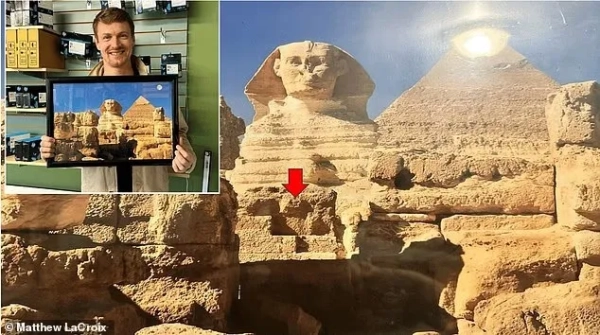
Image showing the Sphinx Temple / Photo by Matthew LaCroix
This idea led LaCroix to analyze the entire Giza Plateau, where he discovered recurring appearances of inverted step pyramids and giant T-shapes in the Sphinx Temple, the Valley Temple, and the mortuary temples of Khafre and Menkaure.
Some researchers have suggested that the Sphinx was originally carved as a lion before being later reworked with the face of a pharaoh, although this theory is not accepted among mainstream archaeologists.
Using astronomical precession – the slow wobble of the Earth’s axis – and the proposed alignment of the Sphinx with the constellation Leo, LaCroix narrowed the construction date to either about 12,000 years ago, near the end of the last ice age, or to 38,000 years ago, one full precession cycle earlier.
He rejected the younger date, citing theories of catastrophic floods that would have destroyed surface structures, and instead dated the Great Pyramids, the Sphinx, and the Valley Temple to about 38,000 years ago.
LaCroix noted that the same architectural plan also appears in South America at Tiahuanaco and Puma Punku. The layout of the Akapana pyramid temple at Tiahuanaco has exactly the same shape as the stones in these structures, as does the layout of the temple itself.
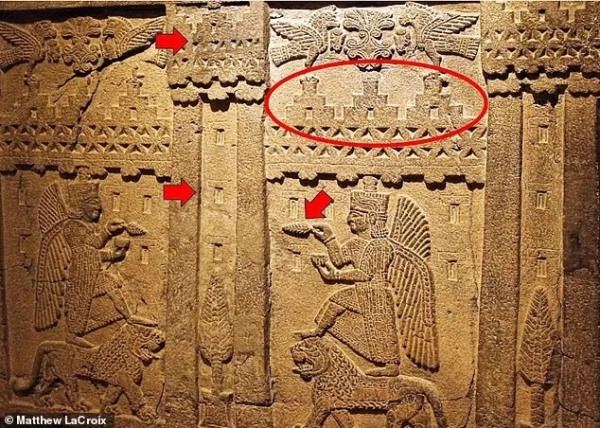
The site and Kefkalesi are one of the most striking examples of repeating stone symbols / Photo by Matthew LaCroix
Lidar scans of Puma Punku revealed a massive T-shaped design, which LaCroix says supports his theory of a shared architectural pattern. Puma Punku and Tiahuanaco are therefore mirror images of Egypt in South America.
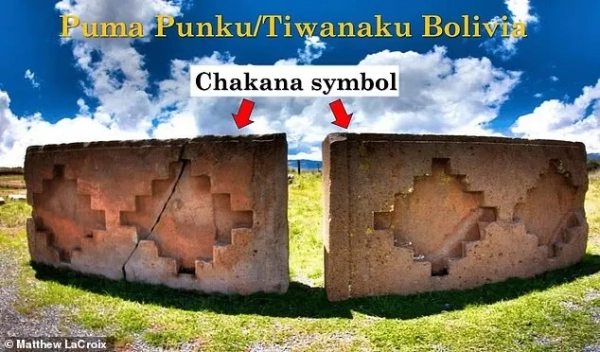
Symbols from Puma Punku / Photo by Matthew LaCroix
At the heart of LaCroix’s interpretation is what he calls the cosmogram, an ancient geometric model that represents the structure of the universe. According to the researcher, symbols such as three-step pyramids, inverted pyramids and T-shapes encode multi-layered realities: the non-physical underworld, the physical realm and the celestial realms.
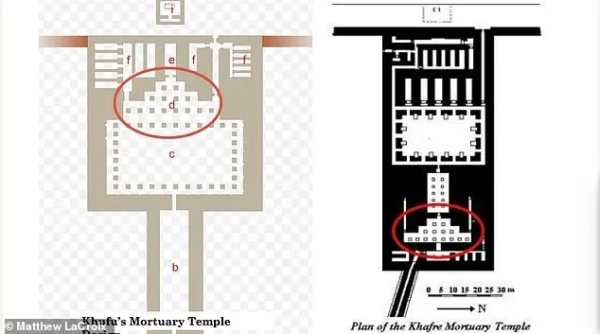
Step pyramid-shaped structures inside the mortuary temples of Khafre and Menkaure / Photo by Matthew LaCroix
- The left door represents a realm of reality called the underworld or the non-physical realm of reality.
- Its opposite is the right door, which is the heavenly realms of reality where angels reside.
- The central vertical axis of the T symbol represents the middle door that balances the system – a concept often referred to in ancient cosmology as the axis of the world or the central point connecting all spheres.
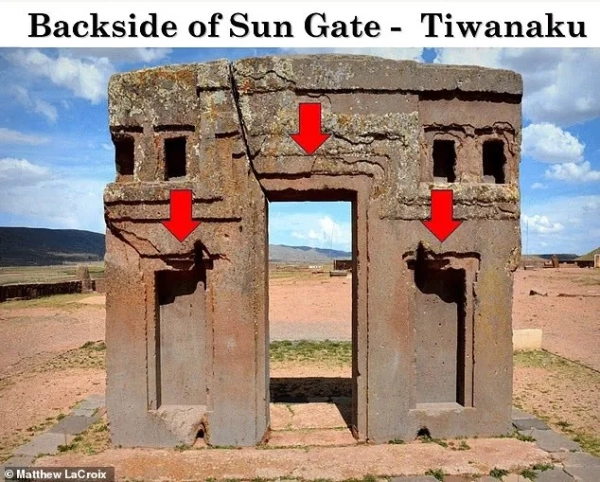
The author suggests that these messages are attempts to tell humanity about the Universe / Photo by Matthew LaCroix
They show us how all of reality works and how everything balances, LaCroix said. He linked the structure to surviving Egyptian traditions, particularly Hermeticism, an ancient spiritual and philosophical system attributed to Hermes Trismegistus that emphasizes humanity's connection to the cosmos, the divine, and hidden knowledge.
LaCroix believes the ancient code was intentionally hidden to preserve knowledge that humanity later turned upside down. Speaking philosophically, he added that we do almost everything opposite of what we should do.
He adds that evidence suggests that humans were once understood as divine beings interconnected with all of existence.
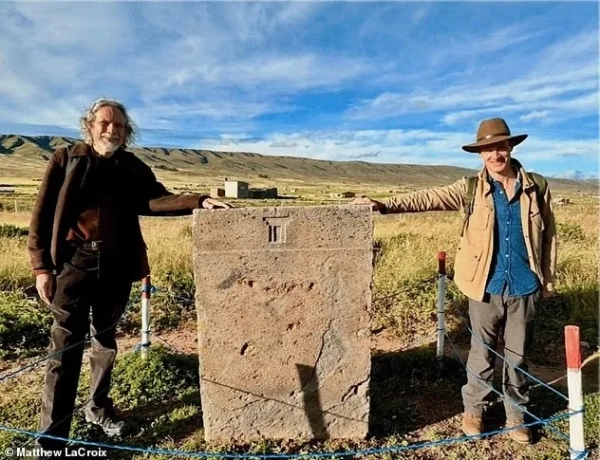
T-shaped symbol in the center of the stone slab. Matthew LaCroix standing on the right / Photo by Matthew LaCroix
How do other researchers react to Matthew LaCroix's statements?
In general, the attitude of the academic community (historians, archaeologists, and anthropologists) towards the works of Matthew LaCroix can be described as skeptical. The fact is that LaCroix works in the genre of “alternative history”, and his methods and conclusions significantly differ from the scientific standard.
Matthew LaCroix is perceived more as a mystical philosopher or popularizer of alternative views than as a historian.
For example, traditional archaeologists date the known sites of Lake Van to the Urartu period, which is thousands of years old, not tens of thousands, and argue that there is no evidence to support a global civilization from before the Ice Age. No peer-reviewed research has yet confirmed the dating proposed by LaCroix.
LaCroix frequently appears on shows and podcasts, such as the Danny Jones podcast, where the host and guest discuss theories about the extraterrestrial origin of human texts and potential “evidence” that suggests the possible existence of extraterrestrial civilizations.