
Main points
- A new study shows that inhomogeneous heat flow in the Earth's mantle can affect the stability and geometry of the magnetic field over hundreds of millions of years.
- Simulations indicate that mantle heterogeneity contributes to the stability of the dipole magnetic field, which affects reconstructions of continental motion and studies of mantle evolution.
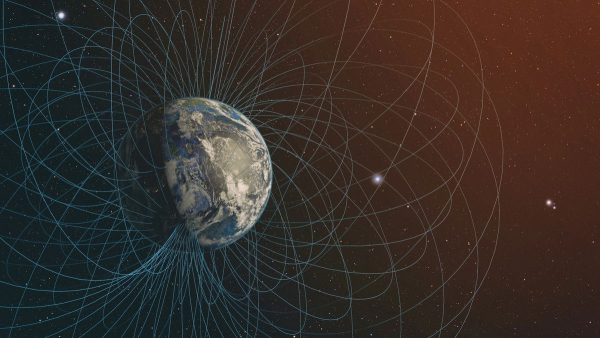
What has controlled the planet's magnetic field for hundreds of millions of years / Depositphotos
Earth's magnetic field is usually thought of as a product of processes in the planet's core, but new scientific findings are changing that picture. Data from the deep past indicate that a completely different structure may have played a crucial role in the formation and long-term stability of the magnetic field.
Could the mantle control Earth's geodynamo?
Earth's magnetic field is generated by the geodynamo, the movement of molten iron in the outer core. This process is fueled by heat flowing from the core into the mantle. The study, published in the journal Nature Geoscience, shows that the nature of this heat flow was far from uniform, and that this may have determined the behavior of the magnetic field for at least the past 265 million years.
In the lower mantle, at a depth of about 2,900 kilometers, seismology records two giant regions of reduced seismic wave velocity. They are located under Africa and the Pacific Ocean and are known as large areas of reduced shear wave velocity. These structures are likely hotter than the surrounding mantle, which means sharp contrasts in heat flow at the core-mantle boundary.
The authors, led by Professor AJ Biggin, combined paleomagnetic data, global magnetic field models and numerical simulations of the geodynamo. The main focus was not on the intensity of the field, but on its geometry and variability, in particular on the so-called paleosecular variation – chaotic fluctuations in the direction of the magnetic field on a geological time scale.
What did the study reveal?
The results showed a clear pattern. Simulations with uniform heat flow across the core-mantle boundary fail to reproduce key features of the Earth's real magnetic field. In contrast, models in which the heat flow varies depending on the region of the mantle exhibit behavior that is in good agreement with the available paleomagnetic record.
In particular, the inhomogeneous heat flow breaks the axial symmetry of the magnetic field. This is manifested in persistent differences between different longitudes, which are recorded both in the modern magnetic field and in data tens and hundreds of millions of years old. Such features are practically impossible to obtain in models with a homogeneous mantle.
Another important finding is that mantle heterogeneity could have contributed to the stability of the dipole magnetic field, writes SciTechDaily. In simulations without thermal contrasts, the geodynamo more easily transitions into the multipolar regime, which is characteristic of the Earth only during inversions or excursions. In contrast, in the presence of hot and cold regions in the lower mantle, the dipole remains dominant much longer.
What does this give us?
These results have broad implications:
- Paleomagnetic data are used to reconstruct continental drift and the ancient geography of the Earth. If the magnetic field had persistent regional anomalies over hundreds of millions of years, this could introduce systematic errors into such reconstructions.
- The study also opens up a new way to study the evolution of the mantle – through the analysis of ancient magnetic fields recorded in rocks.
- Finally, this could have some impact on how we study exoplanets, looking for habitable worlds.