
Main points
- For the first time in history, remains of the genus Paranthropus have been found in the Afar Basin in northern Ethiopia, significantly expanding its known range.
- The study suggests that Paranthropus was more malleable and widespread than previously thought, and its absence from this region was a result of gaps in the fossil record, rather than their actual absence from these locations.
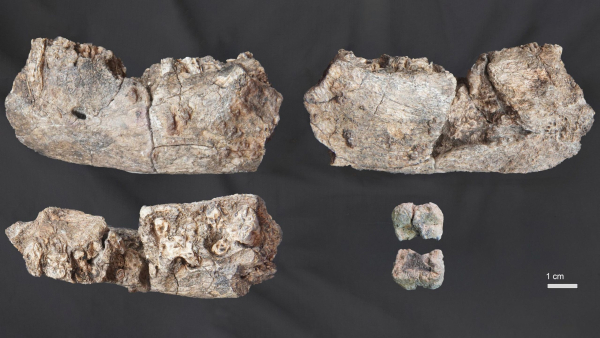
Paranthropus bones / Alemseged Research Group
A fossil bone from northern Ethiopia has challenged established ideas about the distribution of ancient hominins. It comes from a region where the remains of many human lineages, relatives and ancestors have been found for decades, but one particular member of our evolutionary history has always been thought to be missing. Until now.
Why was Paranthropus considered absent from Afar?
A new study describes the first-ever discovery of the remains of the genus Paranthropus in the Afar Basin of northern Ethiopia. Until now, all known Paranthropus fossils had been found much further south. The new jaw was discovered about 1,000 kilometers north of the previously known range, radically expanding the geography of the genus, writes SciTechDaily.
That's why the absence of Paranthropus in Afar looked suspicious for decades: hundreds of remains of Ardipithecus, Australopithecus, and early Homo were found here, but not these hominins.
Some scientists explained this by the narrow dietary specialization of Paranthropus or its weak competitiveness compared to Homo.
The work was led by paleoanthropologist Zeresenai Alemseged of the University of Chicago. He flatly denies both versions. According to him, the new find shows that Paranthropus was much more plastic and widespread, and the “absence” in the Afar region was the result of gaps in the fossil record, not real evolutionary history.

Professor Zeresenai Alemseged sifts through fossil fragments at the excavation site to find parts of a Paranthropus specimen / Photo by Alemseged Research Group
The find itself is a part of a lower jaw about 2.6 million years old, one of the oldest for this genus, according to a study in the journal Nature. It was discovered in the Mille-Logie area. The fragments were collected directly on site, then transported to Chicago, where they were examined using micro-CT. Such analysis allowed a detailed study of the internal structure of the bone and comparison with other known specimens.
Scientists are particularly interested in revising the established image of Paranthropus as a “nutcracker,” that is, one that was able to crack nuts with its teeth. It was believed that these creatures with powerful jaws were adapted only to a very limited diet. While massive molars and thick enamel do indicate the ability to chew hard food, new evidence suggests that this genus may have used a wider range of food resources from the very beginning.
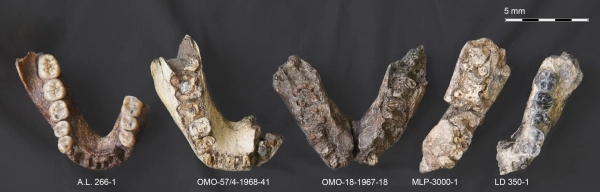
The Paranthropus teeth are shown under the designation MLP-3000-1. The photo shows jaws of other species – Australopithecus afarensis (AL 266-1), Paranthropus aethiopicus (OMO-57/4-1968-41 and OMO-18-1967-18) and early Homo (LD 350-1) / Photo by Alemseged Research Group
This is also important for understanding the early history of the genus Homo, to which modern humans, Homo sapiens, belong. If Paranthropus and Homo coexisted in the same regions and ecosystems, their evolutionary strategies were not as different as previously thought. Competition, adaptations to the environment, tool use, and nutrition may have been more complex and less straightforward.
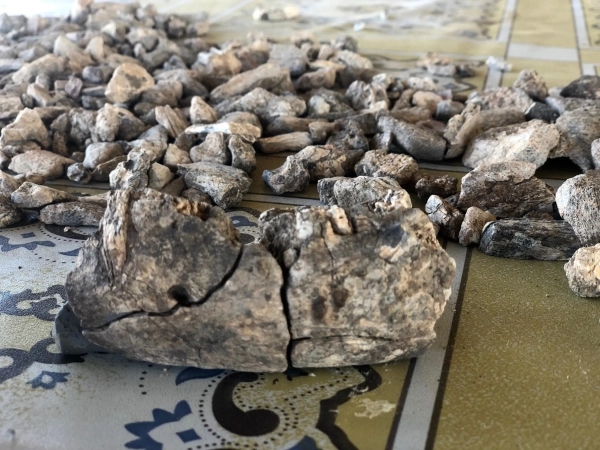
Fragments of the lower jaw of a paranthropus / Photo by Alemseged Research Group
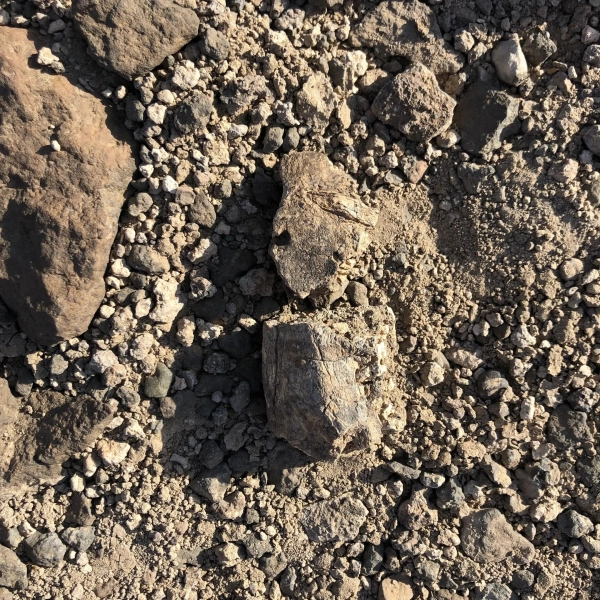
Two fragments of a recently discovered lower jaw specimen / Photo by Alemseged Research Group
In short, a single jaw from Afar forces a new look at early human evolution. It shows that some of the “blank spots” in science may not be the result of real limitations of ancient species, but simply the result of the fact that the necessary discovery has not yet been made.