

Scientists have come up with an unusual way to explore the tunnels of Mars – “dandelions” will help / Unsplash / Daniele Colucci
Scientists have developed a unique concept for exploring giant underground lava tubes on Mars. The new technology, inspired by Earth's nature, will help us peer into places that conventional rovers could never reach.
An ambitious new project is offering a radically different approach to studying the Martian interior, Space.com reports. Instead of heavy equipment, scientists plan to send a swarm of miniature devices underground. This will allow them to safely map hard-to-reach cavities without the risk of losing expensive equipment.
Why are traditional rovers not suitable for exploring caves?
Traditional Mars rovers like NASA’s Curiosity and Perseverance have done incredible work on the surface of the Red Planet. However, they are too large and cumbersome to penetrate the narrow and dangerous entrances to underground caves. In addition, the harsh conditions on the Martian surface, including strong winds, pose additional risks for damaging expensive equipment. That’s why the planet’s vast underground tunnels remain largely unexplored.
Here it is worth explaining what lava tubes are. In simple terms, they are giant natural underground tunnels that were formed billions of years ago during volcanic eruptions. When hot lava flowed across the planet, its upper layer froze in the cold air and turned into a hard crust. When all the liquid lava flowed out, giant empty corridors remained inside.

By the way! On Mars, these tunnels are impressive in their scale: they can stretch for over 1,200 kilometers (more than 745 miles) and reach a width of over 250 meters (820 feet).
The project is led by Mostafa Hassanalian, an associate professor at New Mexico State University. His team decided to turn to biomimicry to overcome the limitations of traditional Mars rovers. Biomimicry is an approach in science and engineering where people take ideas from nature and copy the mechanisms of living organisms (plants or animals) to create new technologies. In this case, the scientists were inspired by a common dandelion and a toy wheelbarrow.
The proposed spherical “roller coaster” robot would be delivered to Mars and parachuted through a natural opening in the surface—a so-called “light window”—right inside a lava tube. Once inside, the robot would unfurl and release its payload—a swarm of microdrones.
How exactly will tiny drones explore dark Martian caves?
These ultralight drones, which mimic dandelion seeds, will drift through the tunnels using natural airflow or a built-in fan on the mother robot. They are equipped with special sensors to map the tunnels, measure temperature, humidity and other conditions, and transmit the collected data back via radio signals.
The design of these devices is completely copied from nature. The drones will be painted white so that they reflect sunlight, stay cooler and lighter, just like real dandelion seeds. But how to power the equipment in the absolute darkness of caves, where solar panels are useless? For this, scientists plan to use piezoelectric materials. These are special substances that are able to produce an electric current when they are compressed, bent or subjected to any other mechanical deformation (for example, from air or wind vibrations). This will allow the drones to work even in complete darkness.
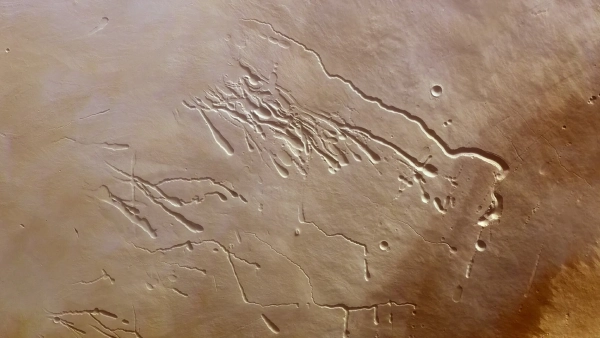
Entrance to an underground cave on the slope of the Pavonis Mons volcano / Source: Pavonis Mons
The team is currently testing their technology in volcanic caves on Earth. The researchers note that the communication range and energy efficiency of the small drones still need further optimization. To date, no human-made object has entered a Martian lava tube. While NASA's Ingenuity helicopter proved that controlled flight on Mars is possible, the now-defunct craft has never flown into a cave system.
How are autonomous robot swarms and new technologies helping to colonize other planets?
The idea of using swarms of microdevices to explore Mars echoes other advanced developments in the field of robotics. In particular, as the NV edition writes, engineers from Cornell University led by Kirstin Petersen and Danna Ma have created a revolutionary Cross-Link Collective system. This is a swarm of small robots (each module is 20 centimeters long and 2 centimeters wide), which is able to self-organize into continuous chains without any centralized control, behaving like a flowing liquid. Thanks to mechanical coupling using simple Velcro, these devices can jointly overcome steep climbs and obstacles, which makes such technology extremely promising for work in unpredictable conditions of extraterrestrial caves and lava tubes.
In addition to exploring underground tunnels, scientists are actively working on creating autonomous construction robots for future space bases. As reported by another article in the NV edition, a team of students from the University of Virginia, led by chief designer Craig Kalkwart, has developed a unique 36-kilogram robot for the prestigious NASA Lunabotics competition. This device is able to maneuver autonomously, collect lunar regolith, which is complex in its physical properties and resembles baby powder in consistency, and build protective ramparts (berms) from it. Such structures are critical for protecting future residential modules of the Artemis mission from space radiation, dust during landing of ships, and extreme temperatures.
These technological breakthroughs demonstrate that the future conquest of both the Moon and Mars will be inextricably linked to the use of highly adaptive autonomous systems. The combination of swarm intelligence for mapping hard-to-reach cavities and specialized robots for preparing infrastructure on the surface will allow humanity to establish a much safer and more efficient foothold on other celestial bodies.
Lava tubes are of great importance for future missions. They could be ideal places for future habitats, as they provide natural protection from radiation and the extreme temperature changes on the Martian surface. Some of them may contain frozen water ice, which could be used for drinking and obtaining oxygen. In addition, these caves may contain traces of ancient microbial life.
NASA has previously expressed interest in exploring Arsia Mons, a shield volcano in the Tharsis region of Mars. The region also includes Olympus Mons, the largest known volcano in the solar system. Arsia is of particular interest because NASA has captured images of “light windows” in the area—entrances to caves that lead to vast networks of underground tunnels. With the first manned missions to Mars tentatively scheduled for the 2030s, this swarm of nature-inspired drones could help map the region in detail in advance.
The development of the concept of a “roller coaster” robot and a swarm of microdrones is an extremely important step for the future exploration of space. It demonstrates how simple and elegant solutions borrowed from Earth's nature can help overcome complex engineering challenges on other planets. The use of biomimicry allows for the creation of lightweight, energy-efficient and sustainable systems for operation in extreme conditions.
Successful mapping of Martian lava tubes using this technology could completely change the approach to planning future manned missions. Instead of building expensive and complex ground bases, astronauts will be able to use natural underground shelters that will reliably protect them from radiation and the harsh climate of the Red Planet.
In addition, exploring these pristine caves will give science a unique opportunity to peer into Mars' geological past. The discovery of frozen water or even traces of ancient life in lava tubes would be one of the greatest discoveries in human history, radically changing our understanding of planetary evolution and the possibility of life beyond Earth.
How do cave exploration in the Gebrus Valley and testing of autonomous robots bring us closer to conquering Mars?
Interest in the underground world of the Red Planet is growing rapidly, because it is there that evidence of the existence of extraterrestrial life may be hidden. Previously, scientists discovered eight unique formations in the Hebrus Valles region, which, unlike most known cavities, are of aquatic, not volcanic origin. These Martian caves may hide signs of past life, because water and protection from destructive solar radiation created favorable conditions for the preservation of ancient microorganisms there.
Since traditional wheeled rovers are too slow and unable to overcome difficult terrain, the emphasis is shifting to autonomy and new types of structures. In particular, specialists have already tested semi-autonomous robots for exploring the Moon and Mars, which are able to make decisions and lay routes independently without constant control from Earth. One of the most promising prototypes is the quadruped robot ANYmal D, which, thanks to a walking platform and a DynaArm manipulator, can explore hard-to-reach slopes and craters three times faster than conventional vehicles.