
Main points
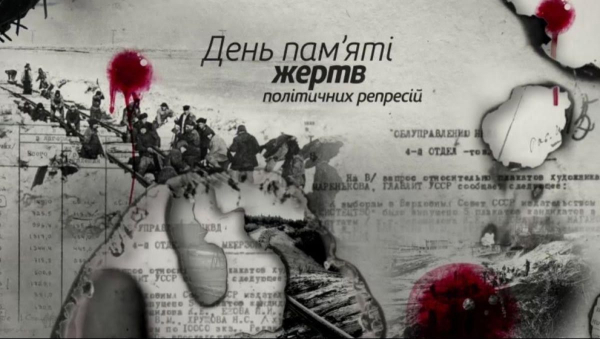
- In Ukraine, every third Sunday of May, the memory of the victims of political repressions in the USSR is commemorated, in particular the tragedy in the Bykivnyan Forest, where more than 19,000 executed people are buried.
- The Soviet government carried out mass repressions and ethnic cleansing, carrying out executions without trial, which led to the deaths of hundreds of thousands of people, including Ukrainian intelligentsia.
- 1 Why did the Bolsheviks unleash terror?
- 2 How did Ukraine suffer from repression?
- 3 How many Ukrainians died?
- 4 Who killed people and how?
- 5 Bykivnyanskyi Forest – the scene of the crime of the Soviet regime
- 6 Other mass grave sites
- 7 Restoration of totalitarianism in the occupied territories
- 8 Commemoration of the victims of Soviet repressions
- 1 Why did the Bolsheviks unleash terror?
- 2 How did Ukraine suffer from repression?
- 3 How many Ukrainians died?
- 4 Who killed people and how?
- 5 Bykivnyanskyi Forest – the scene of the crime of the Soviet regime
- 6 Other mass grave sites
- 7 Restoration of totalitarianism in the occupied territories
- 8 Commemoration of the victims of Soviet repressions
In Ukraine, every third Sunday of May, victims of political repression in the USSR are remembered. In 2026, the memorial day falls on May 17. In the 20th century, Ukrainian lands became a testing ground for social experiments conducted by the leaders of the new version of the Russian Empire, the USSR.
Millions of people became victims of the totalitarian communist regime, and the consequences of Soviet eugenics, unfortunately, still leave a noticeable mark in Ukraine. Read more about this in the material of Channel 24 .
Why did the Bolsheviks unleash terror?
The Soviet state was based on terror and propaganda. Repression was the main means of state administration in the Bolshevik state. Thanks to this, they first conquered, and later kept a huge country in subjection.

After people realized that the populist promises that brought Lenin and company to power would not be fulfilled, terror became the main tool for large-scale social experiments.
The Bolsheviks systematically and centrally destroyed entire social strata and carried out ethnic cleansing – it is from this angle that the genocide inspired by the Bolsheviks, which received the personal name Holodomor , should be viewed.
The ultimate goal was to create a new type of Soviet person, who was deprived of nationality (in fact, adjusted to the Russian-speaking standard) and was supposed to be obedient, controllable, and fanatical.
Stalin is the executioner of the Ukrainian people: watch a video about the dictator
Another aspect of the USSR's repressive policy was the creation, as a result of terror, of a large mass of practically free labor force that would work on large construction sites and implement large-scale Kremlin projects.
Thanks to terror, people were driven to “shock construction sites” in Donbas, Kuzbass, Siberia, and Central Asia, which the Russians then called Middle Asia.
Thanks to virtually slave labor, at the cost of tremendous effort and enormous sacrifices, as well as American and European technologies, a powerful industry and a gigantic army were created in the USSR.
Stalin was indeed one of the bloodiest dictators in history, but he was not the architect of Soviet terror. The entire Soviet government was programmed for repression – even by Lenin and his associates.
Stalin was only a follower and disciple of Lenin, diligently implementing his plans. Perhaps there would have been even more victims if Bolshevik fanatics such as Sverdlov and others had not perished during the so-called “civil war”, and if the adaptators led by Stalin, who removed Trotsky, had not come to power in the 1920s.
Against the background of the latter, Stalin even looked like a kind of liberal, no matter how wild it may sound.
How did Ukraine suffer from repression?
After the defeat of the UNR and the Soviet occupation, the Ukrainian lands were under the rule of Moscow for many years. At the same time, formally, the Ukrainians received their own national ersatz state – the Ukrainian SSR, which even behaved relatively autonomously for a short time, but this was a temporary phenomenon. Therefore, in fact, it was a new form of Russian occupation.
At the same time, the Ukrainian SSR was initially led by Ukrainian Bolsheviks, who generally shared the views of their Moscow colleagues on terror and repression. However, they themselves later became their victims.
The Bolsheviks introduced their administration and order in Ukraine, and also began to implement their experiments in Ukraine.
The Great Terror, as the tragic events of 1937-1938 are commonly called, was not actually an exceptional phenomenon.
Repression was used by the Soviet government throughout its existence – both in 1919 and in 1989. Therefore, it is worth talking about “waves of terror”, when its intensity increased or decreased depending on the time.
Actually, the USSR both held on to repression and collapsed when the authorities no longer dared to shed the blood of their citizens. Over the years, the forms and methods changed, but the essence remained.
During the years of Soviet occupation, Ukraine went through the Red Terror of the “civil war”, war communism, forced collectivization, famines, purges and hunts for “enemies of the people”, mass deportations, and other crimes of the regime.
As a result of the Soviet experiment, the very social structure of the country changed, entire strata and classes of the population were destroyed, and the consciousness and psyche of people were changed. The result was marginalization, lumpenization, and Russification.
How many Ukrainians died?
The number of victims of communist terror in Ukraine is, unfortunately, impossible to count.
It is known that during the so-called “Great Terror” of 1937-1938, almost 200,000 people were convicted in the Ukrainian SSR, a third of whom were shot, and the rest were sent to Gulag camps. However, this is only the tip of the iceberg.
Millions died of hunger, tens of thousands of people were shot without trial, hundreds of thousands were imprisoned, exiled, and in camps, forcibly underwent psychiatric treatment, lost the right to a profession, were unable to practice their faith, and were persecuted for their beliefs.
They are all victims of the communist regime, often, unfortunately, nameless.
Who killed people and how?
The Soviet terror machine was diverse. But perhaps the most telling were the crimes of the so-called “troikas” and “deuces.” Their victims were tortured and killed in defiance of even the laws of the USSR.
There was no trial as such over people, the victim had no right to a lawyer, the decisions of the “troikas” were made secretly, they were final and could not be appealed.
In fact, these were planned executions with imitation of investigations – the leadership laid out plans with a predetermined number of people to be killed, and the executioners on the spot had to carry out these orders.
Mass killings in the USSR were carried out on a regular basis – executions were usually carried out in prison yards, in NKVD basements, or immediately before burials.
The killers were NKVD officers themselves. Some of them soon repeated the fate of their victims, but there were also those who lived long lives, made careers, and were never punished for their crimes.
Initially, special sections of cemeteries were set aside for mass burials. At the peak of the repressions, in order to hide the scale of the crime, the NKVD changed this practice. Trenches for burials were dug in orchards, parks, and suburban forests, and the corpses were often covered with quicklime.
People were killed by a shot to the back of the head or the first cervical vertebra. The murder weapon, as a rule, was a “Nagant” pistol – it was simple and reliable, had good killing power and, most importantly, the weak recoil allowed the executioners to save energy. After all, sometimes several hundred people had to be killed at a time. For example, on the night of May 19, 1938, 563 people were shot in Kyiv alone.
Bykivnyanskyi Forest – the scene of the crime of the Soviet regime
The Bykivnyanskyi Forest near Kyiv has become a tragic symbol of communist crimes in Ukraine. It is the largest mass grave site in Ukraine for victims of political repression.
Bykivnyanskyi Forest was used as a “special purpose” facility by the NKVD of the Ukrainian SSR during 1937-1941. According to various sources, the bodies of from 15 to over 100 thousand people were buried there.
The names of over 19,000 people shot there have already been identified.
The following prominent Ukrainians, victims of repression, are buried in the Bykivnyan Forest:
-
artists Mykhailo Boychuk, Vasyl Sedlyar, Sofia Nalepynska, Mykola Ivasyuk, Mykola Kasperovych, Ivan Padalka;
-
writers Mike Johansen, Mykhailo Semenko, Veronika Chernyakhivska, Myroslava Sopilka, Ivan Malovichko, Yakiv Vodyanyi, Yuriy Vukhnal, Yakiv Savchenko, Stepan Ben;
-
scientists Oleksandr Asatkin, Hnat Ruchko, Petro Suprunenko, Yuriy Tkachenko, Ivan Mironivskyi, Oleksandr Puchkivskyi, Volodymyr Bily;
-
actors and directors Borys Drobynskyi, Yanuariy Bortnyk, Serhiy Kargalskyi, Kyrylo Getman, Yosyp Yizhakevich;
-
museum workers Fedir Kozubovsky, Neonila Zaglada, Lidia Shulgina, Trokhym Teslya;
-
church figures – Vasyl Lypkivskyi, Yefim Kalishevskyi, Marko Hrushevskyi, Yuriy Mikhnovskyi and other innocent people.
The burial in the Bykivnyansky Forest became known in 1941 – after the occupation of Kyiv, the Nazis used this fact to expose the crimes of the communists. Of course, for their own purposes.
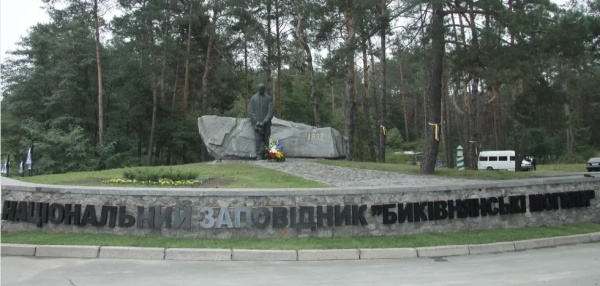
Eternal memory / Photo – ua.bykivnya.org
After the end of World War II, the Soviet government hid the truth until the last moment and, as in the case of Katyn, “hung” the victims on the Nazis. Even in 1987, when the USSR was living its last days, a special state commission again declared that Nazi victims were buried in Bykivna.
Only in 1989 was it recognized that these were victims of Stalinist repressions.
The truth about the Bykivnyan tragedy – watch the video:
After Ukraine gained independence, the site of mass executions became a memorial, and since 2006, the “Bykivnyan Graves” have received the status of a reserve of national importance.
Bykivnyanskyi Forest has become a place of remembrance, where victims of political repressions of the communist regime are traditionally honored.
Other mass grave sites
Unfortunately, Bykivnyanskyi Forest is just one of many such places. Mass executions and subsequent secret burials of communist victims took place in many other places as well.
Currently, almost 20 large mass graves of those repressed during the Soviet era are known in Ukraine:
-
Rutchenkove Field (Donetsk);
-
Park of Culture and Recreation area (Vinnytsia);
-
Pyatikhatky (Kharkiv);
-
Catholic Cemetery (Uman);
-
Jewish Cemetery (Cherkasy);
-
village of Khalyavyn (Chernihiv region);
-
Second Christian Cemetery (Odesa);
-
9th kilometer of Zaporizhzhia highway (Dnipro) and others.
In Western Ukraine after 1939, mass grave sites also appeared, in particular the Demyaniv Laz tract (Ivano-Frankivsk), the Salina tract (Lviv region), and the Lonskoho Prison (Lviv).
Prison on Lontskoho Street – the site of mass executions of victims of the communist regime in Lviv:
In addition, there are mass graves of repressed victims in or near every regional or district center.
Ukrainians were also killed in other places outside of modern Ukraine.
From October 27 to November 4, 1937, hundreds of people – the flower of Ukrainian culture and intelligentsia – were shot in the Sandarmokh tract in Karelia.
In Sandarmos, the following died:
-
Les Kurbas;
-
Mykola Kulish;
-
Mykola Zerov;
-
Marko Vorony;
-
Valerian Pidmohylny;
-
Myroslav Irchan;
-
Oleksandr Badan-Yavorenko;
-
Serhiy Hrushevskyi;
-
Vladimir Chekhovsky;
-
Antin Krushelnytskyi and many others.
Restoration of totalitarianism in the occupied territories
In the Ukrainian territories temporarily occupied by Russia, there is currently a revival of the cult of Stalin and tolerance of the crimes of the Soviet regime. As in Russia itself.
The occupiers are actively following the traditions of the NKVD – they practice extrajudicial executions and torture, revive the practice of concentration camps (“Isolation” in Donetsk), massively violate human rights, and cultivate racial intolerance and persecution on national grounds.
Neo-Stalinism in ORDiLO:
During the full-scale invasion, the Russians, with numerous war crimes in Bucha, Mariupol and other Ukrainian cities and villages, confirmed that they are preserving the Soviet tradition of using mass terror as a tool for governing the occupied territories. Fortunately, Ukraine now has its own state, capable of defending itself and its citizens. Unfortunately, Russia continues its terror against the occupied and does not stop in its desire to destroy Ukrainian statehood again.
Commemoration of the victims of Soviet repressions
Today, in Ukraine, the memory of communist victims is honored at the state level. The crimes of the Soviet regime have been condemned, and the communist ideology and the Communist Party itself are outlawed.
The victims of the Russian occupation during the Soviet era in Ukraine are commemorated every fourth Saturday of November ( Holodomor Remembrance Day ) and every third Sunday of May ( Remembrance Day of the Victims of Political Repressions of the Communist Regime ).
Ukrainians have not forgotten the crimes of totalitarianism, their perpetrators and instigators. Eternal memory to all victims of repression!