
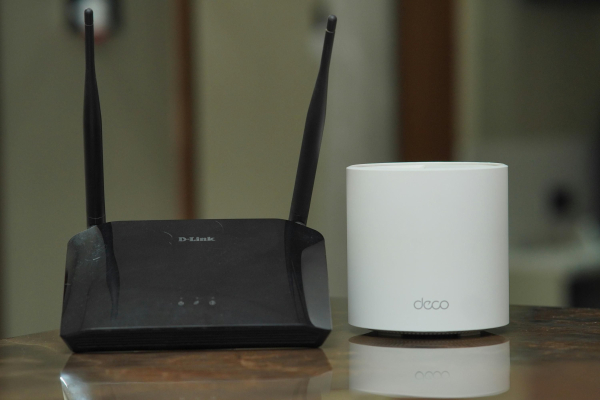
/ Unsplash / TechieTech Tech
5G routers are gradually moving beyond niche gadgets for travelers. The new breed of devices promises faster internet, lower latency, and less reliance on cable infrastructure – but they're not for everyone.
Traditional Wi-Fi routers act as a middleman between your home network and your ISP. They receive internet via cable, DSL, or fiber, and then distribute it throughout your apartment or house via Wi-Fi. BGR reports.
How is a 5G router different from a regular one?
5G routers work differently. They connect directly to the fifth-generation mobile network, just like a smartphone. Inside such a device, two components are combined at once: a 5G modem and a regular Wi-Fi router.
As a result, the user gets a home network without the need to lay a separate Internet cable. It is enough to insert a SIM card or eSIM and connect the router to power. That is why 5G routers are often called one of the main candidates for replacing traditional home Internet – especially in regions with good mobile network coverage.

The main advantage of 5G is not only high speed, but also lower signal latency. This is especially important for online gaming, video calls, 4K streaming, or working with cloud services. Even an expensive Wi-Fi router still depends on the provider's physical infrastructure. If the cable network is overloaded or outdated, the user will experience a drop in speed regardless of the capabilities of the router.
5G allows you to bypass some of these limitations. In many cities, next-generation mobile networks are already capable of providing speeds that exceed typical cable connections. The exception is fiber-optic Internet, which is still considered the most stable and fastest solution for the home.
Another advantage is flexibility. If the 5G network is temporarily unavailable, many routers automatically switch to 4G without completely shutting down the internet.
For whom can 5G routers be the ideal solution?
First of all, such devices are aimed at users who live in cities with high-quality 5G coverage. Geography remains one of the key factors at the moment. In rural areas or regions with a weak mobile signal, a 5G router may not give a noticeable increase in speed. In some cases, a regular cable connection will be more stable.
A separate category of users are people who work remotely or travel frequently. Some models of 5G routers are equipped with built-in batteries, so they can work as a mobile access point almost anywhere. This is especially important for digital nomads, journalists, freelancers or teams working in temporary offices. In fact, such a router allows you to create a full-fledged working network even in a cafe, hotel or car.
Despite the rapid development of technology, there is still no universal answer . For many users, a traditional Wi-Fi router will remain a sufficient solution for a long time – especially when it comes to browsing social networks, watching videos in standard quality, or simply surfing the web.
However, user needs are gradually changing. Online games, high-quality video streaming, cloud gaming and working with large files require a more stable and faster connection. This is where 5G routers start to look like an attractive alternative. In addition, they can act as a backup communication channel in case of problems with the home provider.
Why are manufacturers betting on 5G?
As Capestone writes, the network equipment market is gradually shifting towards new generation mobile standards. Router manufacturers and telecom companies see 5G as a way to reduce dependence on expensive cable infrastructure and expand access to high-speed Internet . Thanks to this, 5G routers are no longer just expensive gadgets for enthusiasts. They are gradually moving into the mass segment – especially against the background of the development of mobile networks in large cities.
Even if coverage is still limited in a given region right now, the situation could change quickly in the coming years. That's why some users are already considering a 5G router as a way to “future-proof” their home internet.