
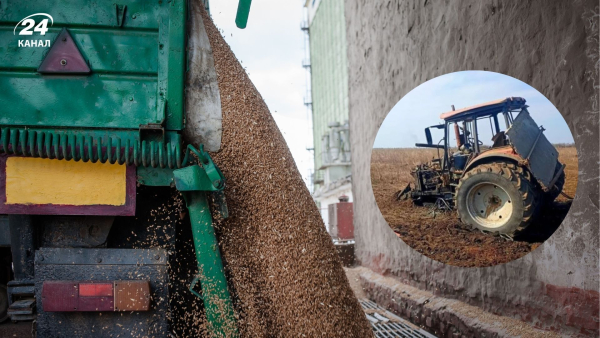
How farmers work in frontline areas / National Police / Channel 24 collage
Ukrainian farmers who left the occupation in 2022 are trying to revive their business in the frontline territories. In addition to the impact of the war, they face a number of problems that require legislative regulation.
What problems do farmers who left the Russian occupation have?
Farmers from temporarily occupied territories are working in conditions of increased risk, losing equipment and risking their lives due to enemy shelling. Their situation is complicated by problems with old loans and a shortage of land. This was stated by agrarian policy expert Denys Marchuk in a commentary for Channel 24 .
As the expert notes, farmers from the temporarily occupied territories (TOT) are people who built businesses from scratch and were very active in their communities. They developed land banks, paid taxes, but with the outbreak of full-scale war, they lost everything .
After leaving the occupation in 2022, farmers lost their businesses to the occupation, as they were “nationalized” by Russia. According to Denis Marchuk, there are many stories of farmers from Kherson and Zaporizhia regions whose businesses were taken away and repeatedly resold by the Russians. At the same time, they remained guarantors for loans taken before the full-scale invasion.

Currently, the problems of farmers with TOT are being addressed by the public organization “Association for the Restoration of the Agricultural Sector of Ukraine”, which provides them with legal support. It was created on the basis of the All-Ukrainian Agrarian Council, which is lobbying for a number of legislative initiatives to support farmers. In particular, one of the pressing issues remains work with financing.

Denys Marchuk,
expert on agrarian policy, deputy chairman of the All-Ukrainian Agrarian Council
We passed a law that actually cancels the collection of loans taken by commodity producers before the Great War. We defended this bill for a long time – it was passed. But, unfortunately, there is a history when banks do not implement the law and a certain pressure continues on the work of farmers, who, in fact, have nothing. Back then, they were their own guarantors of these pledges, and today they are being caught up and taken away, if someone has one, a car, an apartment.
It should be noted that the law on the “freezing” of loans, which provides for a moratorium on the forced collection of collateral for businesses from occupied and frontline territories, was signed by the President of Ukraine in August 2025.
However, according to Denys Marchuk, the practice of collecting old loans from farmers has not disappeared , so it is important to ensure state control over compliance with the law.
Another problematic issue is the lack of land . There is a land market in Ukraine, by the rules of which everyone works. However, farmers from TOT have lost access to their land, and without it, it is impossible to resume production in relocation.
Now we are advocating that in Ukraine there are a number of state lands, the Academy of Agrarian Sciences, in particular, which could be distributed to these people through auctions on a preferential basis. By working at these enterprises, they would have the opportunity to earn money for the state, pay taxes and form some kind of financial base for themselves to return after the temporary occupation,
– says Denys Marchuk.
The VAR proposes to temporarily provide preferential access to state lands to these categories of farmers, for example, for a period specified in the contract or until the return of the occupied territories.
Another important issue is land under fortifications . Since 2014, a significant part of the area has been used by the military to build defense structures. Although farmers no longer cultivate this land, this does not exempt them from paying taxes and rent, and the mechanisms for registering rights to plots under fortifications and compensating owners have not yet been determined.
To address this issue, draft law No. 14117, which is currently under consideration in the Verkhovna Rada, was created. It provides for a mechanism for temporary land easement and compensation.
“With the beginning of the great war, we understand that there have been and will be more and more such lands. Plus, we have front-line territories – Sumy, Chernihiv. Even Zhytomyr, Volyn, Odesa, Vinnytsia regions – many border territories that can be used by the military. Therefore, it is assumed that money will be paid for the lands under the fortifications, and the military can continue to use them,” the expert says.
Risks of working in frontline areas
Working in areas close to combat operations poses a number of dangers to property, as well as to the health and lives of farmers and their employees. Russian drones hunt for farmers' equipment every day, so it is impossible to predict how long it will “live”: a day, a month, or a few hours. The losses from its loss are significant.
“The equipment costs hundreds of thousands of dollars, and people do not have such funds. We advocate that within the framework of the state program for covering loans for the purchase of domestic equipment, an article on the purchase of used equipment, in particular of foreign origin, be separately applied. These are effective machines for the fields, but their price is many times lower than the market price. People will then understand that they will work, and if they are destroyed, it will not be the kind of money that the market demands to be paid today,” emphasizes Denys Marchuk.
Important! In April, the Cabinet of Ministers of Ukraine updated the rules of the state program for compensation for the cost of agricultural machinery for farms in frontline areas. Farmers with at least 80% of their land located in a combat zone can receive compensation of up to 40% of the cost of Ukrainian-made machinery and equipment (excluding value-added tax).
What is the fate of the farmers who remained in the occupied territories?
Farmers in the occupied territories are forced to destroy vegetables en masse. They are in a critical situation due to logistical problems and the lack of stable channels for selling their products. The Center for National Resistance reported the following about the circumstances of farmers' work in the TOT:
- Traffic jams at checkpoints in the direction of occupied Crimea force trucks with produce to stand for several days; during this time, vegetables spoil and lose their presentation before they even arrive in stores;
- The situation is complicated by the significant cost of transportation, which often exceeds the possible profit from sales;
- At the same time, Ukrainian farmers are losing competitiveness amid the massive import of cheap products from Russia.
So, unable to sell their harvest, farmers are destroying vegetables during the TOT period to avoid even greater losses.