
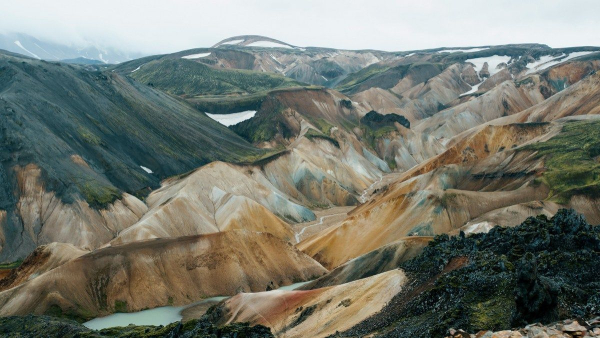
The secret cycle of transformation: how the earth's interior recycles entire continents / Unsplash
Deep beneath our planet's majestic mountain ranges, processes continue that have shaped the land surface over billions of years. Scientists have evidence that the Earth's crust is not simply deformed by plate collisions, but undergoes a complex cycle of transformation in the red-hot depths of the mantle.
What happens to parts of continents after they sink into the mantle?
The Earth's continents are constantly being reshaped deep beneath its surface. We know this thanks to a discovery by researchers at the University of Portsmouth who have uncovered evidence. Their discovery provides new insight into how the Earth's landmass has evolved over billions of years. Channel 24 has investigated the issue to find out more.
The scientists' work, published in the journal Nature Geoscience, focuses on the processes that occur after two continental plates collide, resulting in the formation of large mountain ranges such as the Himalayas and the Alps. While geologists have long known that such collisions build mountains, the new study shows that pieces of continental crust can be pulled deep into the Earth's interior during subduction, after which they rise again and mix with rocks from the mantle.
This unique mechanism is called “relamination.” It involves the separation of the buoyant, silica-rich upper crust from the denser lower lithosphere. Due to its buoyancy, this material rises and integrates into the base of the overlying plate.

Our results show that continental collisions do much more than just raise mountains. They also create deep hybrid zones, where crustal and mantle materials mix, forming magma that actually builds continents.
– commented the lead author of the study, Daniel Gomez Frutos from the School of Environmental and Life Sciences at the University of Portsmouth.
During relamination, a hybrid source is created from a mixture of crust and mantle, which subsequently generates post-collisional magma – plutonic rocks that appear millions of years after the completion of the collision of continents.
Plutonic rocks are a type of igneous rock that forms when molten magma cools and solidifies deep beneath the surface of a planet.
To prove the existence of this mechanism, scientists used a comprehensive approach:
We used a combination of advanced thermomechanical computer simulations and laboratory melting experiments to demonstrate that magma derived from this hybrid source closely matches the chemical composition of post-collisional igneous rocks found around the world,
– said Daniel Gomez Frutos, who worked on this project while still at the National Museum of Natural Sciences in Madrid.
The study also helps solve a long-standing geological mystery: why many young post-collisional rocks resemble ancient rocks known as sanukitoids in composition. Sanukitoids formed during the Archean eon, about 3 billion years ago. The similarities between modern and ancient samples indicate that hybridization of the crust and mantle has been a fundamental process for billions of years, Phys.org writes.
This could help determine the earliest stages of plate tectonics on Earth, which is still a subject of controversy in the scientific community.
This means that complex plate interactions, which include continental subduction and mixing of crust and mantle, may have been active much earlier in Earth's history than previously thought.
– added Daniel Gomez Frutos.
The simulations show that relamination begins at a depth of about 100 kilometers. The volume of relamination peaks about 16 million years (with a margin of error of 5 million years) after the collision. This is consistent with the so-called magmatic pause, a time interval observed in nature when magmatism only begins some time after the main phase of mountain building has ended.
Scientists have also found that even small amounts of relaminated material can significantly alter the isotopic composition of magma. For example, during the collision of India and Eurasia in the Himalayas, a significant enrichment in neodymium isotopes was recorded precisely due to the processing of ancient Archean crust.
Thus, deep crustal reworking plays a key role in the evolution of continents and leaves a clear chemical imprint that scientists can now identify in ancient rocks around the world.