
Main points
- New research suggests that the English monk Aylmer may have recorded the periodicity of Halley's Comet as early as the Middle Ages.
- Modern astronomers believe that Aylmer was the first to record the idea of the periodicity of a comet, which may change the perception of its discovery.

Who was really the first to solve the mystery of Halley's Comet / Unsplash
Halley's Comet is usually associated with a modern scientist, but new research is changing this established picture. Historical sources indicate that as early as the Middle Ages, one person could have been aware of its recurring appearance. These observations were made long before the development of modern astronomy, but they are no less careful and meaningful.
Who knew about Halley's Comet before Halley himself?
The object, known to us today as Halley's Comet, is the first celestial body of its type to have its periodicity determined. The discovery was always attributed to Edmond Halley, who in 1705 compared observations of the comet in 1531, 1607, and 1682 and calculated its return. The prediction came true in 1758, after his death, which finally secured his status as the discoverer and the comet's name, Live Science reports.
However, new evidence suggests that a similar conclusion could have been made much earlier. The English monk Aylmer of Malmesbury observed a bright comet as a child in 989, and then saw it again in 1066. Based on indirect evidence, he understood that it was the same celestial body.
The chronicler William of Malmesbury wrote about these events in the 12th century. He quotes Aylmer as saying at the time of the appearance of the comet in 1066, in which the monk explicitly states that he had seen it before. This reaction seems to be an awareness of the recurrence of the phenomenon, rather than the usual fear of a “bad omen” typical of the time.
Interestingly, Aylmer is known not only for his astronomical observations. According to the same source, he made one of the first attempts at flight in British history, creating homemade wings and jumping from a tower. The flight lasted about 200 meters, but ended with a fall and serious injuries. This shows that the monk had a penchant for experiments and observations, atypical for medieval ideas about the world.

Image of Halley's Comet, taken in 1986 / Photo by NASA
Modern astronomer Simon Portegis Zwart of Leiden University believes that it was Aylmer, or at least his chronicler, who first recorded the idea of cometary periodicity. Together with British Museum researcher Michael Lewis, he published these arguments in a scholarly work devoted to 9th-11th-century Europe.
What is known about the comet itself?
Halley's Comet has a highly elongated orbit and returns to the inner part of the Solar System every 72–80 years. The earliest possible record of it comes from China and dates back to 239 BC.
For centuries, its appearance was considered a harbinger of disaster. The historian Flavius Josephus linked it to the fall of Jerusalem, and in 1066 the comet was even depicted on the Bayeux Tapestry as a symbol of the coming conquest of England.

The Bayeux Tapestry is a huge 70-meter-long canvas embroidered with scenes from life and wars / Photo by the Bayeux Museum
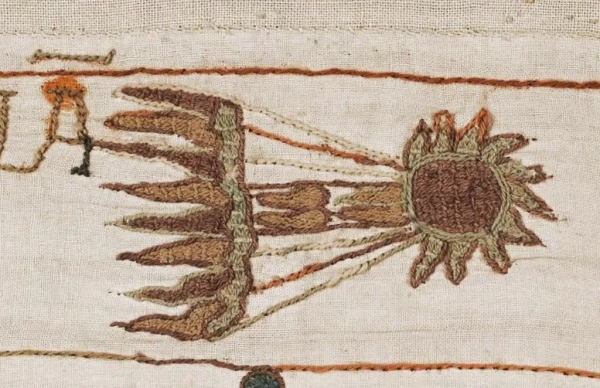
Halley's Comet on the Bayeux Tapestry / Photo Wikimedia
The comet's next return is expected at the end of July 2061, writes Astrobiology. And this time, humanity will observe it with the understanding that the history of its discovery is much more complicated than previously thought.