
Main points
- Archaeologists in Paderborn, Germany, have found a unique wax notebook in a medieval cesspool that had been lying there for 700-800 years.
- The notebook contains Latin texts that can reveal information about the daily life, trade and personal records of medieval Europe, and it is planned to use spectral imaging to study the hidden layers of the writing.
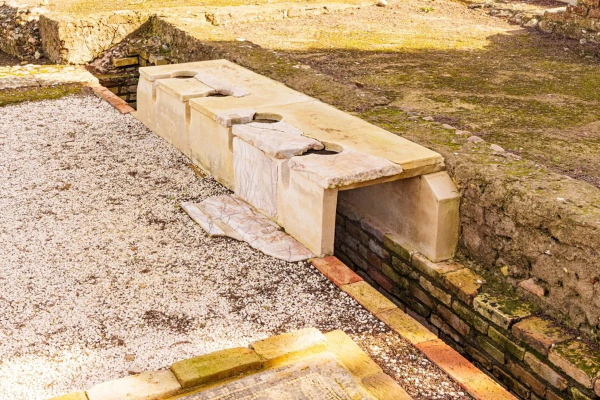
Archaeologists found a book in an ancient toilet that had been underground for almost 800 years / Discovermagazine
During excavations in the center of Paderborn, Germany, archaeologists have come across a rare find that has lain underground for several centuries. It can tell a new story about the daily life of the townspeople of medieval Europe.
What was hidden in a medieval toilet in central Germany?
Archaeologists in the German city of Paderborn have discovered a unique artifact – a small wax notebook that had been lying in a medieval cesspool for approximately 700-800 years. The unusual find was made during construction work on the site of the city’s future administrative building.
The artifact has become a real sensation for researchers, because such objects almost never survive to this day. Unlike religious manuscripts or official documents, which are often specially preserved, such notebooks were used as reusable “drafts” for short notes and were not considered things that should survive the centuries.
According to archaeologist Barbara Rüschoff-Parzinger , this is the first such find in the federal state of North Rhine-Westphalia.
“This is the only such find in all of North Rhine-Westphalia. It may sound strange, but for archaeologists, latrines are almost always real treasure troves. Never before have archaeologists managed to find an entire book in such condition,” she said in a press release.

What did a medieval notebook look like?
The find is a compact book block, about the size of a palm. It consists of ten wooden pages covered with a layer of wax.
These pages were written on with a pointed stylus, a special metal or bone tool that left an indentation in the wax. After use, the surface could be smoothed and reused.
It is this versatility that made such notebooks an analogue of modern notebooks. Preliminary analysis has shown that the text was written in Latin, and probably by one person. At the same time, the different angles of writing indicate that the owner used it in everyday situations, making quick notes literally “on the go”.
Researchers suggest that the notebook could have belonged to a wealthy city dweller – most likely a merchant or a representative of the educated urban environment. In the 13th and 14th centuries, literacy in Europe remained the privilege of the clergy and the upper social strata.
Why is the book preserved in almost perfect condition?
The main reason for the amazing preservation is the specific environment of the medieval cesspool. The constant humidity and almost complete absence of oxygen created a natural airtight chamber that slowed down the processes of destruction of organic materials.
Thanks to this, not only the wooden pages have survived to this day, but also the leather cover, wax coating and a significant part of the inscriptions. Restorer Susanne Bretzel said that at first the object looked like an ordinary lump of wet earth.
“Heavily covered in moist soil, this object at first seemed completely unremarkable. It was only during cleaning in our restoration workshop in Münster that it became clear that this was a real book. And even after so many centuries, the find still had a rather unpleasant smell,” she noted.
According to Live Science , what is particularly valuable is that the inner pages were so tightly closed that dirt almost did not penetrate inside.
Hidden records may reveal new details
Scientists believe that the wax pages may contain more information than is visible to the naked eye. Because older writings were often erased for reuse, traces of earlier notes may have survived beneath newer texts.
Experts plan to use modern spectral imaging techniques to “read” the hidden layers of writing. This could yield unique information about medieval trade, accounting systems, reminders, lists of goods, or even personal records.
Another interesting detail is the leather binding decorated with embossed lilies. In medieval symbolism, this sign was associated with purity, royal power, and divine grace. This may indicate the high social status of the owner.
A medieval toilet as an archive of history?
The notebook wasn't the only find at the site . Archaeologists also found wooden barrels, pottery shards, knives, basket fragments, and silk fabrics. Some of the fabrics were cut into small rectangular pieces that researchers believe could have been used as a medieval equivalent of toilet paper.
Archaeologist Sveva Gai explained that further study of archival documents could help determine who owned the plot where the latrine was located. “Once we can accurately tie this cesspool to a specific plot of land, archival research can help identify its inhabitants. In the best case, this will allow us to link the wax tablet to a specific name,” she noted.
For now, restorers are focused on preserving the artifact. The full restoration, decoding, and translation of the Latin inscriptions could take up to a year. If successful, the scientists will get a rare “window” into the daily life of a medieval city – without official rhetoric, through the prism of ordinary working notes of a man who lived almost eight centuries ago.