

Last year, Romania was the center of political attention for its presidential election. The country’s Supreme Constitutional Court annulled the results after pro-Russian candidate Călin Georgescu won the first round. Romanian intelligence agencies suspected Russia of meddling in the election, and Georgescu was banned from running. Ultimately, in May 2025, Romanians elected a pro-European and pro-Ukrainian president, Nicușor Dan.
But after that, the drama began to unfold around the Romanian parliament. On May 5, 2026, the country's parliament supported a vote of no confidence in the government of Iliye Bolozhan. For this, the Social Democrats joined forces for the first time with the far-right Alliance for the Unity of Romanians (AUR). Where can this crisis lead the country, why is support for AUR growing against the backdrop of these events, and can we already say that support for Ukraine in the war from the Romanian authorities is under threat? We explain in the text.
Reforms that worked against the government
In June 2025, a month after being elected president, Nikushor Dan nominated a candidate for prime minister from the center-right National Liberal Party (PNL). It was not the first time that Ilie Bolojan had to “untangle” complex political stories. For example, from February to May 2025, he served as the country's president. So, Dan decided to appoint him as prime minister – as “the most successful person” for this job, in particular for resolving the country's budget crisis. Bolojan said that he was ready for a “difficult task” and was aware of the responsibility that would fall on him with this position.
One of Bolozhan’s top priorities was to “restore order to the country’s finances.” This was appropriate: the budget deficit, which had reached over 9%, was the highest in the European Union. To address it, the new government began raising taxes and implementing one of the most ambitious reform programs in Romania’s recent history, targeting the state apparatus, state-owned companies, and the pension system. In particular, it began abolishing a special pension scheme for members of the judiciary and raising the retirement age. This reform met with considerable resistance among Romanians.
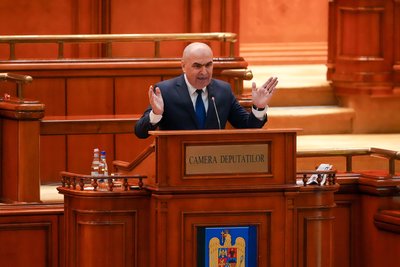 Romanian Prime Minister Ilie Bolojan speaks during a parliamentary session on the day his government was announced to face a vote of no confidence. Bucharest, May 5, 2026. AP/Vadim Ghirda
“Bolozhan also proposed partially withdrawing state control from a number of very important companies — primarily energy and financial ones,” Marianna Prysiazhnyuk, an analyst at the Ilko Kucheriv Democratic Initiatives Foundation, tells Suspilny. “The state would retain only minimal control over them.” Criticism of this initiative was also intensified by the situation surrounding energy prices — largely due to destabilization in the Middle East and the Russian-Ukrainian war. “We observed this in all countries, and in Romania it also caused a wave of concern, a request for some, perhaps, social support. People began to worry,” says Prysiazhnyuk. “And opposition parties began to use this moment to their advantage.”
Before the vote of no confidence in Bolozhan, he warned the members of parliament: “I can leave, but the country’s problems will remain.” He is right, but the composition of the Romanian parliament is specific. According to the results of the elections in June 2025, a four-party coalition united by a common pro-European vector came to power. It included the Social Democrats (PSD), the National Liberals, the progressive-liberal Union for the Salvation of Romania (USR), and the party representing the country’s Hungarian minority, the UDMR. Romanian sociologist Barbu Mateescu explains: the Social Democrats did not share most of the new prime minister’s reforms.
“The PSD has lost its popularity in the polls, largely due to the government’s economic measures. The reforms have also affected the highly paid bureaucrats, an important electoral group for a party that for years was seen as defending their interests,” Mateescu tells the Public. “In addition, the Social Democratic Party did not have a prime minister. And the agreement in the coalition was that the liberals would have the prime minister’s position until next spring, and then it would be the Social Democrats’ turn.”
Finally, on April 20, the Social Democrats withdrew their support for the prime minister and called for his resignation. The PSD accused Bolojan of “destroying the economy, impoverishing the population, and fraudulently selling state assets.”
According to Mateescu, the story of the no-confidence vote came as a surprise even to PSD representatives. “They simply wanted to replace the prime minister with someone much more loyal, even from the PNL. But then the no-confidence vote was passed and the PSD decided not to stop,” the sociologist explains.
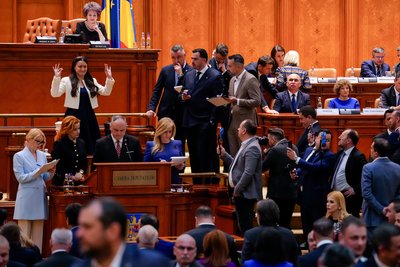 Parliamentarians vote to declare a vote of no confidence in the government of Romanian Prime Minister Iliye Bolozhan. Bucharest, May 5, 2026. AP/Vadim Ghirda
A chance for AUR
A short term for a prime minister is a common thing in Romania. According to DW, the last time a prime minister served a full term there was in 2004-2008. And over the past 14 years, the country has had no less than 11 prime ministers, seven interim heads of government, and 19 cabinet formations. The current government of Iliye Bolozhan lasted only 10 months. Marianna Prysiajniuk explains this trend with the “experiment around the national coalition” in Romania, which caused the transformation of the main pro-European forces in the country. Previously, the PSD and PNL were fierce competitors for many years.
“In recent years, even against the backdrop of COVID-19, they have increasingly acted together. As a result, they simply began to lose their identity and, accordingly, their voters,” explains Prysyazhnyuk. “Against this backdrop, the claims of the core electorate of these parties began to grow — and the AUR ratings. And now it continues, both parties continue to work in the format of a broad national coalition.”
In his first statement after the resignation of the Bolojan government, Nikusor Dan expressed confidence that the next cabinet would certainly continue Romania's pro-Western course: “We will have a new government within a reasonable timeframe. So I reject the scenario of early elections. And I emphasize: after these procedures are completed, the government will be pro-Western. We will survive this calmly.”
“Now is a critical time: both the war and the limits with European money. Also – Romania's own ambitions, economic problems. They don't have time to invent something new, apart from the already existing coalition. So the other day there was an initiative to reconcile these two parties under the slogan “broad European coalition”, that is, to emphasize that this coalition will remain European. The main fear remains that Romania will actually turn into the “Hungary”, which we were dying of after Orban,” adds Prysiazhniuk.
The social democrats also acknowledge the kind of trap of forced cooperation between the PSD and other pro-democracy parties. “We hope that in the next few weeks we will be able to find a way forward. Mathematically, we are locked in this situation with each other if we want to keep AUR and other extremists out [of power],” said Victor Negrescu, the PSD’s top MEP. Indeed, AUR is gradually strengthening its influence on the country’s politics. “The ardent far-right leader, Gheorghe Simion, lost the presidential race last year, but as the country’s centrist government coalition is falling apart, he now sees an alternative path to power,” is how Politico Europe succinctly summarized the essence of the current political crisis in Romania.
It is the figure of Simion that connects last year's epic with the presidential elections and what is currently happening in the country's parliament. The fact is that Simion was predicted to win a landslide victory in the May 2025 elections, but then power slipped away from him. Romanians elected a pro-European candidate, a centrist from the Honest Romania party, Nicăușor Dan. And Simion went to try his hand at parliament with his far-right project, the Alliance for the Unity of Romanians (AUR).
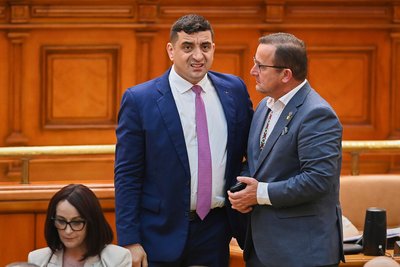 Leader of the far-right Alliance for the Unity of Romanians party, Gheorghe Simion (center), speaks during a parliamentary session in Bucharest, Romania, July 14, 2025. AP/Eduard Vinatoru
AUR became the opening act of the parliamentary elections in Romania in 2020: then the coronavirus played into the party's hands. It advocated the lifting of quarantine restrictions and against vaccination. The party's electorate is mainly citizens without higher education and people who support the idea of “the unity of Romanians, wherever they are – in Bucharest, Iasi, Chernivtsi, Italy or Spain.” Simion is currently banned from entering, for example, Ukraine – since 2011, after a meeting with an agent of the Russian FSB in Chernivtsi.
During the election campaign, Simion advocated reducing military aid to Kyiv, criticized the EU leadership, and supported US President Trump's Make America Great Again movement. According to him, AUR is “a natural ally of the US Republican Party and almost perfectly ideologically aligned with the MAGA movement.”
When asked by journalists whether Simion has any prime ministerial ambitions amid the crisis, he answered modestly: “Not necessarily. Of course, we have people who can take the prime minister's seat, qualified people. But now we want to stabilize the country, because the European Commission allowed the socialists, liberals, and the current coalition to have a huge budget deficit,” Simion said. Marianna Prysiazhnyuk notes that currently, there is no significant increase in the popularity of AUR amid the current crisis. However, at the beginning of the year, their support reached record levels.
According to a survey conducted by the INSCOP sociological company in January this year, if the elections were held right now, almost 41% of Romanians would vote for AUR. This is the highest level of support for the far-right party in more than three decades. The Social Democrats are twice as far behind, at 18.2%, while the Liberals of Iliye Bolozhan have only 13.5%.
“Earlier this month, there was a sociological forecast that showed that AUR lost one or two percent. Their rating is not falling, it has reached a certain plateau. Well, now they are looking for how to use this situation to their advantage. They are trying to show themselves as a party that has a solution. For them, this would be an opportunity to change their toxicity into a certain legitimacy in the political discourse,” says Prysyazhnyuk.
 People cross a street in Bucharest, Romania, May 18, 2026. AP/Vadim Ghirda
Main hazards and scenarios
When asked how Romanian society as a whole perceives this political crisis, sociologist Barbu Mateescu answers: “Romanians are usually very negative [about the government], and this has been going on for decades. We are very critical of the activities of the government, of the parliament. And extremely low expectations are good because nothing will disappoint you. Therefore, there is no disappointment, no shock, no anger. All this is happening after, again, a year of declining purchasing power, many years of inflation. And the general mood does not change significantly,” the sociologist explains. He adds: if you look at the markets, they also seem to be gradually adapting to the situation — just like citizens.
However, it is difficult to predict how long this situation will last. “Currently, the Romanian government is headed by a prime minister who lost a vote of no confidence, but a new prime minister has not been appointed. So it is still, to some extent, the old government, which the social democrats do not support and have left,” Mateescu explains. “The question is whether this interim government can last for months. This is important in the context of stability, as well as access to European funds and programs. The government still has a lot of difficult work to do. The budget deficit has not been reduced sufficiently.”
What could a way out of the crisis look like for Romania? President Nicos Dan is holding consultations with all political forces: they are discussing all possible configurations of what a new government could look like. Then, when a decision is made, the new government will be appointed by a vote in parliament. If Dan's candidacy for prime minister is rejected twice, the country will hold early parliamentary elections.
According to Marianna Prysiazhniuk, a likely scenario under the current circumstances could be a minority government, but this could become an even bigger problem than early elections, as any initiative would encounter a blockage in parliament. Maintaining a stable majority without the PSD will be difficult in any configuration.
In any scenario, the complexity is added by the fact that new parliamentary elections are due to be held in Romania in 2028. This means the start of the election campaign and a new round of destabilization next year. “Consider that from next year there will be a new powerful conflict, a powerful competition between the parties that currently exist. And now we have the opportunity to observe “at a minimum” how this will happen,” warns Prysiazhniuk. Politico reminds that both Gheorghe Simion and AUR will bet on the upcoming parliamentary elections, given their current popularity. Or on the presidential elections scheduled for 2030.
As Serhiy Gerasymchuk, director of the Regional Initiatives and Neighborhood Program of the Foreign Policy Council “Ukrainian Prism” notes in a conversation with European Truth, the most unfavorable scenario for Ukraine is early elections in Romania – precisely because of the very likely victory of the openly pro-Russian AUR. According to him, this will actually mean the termination of Bucharest's support for Ukraine. In addition, Romania may become a stumbling block for the adoption of new anti-Russian sanctions packages at the EU level and will begin to speculate on the topic of national minorities. Maintaining the pro-European vector in the event of the formation of a minority government will mean fewer dangers, and in this case, the topic of Ukraine may recede into the background as “inconvenient.”
“It is important here that Romania returns to working order. I believe that all the decisions that should be concluded legislatively, which define the framework of bilateral cooperation with Ukraine, have already been concluded. Even though the far-right was concerned about the strategic partnership [with Ukraine] and wanted to review it, they will not do so. After all, everyone understands that Ukraine now also has something to share with Romania — in particular, joint production in the defense sector,” Prysyazhnyuk emphasizes.