
Main points
- Asteroid 2026 JH2, with a diameter of 16 to 35 meters, will fly past Earth at a distance of about 90,000 to 90,917 kilometers, which is a quarter of the distance to the Moon.
- The closest point of the flyby will be reached at 00:23 Kyiv time. It will be possible to observe it using telescopes or via a live broadcast from The Virtual Telescope Project on YouTube.
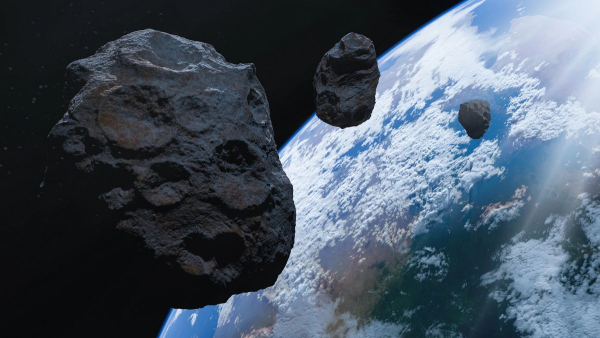
On May 18, 2026, a dangerous asteroid will pass near Earth: does it threaten people / Depositphotos
On the night of May 18-19, the night sky will be the scene of a rare astronomical event. A huge piece of rock, only recently spotted by researchers, will approach our planet at a distance that by cosmic standards is considered almost touching, forcing planetary defense systems to work in an enhanced mode.
What do we know about this asteroid?
A massive asteroid, designated 2026 JH2, will fly past Earth on the evening of May 18. According to astronomers, the object is between 16 and 35 meters in diameter, which is comparable in size to four large London buses. Despite the fact that the asteroid does not pose a direct threat of collision within the next 100 years, its proximity to our planet is of great interest to the scientific community, writes the Daily Mail.
The cosmic body will approach Earth at a distance of about 90,000 to 90,917 kilometers. This is an extremely small distance, only a quarter of the distance from us to the Moon.
In astronomical terms, that's as close as you can get without missing,
– Mark Norris from the University of Lancashire commented on the event.

The object is moving through space at an enormous speed – approximately 32,000 kilometers per hour or 9.17 kilometers per second relative to Earth.
The asteroid was discovered quite recently, on May 10. It was recorded by astronomers at the Mount Lemmon Observatory near Tucson, Arizona, as well as specialists at the Farpoint Observatory in Kansas. Scientists note that such objects are difficult to detect in advance due to their small size.
They don't reflect enough light,
– explained Mark Burchell from the University of Kent.
The size estimate for 2026 JH2 is based on the amount of light reflected from its surface, so the exact size could be larger if the asteroid's material is dark or poorly reflective. Even with the minimum size estimates, this asteroid has enormous destructive potential. This type of object could destroy a city if it hit, Mark Norris stressed.
Richard Moessl, head of the planetary protection office at the European Space Agency, stressed that a potential collision with 2026 JH2 could be compared to the fall of the Chelyabinsk meteorite in 2013, writes New Scientist. Recall that the 18-meter meteor exploded with a force that exceeded the power of the atomic bomb dropped on Hiroshima. Then the blast wave circled the globe twice, more than 1,500 people were injured, and more than 3,600 houses were damaged.
How to observe an asteroid?
The closest point of the flyby will be reached at 00:23 Kyiv time. It will not be possible to observe the asteroid with the naked eye, as it is too dim. However, residents of the northern hemisphere have a chance to see it with the help of small telescopes. The object will look like a faint moving point in the area of the constellation Ursa Major. Due to its high speed, it will cross the sky almost as fast as artificial satellites.
For those who do not have special equipment, Italian astronomers from The Virtual Telescope Project will organize a live broadcast on YouTube, which will begin at 10:45 PM Kyiv time on May 18.
You can already sign up for reminders to be notified when it starts: watch the video
Where next?
Thanks to improved observation systems, scientists can now make precise calculations of the orbits of such bodies. Studies show that 2026 JH2 revolves around the Sun every 3.7 years in an oval orbit that takes it almost to Jupiter.
You will also be interested to know: how often do large asteroids approach Earth?
Asteroids fly by Earth all the time. Astronomers record dozens of such approaches every week, but the vast majority of objects are small and do not pose a serious threat. If we talk about large asteroids with a diameter of hundreds of meters or kilometers, then their dangerous approaches occur much less often. According to NASA estimates, objects the size of the asteroid Apophis fly this close to Earth about once every few thousand years, writes NASA Science.
Apophis is the most famous example in the coming years. On April 13, 2029, it will fly within about 32,000 kilometers of the Earth's surface. This is closer than the orbits of some geostationary satellites. The asteroid has a diameter of about 340 meters and will be visible to the naked eye in parts of the world. NASA emphasizes that there is no threat of collision, but the event is unique in the modern history of observations.
How often do large asteroids fall to Earth?
Large asteroids hitting Earth are much less common than their flybys. Small objects a few meters across enter the atmosphere regularly – sometimes even daily – but they burn up.
Asteroids of tens of meters in size, capable of causing local destruction, fall about once every tens or hundreds of years. An event of the scale of the 2013 Chelyabinsk meteor is an example of such a scenario.
In contrast, large objects that can destroy a metropolis or even a country fall much less frequently.
What could be the consequences of the fall of an asteroid that has the status of “city killer”?
An asteroid with a diameter of approximately 100 to 300 meters, often called a “city killer,” could release energy in the hundreds or thousands of megatons of TNT equivalent.
The consequences will depend on the location of the impact:
- If the object falls into the ocean, giant tsunamis are possible.
- If it hits land, there will be a shock wave, fires, earthquakes, and large-scale destruction of infrastructure for tens of kilometers around the epicenter.
An object about one kilometer in diameter is already capable of causing a global catastrophe. It was such an asteroid that caused the mass extinction of the dinosaurs about 66 million years ago. After the impact, a huge amount of dust and soot was thrown into the atmosphere, which led to a long-term cooling and the destruction of ecosystems.
What is the difficulty in detecting asteroids and why do we sometimes notice them too late?
The difficulty of detecting asteroids lies in several factors:
- First, most of them are very dark. They reflect little sunlight and literally get lost in space.
- Secondly, asteroids often approach from the Sun. In this case, telescopes on Earth cannot see them properly due to the glare. That is why some objects are noticed only a few days or even hours before the approach.
Another problem is size. A small asteroid of a few dozen meters becomes noticeable only when it is very close. For example, some dangerous objects were discovered by astronomers after they flew past the Earth. In 2026, scientists reported on the asteroid 2026 JH2, about 35 meters in size, which flew at a distance of about 91 thousand kilometers from Earth, that is, closer than some satellites, writes Live Science.
Does humanity have real technology to protect against asteroids?
Humanity already has the first real technologies for protecting against asteroids, reminds Channel 24. The most famous example was NASA's DART mission. In 2022, the spacecraft deliberately crashed into the asteroid Dimorph and changed its orbit. The experiment was recognized as successful – for the first time in history, people were able to noticeably change the trajectory of a celestial body.
However, this method only works if the dangerous object is detected in advance – preferably years or decades before the potential impact, so that we have time to build a device, calculate its flight, launch it and approach the object. If the asteroid is spotted too late, there may simply be no time to deflect it.
Space agencies are now actively developing planetary defense systems. NASA is building new telescopes to search for near-Earth asteroids, and ESA is preparing missions to study potentially dangerous objects. In particular, Apophis will become the main target of international observations and space missions in 2029, NASA reports.
What dangerous or record-breaking close asteroid flybys are expected in the coming years?
Among the most anticipated close encounters in the coming years, Apophis is the one that is drawing the most attention. Its flyby will be the closest approach of such a large asteroid that humanity has been able to predict in advance, writes NASA Science. Astronomers also continue to closely monitor other near-Earth objects, including potentially hazardous asteroids that may require additional observations in the future.
Later, in 2032, another “city killer” is expected to visit – asteroid 2024 YR4, but it also poses no threat to us. This is the same asteroid that could hit the Moon.
Despite the loud headlines in the media, there is currently no known large asteroid that is guaranteed to threaten the Earth in the coming decades, concludes Channel 24. But the problem is that humanity still does not see all the dangerous objects. That is why astronomers consider early detection systems to be one of the key elements of the future security of civilization.