
Main points
- In Moldova, near the village of Gura Bycului, archaeologists have found a Scythian tomb dating back to the 3rd century BC, with unique funerary artifacts.
- The find includes arrowheads, a knife, ceramic vessels, beads, worked stone, and a rare censer, telling the story of the military and spiritual culture of the Scythians.
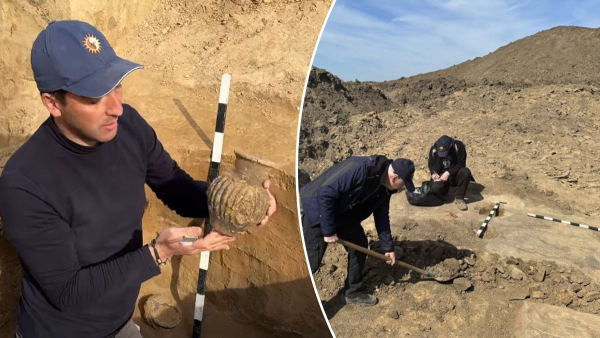
Archaeologists in Moldova have excavated an ancient underground tomb belonging to the Scythian culture / Collage of Channel 24/National Archaeological Agency of Moldova
Near the village of Gura Bykului, archaeologists have come across a unique find that sheds light on the life of nomadic tribes long before our era. The focus of the researchers was an ancient structure with a rich inventory, where among the weapons and jewelry they discovered objects that were almost never found in this region before.
What secrets did the burial reveal?
In the territory of Moldova, in the Aneniy Noi region, during rescue archaeological excavations, a Scythian tomb was discovered, the age of which is approximately 2300 years. The find, dated to the 3rd century BC, is located in a burial mound-type necropolis near the village of Gura Bycului. This event has already become one of the most significant archaeological news of recent times, as the object has preserved unique evidence of the burial traditions of the late Iron Age, writes Arkeonews.
The architecture of the discovered tomb indicates careful preparation for the burial process. The structure consists of an entrance shaft, a burial chamber and a special passage known as a dromos, writes the local publication NordNews.md. Such a structure indicates that it was not just an ordinary underground space, but a clearly planned place for rituals, where the body of the deceased and accompanying objects were placed according to a certain canon.
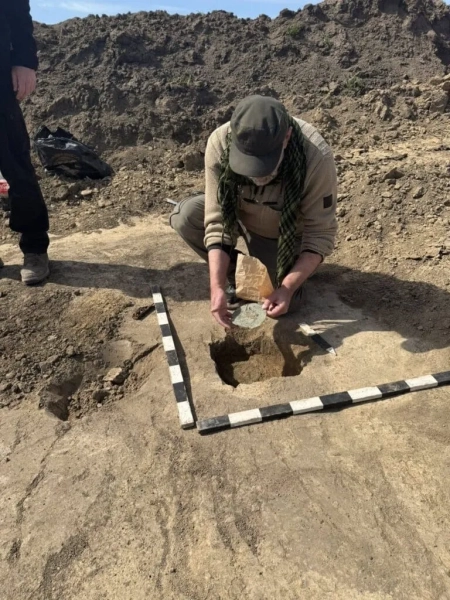
Excavation of the tomb / Photo by the National Archaeological Agency of Moldova

Inside the chamber, archaeologists found objects that reflect two aspects of Scythian life: military and spiritual culture. Among the finds were arrowheads and a sheathed knife, reminiscent of the Scythians' status as skilled warriors of the steppe.
However, the special attention of scientists was attracted by artifacts related to the ceremonial part of the burial: ceramic vessels, beads, worked stone, and an extremely rare incense burner.
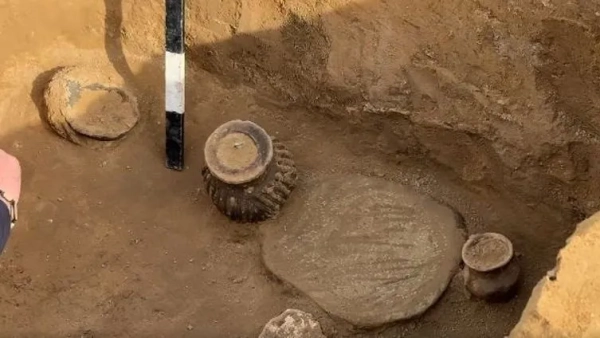
Some of the objects found in the tomb / Photo by the National Archaeological Agency of Moldova
As Vlad Vornyk, director of the National Archaeological Agency, commented, excavations at this site are still ongoing. According to him, important finds have already been recorded in the southeastern part of the chamber, including a whole ceramic vessel and other objects typical of Scythian necropolises of the 3rd – 2nd centuries BC.
One of the most impressive discoveries is a ceramic censer, notes the Ancientist publication. Such objects are rare in the archaeological heritage of Moldova, but representatives of the National Archaeological Agency of Moldova commented that the found censer is a typical feature of Scythian culture in general. It could become one of the key exhibits of the National Museum of History, adds Pivot.md.
The use of incense burners in funerary contexts is associated with purification, burning incense, or other symbolic acts during farewells to the deceased. In addition, a polished stone found nearby, according to preliminary estimates, could have served as a small ritual altar.
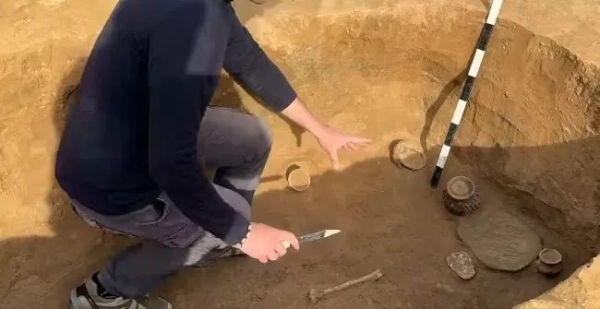
Excavation of the tomb / Photo by the National Archaeological Agency of Moldova
The location of the tomb in the Lower Dniester basin adds special significance to the discovery. In ancient times, this region was a zone of contact between nomadic groups of the Northern Black Sea steppes and local settled communities. The find helps to better understand how Late Iron Age communities used the landscape and how their traditions interacted with the broader cultural practices of the Scythian world.
Excavations are currently underway. Archaeologists hope that further research will allow them to more accurately identify the buried individual. Analysis of human remains, ceramics, and artifacts may provide answers to questions about the age, sex, health, and social status of the individual who lived more than two thousand years ago.
You will also be interested to know: who are the Scythians and why did they become one of the most famous peoples of the ancient world?
The Scythians were a group of Iranian-speaking nomadic and semi-nomadic tribes who dominated the steppes of Eurasia from approximately the 7th to the 3rd century BC. They reached their greatest power in the Northern Black Sea region – that is, modern-day Ukraine, parts of southern Russia, Moldova, and neighboring regions.
As analyzed by 24 Channel , ancient Greek authors, including Herodotus, described the Scythians as an extremely warlike people, skilled horsemen and archers, capable of quickly moving across the steppe and waging mobile warfare. It was cavalry that became the basis of their strength.
The Scythians were not a single centralized state in the modern sense. It was a union of tribes with their own elite, warriors, priests and rulers. Some of the Scythians remained nomads, moving with herds of horses, cattle and wagons-dwellings. Others gradually moved to a settled life, engaged in agriculture and trade.
Interaction with the Greek colonies on the Black Sea coast was of great importance to the Scythians. Through trade, they obtained expensive jewelry, weapons, wine, ceramics, and luxury items.
The Scythians were especially famous for their burial mounds – huge burial mounds in which nobles and warriors were buried. Weapons, jewelry, horses, utensils and even servants were often buried with the dead. It was thanks to these burials that archaeologists were able to learn a lot about Scythian life. The so-called “animal style” dominated the art of the Scythians – ornaments and decorations with images of deer, griffins, panthers, eagles and other animals.
How did the Scythians live in the territory of modern Ukraine and what treasures did they leave behind?
On the territory of modern Ukraine, the Scythians left behind a huge archaeological heritage. Most of their monuments are located in the steppe regions of the south and east of the country – in modern Dnipropetrovsk, Zaporizhia, Kherson, Mykolaiv regions and Crimea. It was here that the so-called Great Scythia once existed, writes 6262.com.ua.
One of the most famous finds was a gold pectoral from the Tovsta Mohyla mound near the modern city of Pokrov in the Dnipropetrovsk region. It was found in 1971 by archaeologist Boris Mozolevsky. The pectoral is a massive gold breastplate weighing over a kilogram, decorated with intricate scenes from the life of the Scythians and the animal world. It is considered one of the most valuable archaeological artifacts of Ukraine and a symbol of Scythian culture, reports the Ukrainian newspaper Chas.
In addition to Tovsta Mohyla, other large Scythian burial mounds are known in Ukraine – Chortomlyk, Solokha, Gaymanova Mohyla, Oguz and Mamai-Gora. They have yielded gold jewelry, swords, arrowheads, horse equipment and household items.
Archaeologists also study Scythian hillforts – fortified settlements. One example is the Khotiv settlement near Kyiv, which existed as early as the 6th century BC.
The Scythians played an important role in shaping the history of the Ukrainian steppes, concludes 24 Kanal . It was they who controlled the trade routes between Europe and Asia, interacting with the Greeks, Persians and other peoples. At the end of their rule, they gradually lost influence due to pressure from the Sarmatian tribes, and some of the Scythians moved to Crimea.
What is known about the Scythians in modern Moldova and what archaeological discoveries have been made there?
The Scythians also left a noticeable mark on the territory of modern Moldova, although the scale of their presence was smaller than in the Ukrainian steppes. Most Scythian monuments have been discovered in the eastern and southern parts of the country, especially near the Dniester. Archaeologists have found burial mounds, warrior burials, ceramics, arrowheads, knives, and ritual objects there.
Finds in Moldova show that the Scythians actively moved through the territories between the Dnieper and Danube and maintained contacts with other cultures of the region. Their burials in Moldova are in many ways similar to Ukrainian ones – they are also burial mounds with burial chambers and a characteristic set of weapons and ritual objects.