
Main points
- The Psyche spacecraft, during its flyby of Mars, took a unique image of the planet in the form of a narrow silvery crescent illuminated by sunlight.
- The Psyche mission, which launched in October 2023, aims to study asteroid 16 Psyche, suggesting that it may be the remnant of a protoplanetary core, which will provide insights into the formation of planets in the Solar System.
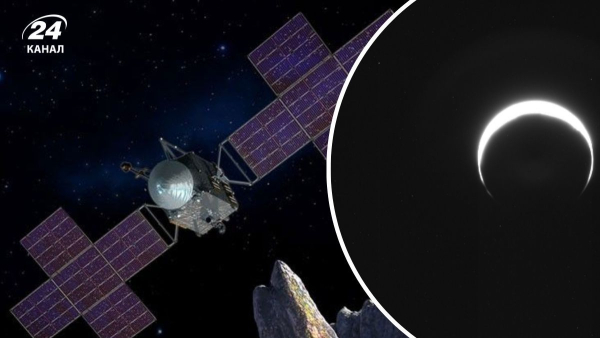
NASA has published a rare image of Mars / NASA
The Psyche spacecraft, en route to asteroid 16 Psyche, has captured an unusual image of Mars. In the photo, the Red Planet appears as a thin silvery crescent with a dark side that is almost completely absorbed by space.
At first glance, the frame released by NASA resembles a solar eclipse or a thin new moon, but in fact it is a rare view of Mars, only partially illuminated, explains Channel 24 .
Why does Mars look like a silver crescent?
The photo was taken on May 13 and shared via NASA's official social media account X. NASA explained that the bright silver crescent is sunlight reflecting off the dayside of Mars' surface. Additional glow is created by the planet's atmosphere, through which sunlight also passes.
This is not an eclipse, but an even more rare sight: a crescent Mars as seen by NASA's #MissionToPsyche spacecraft.
The unprocessed image — taken by Psyche today — shows the night side of Mars as the spacecraft approaches the Red Planet for a flyby on May 15. The glowing… pic.twitter.com/MMxQfcXl5Z
— NASA Solar System (@NASASolarSystem) May 13, 2026
The agency noted that the irregularities along the bright edge are likely related to features of the Martian surface, as well as dust and clouds in the planet's atmosphere.

Where is Psyche flying to?
The final destination of the journey is asteroid 16 Psyche. On May 15, Psyche was supposed to pass within about 4,500 kilometers of Mars. During the flyby, the probe was moving at a speed of about 19,848 kilometers per hour. This allows the mission not only to take a series of spectacular photographs, but also to conduct important calibrations of scientific instruments.
Preparations for this stage have been ongoing since May 3. NASA engineers have been testing the equipment that will later be used to study the mission's main target, the metallic asteroid 16 Psyche. Its diameter is approximately 280 kilometers.
The Psyche mission launched in October 2023, and is scheduled to arrive at the asteroid in 2029. The spacecraft is heading to the main asteroid belt between Mars and Jupiter, where the mysterious object is located.
However, the approach to Mars is not only necessary for photographs. The main purpose of the maneuver is to obtain a gravitational impulse from the planet. Such a “gravitational push” allows you to change the flight trajectory and increase the speed of the device without additional fuel consumption.
NASA considers asteroid 16 Psyche to be one of the most intriguing objects in the solar system. Scientists suggest that it may be the remnant of the core of an ancient protoplanet that lost its outer layers after massive collisions in the early history of the solar system.
Why is the “sickle of Mars” shot so rare and how was it even possible to obtain it?
Mars' unusual appearance is explained by the fact that the Psyche spacecraft approached the planet from its night side at a very large phase angle. Because of this, the cameras saw mostly the dark side of Mars, leaving only a thin strip of the surface illuminated. That is why the planet appears as a narrow silvery crescent in the photo.
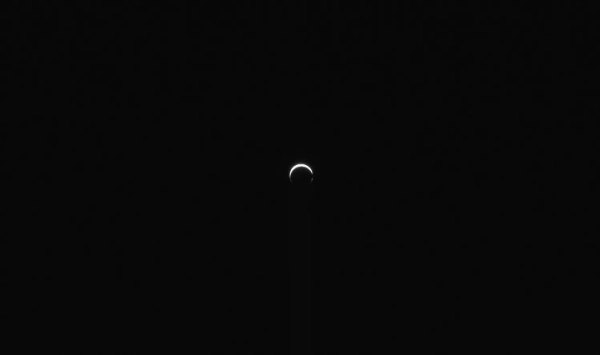
Psyche photographed the crescent of Mars / NASA photo
This is almost impossible to see on Earth. Due to the arrangement of our orbits, we usually see Mars either fully or largely illuminated. To get such a shot, you need a spacecraft that is far from Earth and moving at a specific angle relative to Mars.
The Red Planet's atmosphere adds an additional effect. NASA explains that the glow around the crescent is caused not only by sunlight reflecting off the surface, but also by light scattering by dust in the Martian atmosphere. This creates a soft glow around the planet, which is clearly visible in the photo.

Glow around Mars / Photo by NASA
For the mission team, such images also have practical value. During the flyby, engineers will test and calibrate multispectral cameras and other scientific instruments that will later operate near asteroid 16 Psyche.
What exactly is the Psyche mission looking for on asteroid 16 Psyche and why do we need it on Earth?
The mission's main goal is to understand whether asteroid 16 Psyche is the bare metal core of an ancient protoplanet. Scientists suggest that billions of years ago, the large cosmic body experienced a series of powerful collisions that literally “torn” its outer rocky layers, leaving only the inner metal part, explains Space.com.
This is extremely important for science, because the Earth's core is located thousands of kilometers deep and is inaccessible to direct study. Asteroid Psyche could become a kind of “open sample” of a planetary core, which will allow us to better understand how the rocky planets of the Solar System – in particular Earth, Mars and Venus – formed.
The spacecraft will study the asteroid's magnetic field, gravity, density, topography, and chemical composition. Of particular interest are iron and nickel, which may dominate the object's structure, Aerospace writes.
However, recent studies, including one published in Earth and Planetary Astrophysics and another in the same journal, suggest that Psyche may be more complex than previously thought. Observations show that the surface contains not only metals, but also silicate rocks and traces of ancient collisions. This could change our understanding of how the first planetesimals evolved in the early Solar System.
Despite the numerous headlines about the “quadrillion dollar asteroid,” NASA emphasizes that the mission is not aimed at resource extraction. The main task is fundamental science and the study of the origin of planets.
Why might the mission not have happened without Mars?
The flyby of Mars is critical to the entire Psyche mission. The spacecraft uses a so-called gravity maneuver, a technique in which the probe gains additional speed thanks to the planet's gravity, as previously reported by NASA.
Mars is effectively “pushing” the spacecraft toward the main asteroid belt. Without this maneuver, Psyche would have to use significantly more xenon fuel for its ion thrusters or launch a heavier vehicle with more energy. This could make the mission much more expensive or even technically impossible in its current form.
NASA explains that after approaching Mars, the flight trajectory will change and the speed of the device will increase significantly. This is what will allow the probe to reach the asteroid in 2029 after a journey of more than 3.5 billion kilometers.