
Main points
- The Russian Cold company in Russia is on the verge of bankruptcy due to debts that have exceeded 12.5 billion rubles.
- Investment company A1 offers to buy back the debts in exchange for control, and 1.5 billion rubles of investment is needed for recovery.
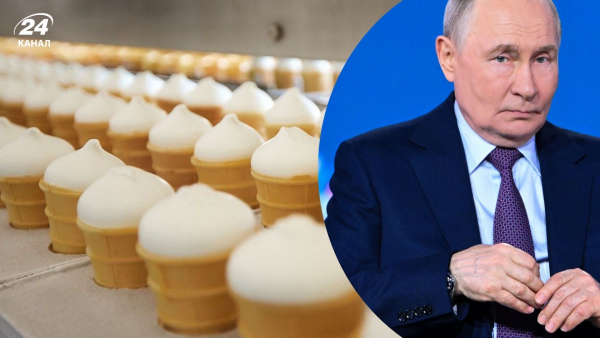
In Russia, a large ice cream manufacturer is “collapsing” due to debts / Collage by Channel 24, photo Getty Images, Russian media
One of the largest ice cream producers in Russia, the Russian Cold company, is on the verge of financial collapse. The investment and financial group Fordewind plans to seek bankruptcy through the court.
What is happening with the Russian Cold company?
Bankruptcy is being sought for four key structures of the company: JSC “Russian Cold”, JSC “TD “Russian Cold”, LLC “Altaikholod” and “Laguna Coil”, writes Dairy News.
The company's problems have been accumulating gradually. According to Soyuzmoloko and Streda Consulting, last year the production of Russian Cold ice cream decreased by 25% – to 15 thousand tons. For comparison, the overall drop in ice cream production in Russia was much smaller – about 7.5%. The situation has worsened already this year:
- Since May 1, the company has actually stopped supplying products to its main partners and has begun an internal audit.
- Against this background, it became known that the total debt of the four main structures exceeded 12.5 billion rubles.
What are the reasons and can anything save the ice cream manufacturer?
At the same time, a potential savior of the business appeared on the market: the investment company A1 offered to buy out the debts of “Russian Cold” in exchange for control over the company. According to preliminary estimates, at least 1.5 billion rubles of investment is required to financially restore the manufacturer.

The tool is used as a way to record delinquency, declare yourself as an active creditor, and influence the parameters of a future deal,
– says Pavel Novikov, partner of Melling, Voytishkin and Partners.
Another expert, Lidings partner Oleksandr Popelyuk, suggests that Fordewind could have bought the company's debts from banks in order to be able to initiate bankruptcy proceedings more quickly.
By the way, the situation in the Russian ice cream market as a whole is also deteriorating. According to Artem Belov, CEO of Soyuzmoloko, in January-February this year, ice cream production in Russia dropped by another 17.1%. Among the reasons:
- cold winter and spring;
- falling sales in the restaurant sector;
- general deterioration of the situation in the consumer market.
What does this mean?
The Russian Cold crisis has become another signal of the worsening situation in the Russian consumer sector. The company's problems indicate:
- decline in purchasing activity;
- restaurant market contraction;
- difficulties with business financing;
- growing debt burden even among large food producers.
Note! The situation surrounding the “Russian Cold” demonstrates that financial problems in Russia are increasingly affecting even large food companies. Billions of dollars in debt, falling production, and halted supplies indicate systemic difficulties in Russia's consumer sector, which continue to intensify amid economic pressure and shrinking domestic demand.
The global economy of Russians is the main reason for the crisis of companies
Putin's policies have forced Russians to save not only on luxury purchases but also on basic goods like food. Data from Sberbank showed that the drop in the number of catering establishments in January was the largest since 2021, and restaurant spending hit a three-year low in November-early December 2025, Reuters reports.
Real consumer spending growth fell to zero in February for the first time in two years. Russia forecasts economic growth of 1.3% this year after 1% in 2025, 4.9% in 2024 and 4.1% in 2023. The International Monetary Fund forecasts growth of 0.8% in 2026.
A central bank study found that across Russia's 11 time zones, people are looking for cheaper options: eating at fast food or supermarkets instead of restaurants, discounted food at supermarkets, car repairs instead of new purchases, and a cooling housing market.
The number of cafe and restaurant closures in the capital in 2025 increased compared to 2024, while the number of takeaway coffee outlets continues to grow,
– the Central Bank of Russia reported.
By the way, they even started saving on water. According to Evotor analysts, in January-April 2026, retail sales of bottled water fell by 14% in units and by 1% in monetary terms, The Moscow Times writes.
The Kavminvody company reported that in the first quarter, sales plummeted by 33.5% year-on-year. They note that this trend is typical for the entire market and is associated with a decrease in the purchasing power of the population. What do experts say?
- Dmitry Leonov, Deputy Chairman of the Board of the Rusprodsoyuz Association, explains that Russians are increasingly abandoning regular water purchases in favor of filters for purifying tap water.
- At the same time, Alla Andreeva, Director General of the Union of Juice, Water and Beverage Producers, notes that consumers have become much more sensitive to prices and are more carefully forming their grocery basket.
How is Russia's budget deficit growing despite additional revenues?
Economist Oleg Getman told Channel 24 that for a certain period of time – about a month or so – Russia could receive additional income from oil sales against the backdrop of events in the Middle East. And now it will continue to earn from this for some time.
Oleg Getman,
Coordinator of expert groups of the Economic Expert Platform
But against the background of the overall budget deficit, in particular for the period January-March 2026, which has already exceeded 4.5 trillion rubles, this is a drop in the ocean.
That is, even if the Russians receive an additional $5-10 billion, they will spend much more.
Therefore, it is worth understanding that if the conflict in the Middle East “declines” in the coming weeks and months, Russia will be able to receive a small amount from the sale of oil, which will not affect the economic situation in the country in any way.
– explains Hetman.
That is why it is important for Ukraine that the conflict in the Middle East does not drag on and last a year or more. Otherwise, it could save the Russian budget due to the increase in the price of oil, which could then reach about $100 per barrel.
And if everything ends soon, then oil, on the contrary, will fall to $70 per barrel, and sanctions on Russian oil will return,
– says the economist.
What other problems does Russian business have?
-
The financial performance of Russian companies deteriorated sharply in early 2026, with a combined net profit of 3.4 trillion rubles, down 33.1% from the previous year. Revenues from small businesses and the self-employed fell to approximately $7.5 billion in the first quarter of 2026.
-
The Russian government has decided to cut spending on developing new drugs, funding only “breakthrough” drugs with no analogues. Pharmaceutical companies are facing problems due to insufficient state support, as the development of innovative drugs costs more than 5 billion rubles.