

- 1 At the height of the Maidan, he presided over the court and then announced the verdict against Yanukovych: who is Judge Devyatko?
- 2 One tried the Maidan protesters, the other acquitted Medvedchuk: what is the Dyb-Maybozhenko couple known for?
- $ 3,425 per 100 sq m: is land near Kyiv ever this cheap?
- 4 Cottages disguised as unfinished dachas: where do judges live?
- 5 Questions, no answers: what next?
- 1 At the height of the Maidan, he presided over the court and then announced the verdict against Yanukovych: who is Judge Devyatko?
- 2 One tried the Maidan protesters, the other acquitted Medvedchuk: what is the Dyb-Maybozhenko couple known for?
- $ 3,425 per 100 sq m: is land near Kyiv ever this cheap?
- 4 Cottages disguised as unfinished dachas: where do judges live?
- 5 Questions, no answers: what next?
From Obolon to Khotyanivka – nine kilometers. By car – fifteen minutes, if you don’t stand in a traffic jam at the exit from the city. You turn off the highway “Kyiv – Chernihiv”, pass the barrier, and another world begins: smooth asphalt, neat sidewalks, neat fences, and above them – tiled roofs. The Desna River flows 100 meters away. Somewhere you can see a playground.
This cottage town “Mizhrichia” is a large suburban complex in the Vyshgorod district. About 100 hectares, eight natural lakes, four kindergartens and even a school. On the official website of the project, the price for houses without renovation starts from 97 thousand US dollars. The area of a separate plot for purchase is from 6 hundred square meters, the average cost per hundred square meters is from 3 thousand dollars.
In April 2026, Channel 24 journalists came here not for a tour. We were interested in specific addresses – those where judges of the Obolonskyi District Court of Kyiv live or at least have access to real estate. By the way, the court where in 2014 they handed down decisions against the participants of the Automaidan. The court where, in the end, in 2019, they sentenced Yanukovych.
Actually, judge Vladyslav Devyatko and the judicial couple Oleksiy Dyba and Anna Maybozhenko are the main characters of this text and the happy owners of the right to free use of real estate on the territory of “Mizhrichia”. However, certain figures in their declarations raise questions: opposite the plots there is a price that does not correspond to the market price; next to the cottages (or rather “garden houses”) there are notes “not accepted for operation”.

Read to the end, because this story has more questions than answers. The main one, “Where did the money come from?”, is so awkward that it seems the judges aren't going to answer it.
During the preparation of the material (to search for certain court decisions and information about real estate), investigators used the YouControl analytical platform .
At the height of the Maidan, he presided over the court and then announced the verdict against Yanukovych: who is Judge Devyatko?
Before moving on to the judges' declarations, plots in “Mizhrichia” and cottages for tens of thousands of dollars, a few words about who these people are and why their names are worth knowing.
Vladyslav Devyatko has been a judge of the Obolonskyi District Court since 2007. He became widely known in 2019, when, as the presiding judge, he sentenced former President Viktor Yanukovych to 13 years in prison for high treason. The decision was “reviewed” by all instances, up to and including the Supreme Court, and remained unchanged.
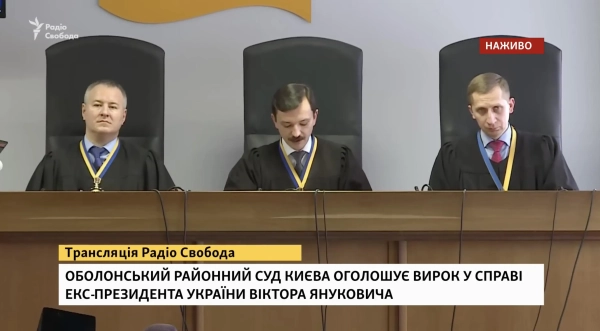
Judge Vladyslav Devyatko (center) reads out the verdict in the Yanukovych case / Screenshot from the broadcast of the hearing / Radio Liberty
At that time, Devyatko had been heading the Obolon Court for five years. But to understand how he ended up in this position, we need to go back to the winter of 2013-2014.
On November 21, 2013, the Yanukovych government unexpectedly suspended negotiations on the signing of an Association Agreement with the European Union. That same evening, the first thousand people gathered on Independence Square in Kyiv. Within a few weeks, their number had grown to hundreds of thousands. Protests spread to different corners of Ukraine. People demanded the resignation of the government, early elections, and a European integration course.
The authorities responded with force. On November 30, the Berkut brutally dispersed the protesters, including students, but this only intensified the protests.
Tensions grew every day, reaching their peak in January and February 2014: deputies passed “dictatorial laws”, clashes occurred between protesters and security forces, and the news reported the first deaths.
At the same time, the Automaidan movement of motorists emerged. Its participants gathered in columns and drove to Mezhyhirya, Yanukovych's country residence near Kyiv, every week. People drove their own cars, honked their horns, and waved flags to convey their position to those in power.
How the road trips to Mezhyhirya took place: Channel 24 story for January 2014
It was these trips that became the pretext for the persecution. Traffic police inspectors drew up reports for “failure to comply with the stop order.” Mostly without any evidence: video recording or witnesses. Judges were supposed to make final verdicts and impose punishments based solely on police reports.
The administration of President Yanukovych demanded the maximum punishment for the Avtomaidan activists. In particular, the then head of the Obolonskyi District Court, Iryna Mamontova, received a call from Bankova in late 2013. She later reproduced the content of the conversation during interrogation at the Prosecutor General's Office, and her testimony was read out at the 13th Congress of Judges in 2015.
According to Mamontova, a person from the Presidential Administration demanded that the cases be considered as quickly as possible and that the punishment be the most severe possible.
The man in question (from the Presidential Administration, – Channel 24) told me that protocols on administrative offenses should be registered and reviewed as soon as possible. He also noted that, given the circumstances in the country, it is necessary to choose the maximum possible penalty,
– Mamontova claimed.
She refused to give instructions to the judges. The phone rang several more times.
On January 17, 2014, some judges of the Obolonsky District Court made the first decisions regarding the Avtomaidan activists, imposing fines on them. The same day, after lunch, according to Mamontova, the Administration called her again: “They expressed their dissatisfaction with such punishments, noting that this contradicts the interests of the state.” Apparently, Bankova wanted a harsher punishment – deprivation of driving licenses.
Mamontova was accused of failing to organize the work of the court. She was made to understand that “certain judges” should be appointed for this category of cases. She wrote a letter of resignation and left it on the table.
That's how Vladislav Devyatko came to replace Mamontova. Decisions to deprive protesters of their driving licenses came one after another.
- January 30, 2014 – Brashkin’s case. At the end of 2013, he allegedly drove along Bogatyrskaya Street in a convoy with Euromaidan symbols, not stopping at the request of a police officer. In the courtroom, both Brashkin and the witness claimed that no one stopped him that day. Devyatko did not call traffic police inspectors, although the defendant requested it, and did not take into account the fact that Brashkin has a minor sick child, for whose transportation to the hospital he needs a car. The sentence is three months without rights. The High Council of Justice later confirmed that the decision “was of a punitive nature”, and the court of appeal also overturned it.
- February 7, 2014 – Zakutaylo’s case. Same Bogatyrska Street, same day, same inspector. Zakutaylo even brought evidence of falsification to court – three inspector’s reports, written in different handwriting and signed with different signatures. In addition, the man insisted that his wife was driving that day. The judge rejected all the evidence. The sentence – three months without a license, which was later successfully appealed.
It is worth mentioning separately the decision of the Devyatok Court of January 24, 2014 in the case of Oleksiy Saliha, who was accused of “mass riots”. The Lviv resident, a participant in the Automaidan, was stopped and beaten by Berkut officers on the night of January 23, along with other activists, on Kriposny Lane in Kyiv.
Most of the detainees had signs of serious injuries. The criminal case materials, as the investigation later established, were based on forged documents.
Despite all this, Judge Devyatko granted the prosecutor's request – two months in custody.
The trial of the detainees, in particular Oleksiy Saliha, had all the signs of arbitrariness,
– the Public Integrity Council emphasized in its conclusion.
In 2017, the High Council of Justice, a state body responsible for judicial discipline, considered the case of Devyatko and even acknowledged that the judge had violated his oath and that his decisions were punitive in nature. However, it did not hold him accountable due to the “expiration of the statute of limitations.”
The Supreme Court later revised its own assessment and removed the wording “breach of oath” from the reasoning of the decision. Probably in order to finally make any attempts to remove Devyatko from office impossible.
“Breach of oath” is not just a disciplinary offense. It can lead to dismissal (which is what happened to other judges of the Obolon District Court).
By the way, this is a very important fact. Other judges of the Obolonsky court who made decisions regarding activists did lose their positions. And Devyatko actually got away with everything: he remained in the chair of the head of the Obolonsky district court until 2023.
One tried the Maidan activists, the other acquitted Medvedchuk: what is the Dyb-Maybozhenko couple known for?
Oleksiy Dyba is another judge of the Obolonsky District Court, Devyatko's neighbor in “Mizhrichcha” and the holder of the status of “Maidan judge”.
He was awarded the title because of the case of Pavlo Onyshchenko, whom he deprived of his driving license for 6 months. The circumstances are typical: the man allegedly failed to comply with the inspector's request to stop while driving in a convoy to the Mezhyhirya residence.
The Court of Appeal overturned the decision as “not in accordance with the requirements of current legislation.”
The court of first instance (Obolon District Court, – 24 Channel) did not fully study the case materials, did not give them a proper assessment,
– the appeal decision states.
Also, in 2015, the ZMINA human rights center wrote about Dyba's controversial decision in the case of a pregnant woman, 26-year-old Tetyana Fedorovych.
As Tetyana herself said, she began her probationary period at a private company without even suspecting that she was pregnant. Upon completion, when the woman was supposed to be hired, it turned out that she had not been officially registered for a probationary period. At the same time, the management found out about the pregnancy.
“I somehow stopped working as an employee. The director told me that we can't fire you. Actually, you didn't work for us,” Tetyana told the court.
The woman filed a lawsuit, which was heard by Judge Dyba. He dismissed the lawsuit in its entirety, stating that there was no employment contract and that the woman was “undergoing training to improve her skills.” All evidence – phone records, e-mail correspondence, and database extracts – was ignored.
Dyba also did not take the issue of discrimination based on pregnancy into account, although one of the witnesses at the trial claimed that it was because of this that Tetyana was “asked to leave”, because in general there were no other claims against her.
A year later, during a retrial of the case, another judge of the Obolonsky court still partially satisfied the woman's claim, obliging the company to pay her the outstanding wages.
But neither the decision regarding the automaidan participant, nor the aforementioned episode with pregnant Tetyana prevented Dyba from successfully passing the assessment for suitability for the position he held (and now also having the right to use the cottage and land in “Mizhrichia”).
The assessment had various elements, such as taking a written test, completing a practical task, and testing personal moral and psychological qualities. The judge managed to score 83% out of 100.
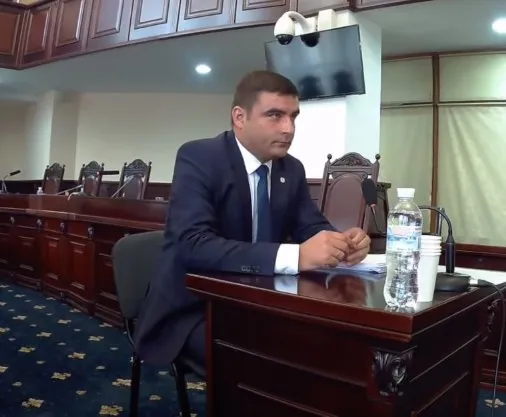
Judge Oleksiy Dyba / Photo from the resource “Judges of the Maidan” (maidan-judges.info)
Oleksiy Dyba's wife, Anna Maybozhenko, also works at the Obolonskyi Court. By the way, she joined the court several years before her husband, in 2009.
There is information on the Internet about Maybozhenko's decisions regarding activists who opposed the Yanukovych regime, even before the Maidan began. However, it was not possible to verify it due to the lack of relevant decisions in the court registry. There is reason to assume that their absence is not a coincidence.
What is known for sure: in 2019, Maibozhenko ruled in favor of pro-Russian politician Viktor Medvedchuk. People's Deputy Mykola Knyazhytskyi sued Putin's godfather – he demanded that Medvedchuk's statement that Knyazhytskyi had allegedly threatened him with physical liquidation be refuted through the court.
Maybozhenko refused to satisfy the lawsuit, qualifying Medvedchuk's statements as a “value judgment” – that is, a subjective opinion that cannot be refuted.
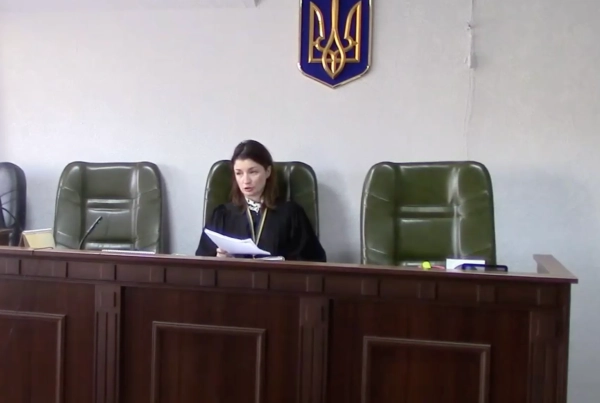
Judge Maybozhenko / Screenshot from the broadcast of the hearing from 09.12.2019 / YouTube channel “Open Court”
Like Dyba, in 2018, Anna Maybozhenko underwent an assessment for suitability for the position she held. In the end, she managed to score 82% out of 100.
$425 per 100 sq m: is land near Kyiv ever this cheap?
All of the above could have remained a forgotten page of history – a story about the times of Yanukovych, the activists and judges of the Maidan, who were never held accountable. And why stir up the past if the assessment recognized Devyatko, Dyba and Maybozhenko as being fit for their positions?
But it's worth keeping this context in mind as you leaf through the declarations of all three judges. And there, right opposite the land plots, are some rather strange numbers.
However, everything is in order.
Judge Vladyslav Devyatko has the right to free use of two land plots, with a total area of almost one and a half hectares, which are located in Khotyanivka near Kyiv and registered in the name of his wife Oksana.
As journalists found out, this land is in the territory of the cottage town “Mizhrichia”, where the price per 100 sq m currently starts at three thousand dollars. That is, almost 15 acres of Devyatka should cost at least 45 thousand dollars in the spring of 2026.
However, in the column “Cost on the date of acquisition…” opposite these plots, Devyatko indicated the amount of 179 thousand hryvnias.
And even considering that the deal took place five years ago, the figure of 12,000 hryvnias per 100 acres – which is about $425 at the then exchange rate – looks unrealistic for 2020.
During the Covid-19 pandemic, land prices near Kyiv increased along with demand.
Prices for land plots for private construction reach 5-6 thousand dollars per hundred square meters at a distance of up to 5 kilometers from the capital (as of 2021, – 24 Channel),
– wrote Pro-Consulting analysts.
According to experts, land in the Vyshhorod district, where Khotyanivka is located, rose in price by 12% in 2020-2021 alone.
There are several possible explanations for why this figure appears in the declaration.
- First, Judge Devyatko indicated not the market value of the land, but its regulatory monetary valuation.
Anton Zelinsky, a lawyer at the DEJURE Foundation, explains: if the contract does not contain an expert – that is, market – valuation of the land, but there is a regulatory and monetary valuation – the declarant has the right to indicate it. This is fully consistent with the position of the National Agency for the Prevention of Corruption.
What is an NGO?
The normative monetary assessment is a tool for calculating land tax, not an indicator of the real market value. It can differ from the market value by several times.
Lawyer and anti-corruption law expert Andriy Mazalov considers this situation problematic:
We have a paradox: a system designed for transparency legally allows this transparency to be circumvented. The declaration turns into a document that records not the real property status of the official, but only what he is formally obliged to show.
However, if the notarial contract already specifies the transaction price, the declarant cannot replace it with a regulatory monetary valuation.
- Second, it is quite possible that 179 thousand hryvnias is indicated in the contract and we are dealing with a decrease in the value of the land.
If that's the case, the question is, how much was actually paid and were there any savings?
According to Devyatko's 2019 tax return, his wife Oksana had no cash savings of her own in dollars – only three thousand hryvnias in bank accounts. The very next year, she received 1.8 million hryvnias from the alienation of property – presumably the sale of an 80-square-meter apartment in Kyiv – and declared $57,500 in cash savings.
And even if this were enough to buy land plots, it would still not be enough to build or buy a cottage, which in “Mizhrichia” costs at least 97 thousand dollars and which, by the way, is listed as a dacha in the declaration of the Nine. Moreover, it is “not put into operation.”
But more about this in the next block.
As for the land of Dyba – Maybozhenko, the story here is the same as with Devyatko. The couple declared the right to free use of a land plot in “Mizhrichcha”, with an area of 8.5 hundred square meters and a value of 86 thousand hryvnias. Officially, the land is registered in the name of Tatyana Dyba – probably Oleksiy's mother. The woman acquired ownership of the land in June 2022, that is, at the beginning of the full-scale invasion, along with a “not put into operation” garden house.
Cottages disguised as unfinished dachas: where do judges live?
In early April 2026, Channel 24 journalists went to Khotyanivka to verify that the facilities that the judges of the Obolonsky District Court indicated in the declarations were indeed “not put into operation.”
At the entrance to the cottage town, you are greeted by a large banner “Mezhrichia” and a barrier that warns that passage is only for the chosen ones: “Attention! Entry to the territory is only possible with a pass.”

Arrival at the cottage town “Mizhrichia” / Photo by Channel 24
Next is smooth asphalt; neat sidewalks paved with cobblestones; neat fences and cottages with decorative elements in the half-timbered style.
Cottage town “Mizhrichia”: video from the Friends Town Development YouTube channel
The street where the Dyba section is located is officially called the “Bavarian Quarter”.
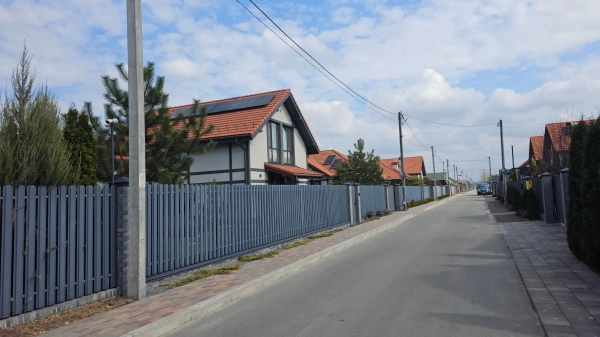
“Bavarian Quarter” in the cottage town “Mizhrichia” / Photo by Channel 24
It is here, behind one of these fences with brick pillars and trimmed thujas, that the land that the judicial couple Oleksiy Dyba and Anna Maybozhenko have the right to use is located.
From the outside, the site is not an “unfinished construction site,” but a fully completed two-story house with a red tiled roof. On the wall are three outdoor air conditioner units. No construction pens or unfinished walls – in general, no signs of active construction.
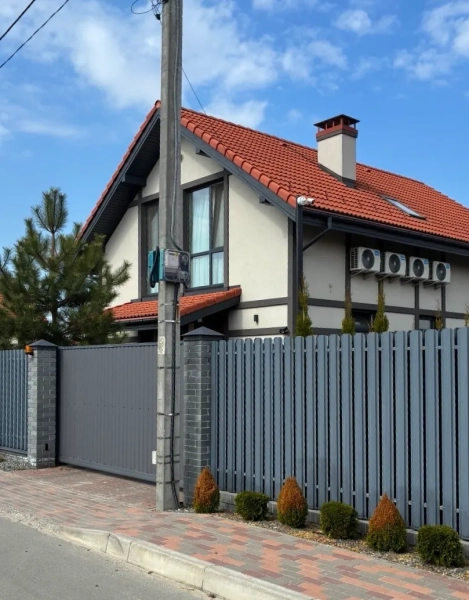
“Unfinished” judge's dacha in Khotyanivka / Photo by Channel 24
So there is reason to speak of a certain discrepancy between what is stated in the judges' declarations and what actually exists.
The situation is similar with the Devyatkovs' “garden house”. The declaration states that it is an unfinished construction site. However, at least satellite images indicate that it is a cottage that has been built for a long time.
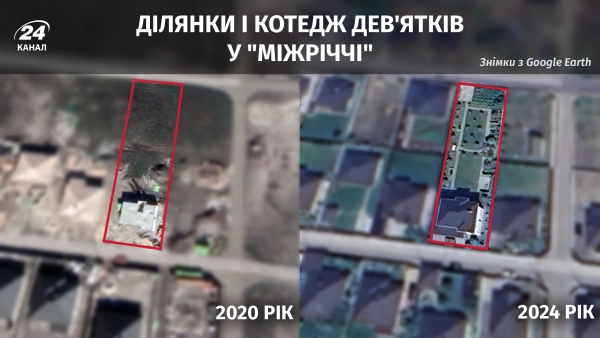
Cottage of the Nines in 2020 and 2024 / 24 Channel / Satellite images from Google Earth
Anti-corruption expert Andriy Mazalov explains the advantage of declaring facilities as “not put into operation”:
Information about the cost of an unfinished construction object is not indicated in the declaration, since declaring such information is not required by law. This means that the building has not been put into operation and its cost does not have to be indicated at all.
That is, until the building is formally “completed,” how much it costs, how much was spent on construction, and where these funds came from remain out of the public's and anti-corruption agencies' sight.
At the same time, Mazalov notes: if it is proven that the object is actually completed, and the declarant did not intentionally change its status precisely in order to hide the cost, this is grounds for bringing to justice. Depending on the extent of the inaccuracy – administrative or criminal.
Administrative liability involves a fine and inclusion in the register of persons who have committed corruption offenses, which effectively makes it impossible to continue a judicial career. Criminal liability involves up to two years of imprisonment.
However, DEJURE lawyer Anton Zelinsky warns that the most difficult thing in such cases is to prove intent. The judge can always say that he “made a mistake.”
Zelinsky also adds: even if the amount of the discrepancy does not reach the threshold of administrative liability, this is still grounds for a disciplinary assessment by the High Council of Justice.
There are questions, but no answers: what next?
So, we have three judges of the Obolonsky District Court of Kyiv – Devyatko, Dyba, and Maybozhenko – with real estate in the same cottage town.
At least two of them have been proven to have tried activists, not been held accountable for it, and are still administering justice.
In addition, as we found out by analyzing the judges' declarations:
First, the land plots are declared at prices that are many times lower than the market price. $425 per 100 sq m: such prices have long been absent and, apparently, will never be again.
Secondly, the “dachas” are listed as “not put into operation”, although according to external signs and satellite images, these are fully built cottages. We were in Khotyanivka – we saw it with our own eyes.
And the key point: where did the money for these elite cottages come from? The declarations do not exhaustively answer the relevant question. And the judges themselves remain silent, no matter how many times we ask them for comments.
In fact, during the preparation of the material, investigators repeatedly wrote and called Devyatka, Dyba, and Maybozhenko regarding their actual place of residence, “not put into operation” dachas, and savings. There was no response, no one ever answered the calls, although one of the messages received the “read” status.
Channel 24 journalists plan to contact the National Agency for Corruption Prevention with a request to conduct a full audit of the declarations of judges Devyatko, Dyba, and Maybozhenko, as well as monitor their lifestyle.