
Main points
- A ninth-century manuscript containing one of the oldest copies of the “Hymn of Caedmon” has been found in Italy's National Central Library in Rome.
- The manuscript, identified by researchers in Dublin, had been thought lost since 1975 and is important for the study of early English literature.
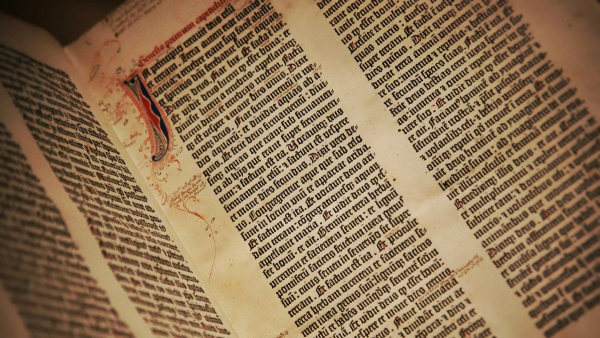
The Mystery of Bede's Manuscript: How Digitization Helped Find the Earliest English Poetry in Rome / Unsplash
For decades, scholars considered the document lost to science forever. Its complicated history, full of thefts and mysterious disappearances, has confused the trail so much that even the directors of leading book depositories have denied its existence. However, modern technology has revealed a completely different picture.
Why is the discovery of this particular manuscript a real sensation?
A real detective story in the world of medieval studies has unfolded around a manuscript that was thought to be lost since 1975. Researchers from Trinity College Dublin, Dr. Elisabetta Magnanti and Dr. Mark Faulkner, have identified a copy of the “Ecclesiastical History of the English People” (Historia ecclesiastica gentis Anglorum) by the monk Bede the Venerable in the National Central Library of Rome. This document, dated to the first third of the ninth century (approximately 800-830), contains one of the oldest copies of the “Hymn of Caedmon” – the first known poem in the English language, writes SciTechDaily.
The find, codenamed Vitt. Em. 1452, is extremely important for several reasons:
- First, this is the third oldest known version of the poem.
- Secondly, it is the oldest example of the so-called Northumbrian “eordu” edition, which significantly predates the previous record holder, a twelfth-century manuscript from Dijon.
- Furthermore, this is the first time that the Old English text of a hymn is embedded directly into Bede's main Latin text, rather than being written in the margins or at the end of the book.
I had come across conflicting references to Bede's “History” in Rome, some suggesting it existed and some suggesting it had been lost. When the library confirmed the document's existence and digitized it for us, we were extremely excited to discover that the manuscript contained an Old English version of the Hymn of Caedmon embedded in the Latin text,
– commented Dr. Elisabetta Magnanti, a specialist in medieval manuscripts.
She added: “The magic of digitisation has allowed two researchers in Ireland to recognise the significance of a manuscript now in Rome containing a poem beautifully composed in Northern England by a shy shepherd 1,500 years ago. This discovery is a testament to the ability of libraries to facilitate new research by digitising their collections and making them freely available online.”
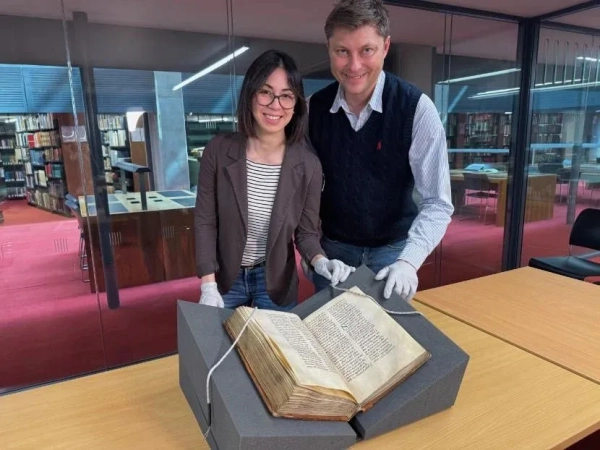
Dr. Manyanti and Dr. Faulkner with a copy of “Church History” / Photo by Trinity College Dublin
What is known about the manuscript?
The manuscript's story is reminiscent of an adventure novel. It was created in the Benedictine Abbey of St. Sylvester in Nonantola, northern Italy. In the seventeenth century, the codex passed to the Cistercian monastery of Santa Croce in Jerusalem in Rome.
During the Napoleonic Wars, in the 1810s, it was moved to the Vatican Library for safety, and then to the monastery of San Bernardo alle Terme. It was from there that the manuscript was stolen before 1821 and fell into private hands.
The document changed several owners, including the famous collector Sir Thomas Phillipps, and only in 1972 did it return to Italian state ownership.
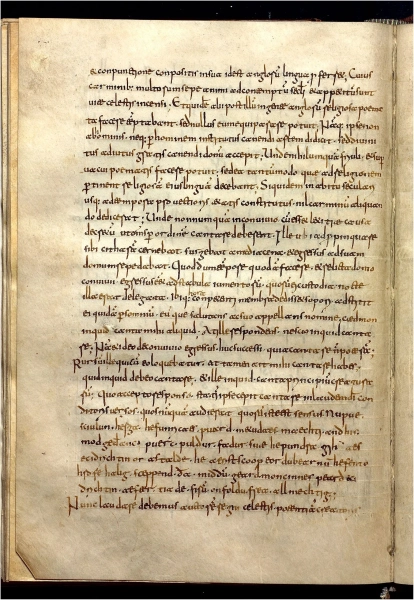
The page on which the hymn of Caedmon was recorded / Photo by National Central Library
The value of the document is incredible.
Dr. Mark Faulkner also emphasizes the importance of the find:
In total, about 3 million words of Old English have survived, but the vast majority of texts date from the tenth and eleventh centuries. The Caedmon Hymn is almost unique as a seventh-century survivor – it connects us to the earliest stages of written English. As the earliest known poem in Old English, it is now celebrated as the beginning of English literature,
– said the scientist.
He said that the fact that the original poem was re-inserted into Latin within 100 years of Bede's completion of his work testifies to the high value of English poetry for early readers.
A feature of the Roman script is its unique punctuation. The text of the hymn contains interpuncts – dots between words – which are almost never found in Old English manuscripts. This may be a remnant of an even older tradition or the influence of epigraphy – inscriptions on stone.
Philological analysis shows that the text retains features of the early Northumbrian dialect, but with some signs of Mercian influence, according to a study published in the journal Early Medieval England and its Neighbours, published by the University of Cambridge.
The discoveries are probably not yet complete.
Valentina Longo, curator of medieval and modern manuscripts at the National Central Library of Rome, noted: “Today, the National Central Library of Rome owns the largest collection of early medieval codices from the Benedictine Abbey of Nonantola. This collection includes 45 manuscripts dating from the sixth to the twelfth centuries. The entire Nonantola collection has been fully digitized and is available through the library's website.”
Andrea Cappa, head of the manuscripts room, adds that the library has already provided access to digital copies of about 500 manuscripts and is completing a project to digitize the microfilms of another 110,000 documents.
You may also be interested in: What do we know about Old English and can modern people understand it?
Old English existed from about the 5th to the 11th century. It was spoken by the Anglo-Saxon tribes after they migrated to Britain. For a modern person who knows English, this language is almost incomprehensible. It resembles a mixture of Germanic languages more than modern English. For example, the famous beginning of the epic poem “Beowulf” sounds like this: “Hwæt! We Gardena in geardagum”. Most modern English speakers will not be able to understand this text without special training.
Old English was very different in grammar. It had cases, gender, and a complex system of endings similar to modern German or Icelandic. Words changed depending on their role in a sentence. It also contained many letters that are no longer used today, including “þ” and “ð”, which represented the “th” sound. Much of the vocabulary came from Germanic roots, with minimal Latin and French influences.
The situation changed dramatically after the Norman conquest of England in 1066. The French language of the Norman elite began to actively penetrate English. It was then that Middle English was formed, which was already gradually approaching modern English. Old English texts have survived today only in a relatively small number of manuscripts, since most documents of that time did not survive wars, fires and destruction, writes Cambridge University Library.
How did monks copy books in the Middle Ages without printing presses?
In the Middle Ages, books were created by hand. Before the advent of the printing press, each copy had to be copied separately. The main centers of book production were monasteries. They had special rooms called scriptoria, where scribes, artists, and manuscript compilers worked.
Work on a book could last for months or even years. The text was applied with goose feathers to parchment made of animal skin. Particularly valuable books were decorated with colored initials, ornaments and miniatures. For this, natural pigments, gold and silver were used. The most luxurious manuscripts were created for churches, monasteries and royal courts.
Popular culture often depicts a single monk sitting in a dark room copying text by candlelight. In reality, the process was more complex. Entire teams worked on large manuscripts. Some prepared the parchment, others wrote the text, and still others created illustrations and decorative elements. In the late Middle Ages, secular workshops and professional copyists began to play an increasingly important role, Quod notes.
Medieval manuscripts had distinctive features. Abbreviations were widely used in texts to save space on expensive parchment. Many books were written in two columns. The Gothic style of writing Textura was popular – a very dense and decorative font that is difficult to read today without special training, writes Chaucer.
How to digitize antiques
Today, ancient manuscripts and archives are being actively digitized. This process has become one of the largest cultural and scientific projects of the 21st century. Libraries, museums and universities around the world are scanning manuscripts in high resolution, creating digital catalogs and making materials publicly available. For example, the British Library, the University of Cambridge and the Parker Library have already digitized thousands of medieval documents, according to the Cornell Guides library.
The digitization process is very complex. Ancient documents are often damaged, faded, or written in almost illegible handwriting. Special scanners are used for the work, which do not damage the fragile parchment. Sometimes multispectral imaging is used – a technology that allows you to see text invisible to the human eye. Such methods help to read erased records, hidden layers of ink, and palimpsests, where old text has been erased and new text has been written over it.
In recent years, artificial intelligence has been actively involved in the work. Systems are being trained to recognize medieval handwriting. This allows them to automatically decipher thousands of pages of manuscripts, which previously required decades of manual work by specialists, explains the study in arXiv. Researchers are already using machine learning to analyze Latin and Germanic manuscripts, identify the authors of texts and even search for features of the handwriting of individual scribes.