
Main points
- The largest Ukrainian mobile operators raised tariffs, which caused dissatisfaction among subscribers.
- The main reason for the increase in tariffs is the increase in costs for supporting mobile communications during war and energy crises.

Mobile operators simultaneously raised mobile tariffs / Shutterstock
At the beginning of 2026, the largest mobile operators of Ukraine – Kyivstar, Vodafone and lifecell – almost simultaneously revised the cost of their tariffs. On average, prices increased by 40-100 hryvnias, and in some packages the increase reached a third of the previous cost.
Why have mobile tariffs increased in price?
Such a synchronous increase caused a wave of discontent among subscribers and even talk of a possible conspiracy between operators. However, experts explain: the main reason is the sharp increase in costs for supporting mobile communications during the war and energy crises, writes OBOZ.
According to telecom analysts, operators are now spending huge amounts of money on:
- generators and fuel;
- batteries for base stations;
- data center support;
- backup power;
- equipment repair and maintenance;
- payment for more expensive electricity.
The number of hours of blackouts has increased – therefore, mobile operators need to install batteries in base stations, on towers, on other equipment. So, is there a reason to raise tariffs now? Yes. It's called “energy independence”,
– explained telecom analyst Oleksandr Glushchenko.
Electronic communications specialist Anatoly Frolenkov added that operators are spending huge amounts of fuel on generators.
One of the operators previously noted that the average support of base stations cost about 100 thousand liters of fuel per month. And during the winter period, it increased to 700 thousand. I think that when there were these severe frosts and severe blackouts, there was even more. Just imagine the tankers, a train of tankers of fuel that just burns to nowhere,
– the expert noted.
In addition to the costs of generators, operators have also faced other problems – rising prices for electricity, batteries, equipment and logistics. Companies also have to invest not only in towers or base stations, but also in supporting the entire telecom infrastructure: data centers, backbones and international data channels.
Was there collusion between the operators?
Despite the simultaneous increase in tariffs, experts see no signs of collusion between Kyivstar, Vodafone, and lifecell. The reason for the synchronicity is simple – all operators operate under approximately the same conditions:
- electricity costs are increasing;
- fuel is getting more expensive;
- the load on the network increases;
- Telecom equipment is becoming more expensive.
Experts also criticize mobile operators for poor communication with customers. Information about new tariffs is often hidden in the descriptions of tariff packages, comes via SMS, which people ignore, and is almost never published on social networks. Because of this, many users find out about new prices only after the funds have been debited.
Note! The Ukrainian mobile market is entering a period of constant price increases for services. The reason is not only inflation, but also the enormous costs of supporting networks during the war. At the same time, operators are still losing in communication with customers: people are willing to pay more for stable communication, but they want honest explanations and clear rules of the game.
What do Kyivstar and Vodafone say about the cost of tariffs?
Mobile tariffs are regularly increasing, and telecom companies are “hunting” for subscribers who want to switch from their operator to another with lower tariffs. 24 Channel asked Oleksandr Komarov how the price increase affects the customer base and what subscribers can expect in the coming months.
Alexander Komarov
CEO of Kyivstar
Tariffs will increase. It's very simple – the country has double-digit official inflation. We are a subject of this country's economy.
Komarov names two key factors that put pressure on the economics of any business.
The first is inflation.
- In a number of expense items that are critical for the operator, the real growth significantly exceeds the official 12%.
- During peak load periods – mornings and evenings – commercial electricity prices have increased by about 60% over the past year.
- Payments for radio frequency spectrum increased by 23%, and labor costs also increased by more than 20%.
The second is devaluation.
- According to Komarov, the hryvnia exchange rate has fallen by 6-7% year-on-year. This is even better than the pessimistic figures the company had budgeted, but it still creates additional pressure.
- The company reinvests approximately 30% of its revenue into the network, and the lion's share of these investments is in foreign currency: batteries, generators, radio equipment, licensed software (Ericsson, Nokia, etc.) are not purchased for hryvnia. Rather, “pillars and part of services” remain in the national currency.
Vodafone CEO Olga Ustinova explained how the price is formed and why it is unlikely to be significantly lower, OBOZ writes.
The authorities understand responsibility and that it is critical for people. Let's look at the numbers: a tariff of 400 hryvnias per month is the price of three or four cups of coffee in Kyiv. For this money, we provide a lot of services for a whole month: an incredible amount of traffic, unlimited voice, the ability to use the “Roaming like at home” service abroad without additional fees,
– says Ustinova.
According to her, Vodafone's business really remains profitable. The margin level reaches about 50%. However, a significant part of these funds does not remain “net earnings”. More than a third – more than 33% – the company is forced to constantly invest in supporting and developing the network.
If we didn't earn from tariffs, we wouldn't be able to buy generators… We buy all base stations and equipment in dollars because there are no local suppliers. When the exchange rate or the cost of electricity increases, our costs skyrocket,
– explained Ustinova.
In fact, we are talking about constant costs for equipment, which depends on the exchange rate, as well as for energy supply – especially critical during power outages. The company also emphasizes that current tariffs are not just a desire to earn more, but the need to ensure stable communication, in particular during blackouts.
What are the mobile phone tariffs in Ukraine and Europe?
Market participants explain that this is not only a commercial decision, but also an issue of infrastructure stability in conditions of war and economic pressure. According to economist and telecom market expert Anatoly Amelin, Ukrainian mobile communications today demonstrate a quality that often exceeds the performance of European and even American operators.

Anatoly Amelin
Telecom market expert
Ukrainian mobile Internet and communication are head and shoulders above European and even more so American! Seriously. In Berlin, I caught 4G intermittently. In the city center! In Washington, the speed sometimes made me nervously refresh the page.
However, the low price also has a downside. Over the past two years, Ukrainian operators have been forced to invest significantly in the energy independence of the network and its restoration after shelling.
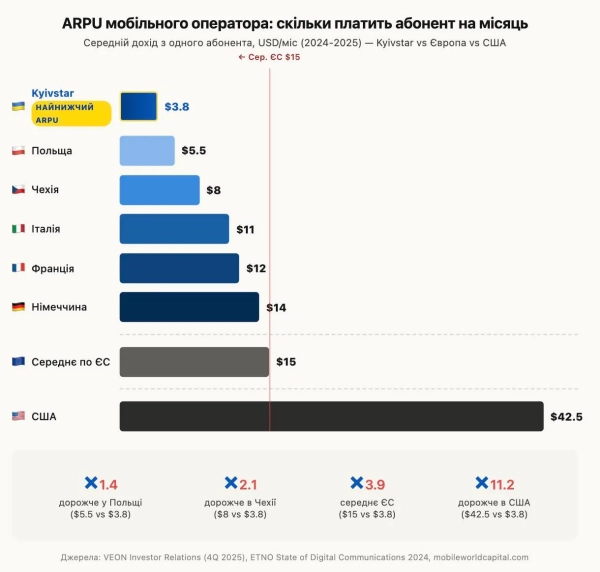
Mobile communication prices in different countries / Infographics from Anatoly Amelin's Facebook
What Ukrainian operators have built over the past two years has no analogues in the world. Nowhere. Not in any country(!): 100% of base stations – with batteries… at least 25% of stations in each region – with generators for 72 hours,
– explains Ameline.
In general, the market is talking about billions of dollars in expenses, including the purchase of thousands of generators and hundreds of thousands of batteries.