
Main points
- Scientists have discovered that thunderclouds can emit gamma radiation similar to that produced during cosmic catastrophes.
- NASA's ALOFT mission confirmed that relativistic particle avalanches can occur inside thunderstorms, which may explain the mechanism of lightning.
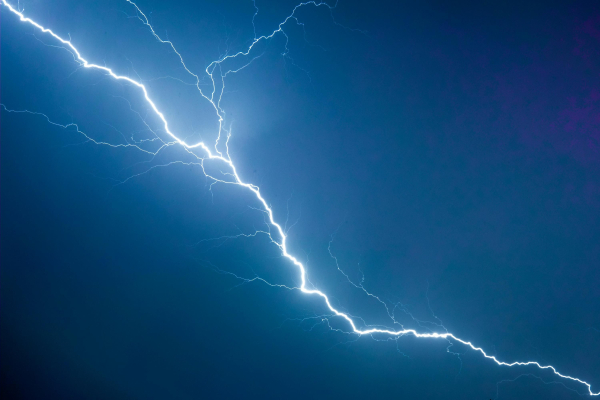
Lightning turns out to be more mysterious than physicists thought – stars may be involved / Unsplash / Michał Mancewicz
Physicists have spent decades trying to understand exactly how lightning is created, but new experiments have shown that processes that are more like cosmic catastrophes than ordinary electricity may be occurring inside thunderclouds.
Lightning has accompanied humanity for millennia. The ancient Greeks considered them weapons of the gods, in Scandinavian mythology they were associated with Thor, and in China thunder was associated with divine punishment. However, even modern science still does not have a complete explanation of how lightning occurs. This is written by Quanta magazine .
Why is lightning still a mystery?
For a long time, physicists thought the mechanism was well understood. Scientists have linked lightning to electricity since Benjamin Franklin's famous experiment in 1752. The process in a thundercloud was thought to work in much the same way as an electric spark between two metal balls in a laboratory—only on a much larger scale.
When the electric field becomes strong enough , it begins to pull electrons out of the air atoms. An avalanche of charged particles occurs, the air heats up and turns into a plasma channel, which we see as lightning.
Physicists have calculated that for such a breakdown of air, a field strength of approximately: E≈3×10⁶ V/m is required.
However, in the mid-20th century, researchers began launching rockets, balloons, and other devices into thunderstorm clouds and discovered a problem. The actual electric fields in the clouds turned out to be much weaker than the required threshold. A typical thunderstorm has only about a tenth of the required field strength.
This created a fundamental mystery: if the conditions for lightning to occur are not sufficient, why does it occur at all?
How are thunderstorms linked to gamma radiation?
The situation changed dramatically in 1994 , when a NASA satellite designed to monitor cosmic explosions suddenly detected gamma-ray bursts coming directly from thunderclouds.
Gamma-ray bursts are usually associated with supernovae, neutron stars or black holes. Seeing them in a typical Earthly thunderstorm was unexpected.
That's when astrophysicist Joseph Dwyer, who had previously studied solar flares with NASA's Wind satellite, noticed lightning in Florida . He says that one day, “there was a boom, boom, boom” outside his window, and he realized that lightning was actually an unsolved scientific problem.
Dwyer turned to the theory of ” relativistic electrons ,” previously proposed by Nobel laureate Charles Wilson. The idea is that electrons traveling at nearly the speed of light can experience virtually no air resistance and begin to accelerate uncontrollably.
Later, Russian physicist Aleksandr Gurevich suggested that such “runaway” electrons could create cascades of particles hundreds or even thousands of meters long.
What happens inside a storm cloud?
According to Dwyer's theory, a real subatomic avalanche is launched inside storm clouds.
A single high-energy electron collides with an air atom and emits a gamma ray. This in turn can produce an electron and a positron, the electron's antiparticle. The cloud's electric field accelerates these particles, triggering new cascades.
The result is a chain reaction that dramatically intensifies the electric field inside the thunderstorm. Dwyer himself compared the process to a microphone next to a speaker: “Everything gets extremely loud very quickly.” Computer simulations have shown that such a model can explain both gamma-ray bursts and the growth of the electric field to the level necessary for lightning to occur.
What did NASA's ALOFT mission show?
The real breakthrough came in 2023 during NASA's ALOFT mission . Researchers mounted gamma-ray detectors on an ER-2 high-altitude aircraft and began flying directly over powerful tropical thunderstorms in the Caribbean, Gulf of Mexico, and Central America.
The results were unexpected.
The storm clouds literally glowed with gamma rays . In addition to the large flares, the researchers detected faint flickers that were previously invisible to satellites.
What was particularly important was that the nature of these flashes matched Dwyer's computer models almost exactly, providing some of the strongest evidence yet that relativistic particle avalanches do indeed occur inside thunderstorms.
Atmospheric physicist Caitano da Silva said : “There is a growing consensus in the scientific community that high-energy processes play a critical role in triggering lightning.”
Can lightning release cosmic rays?
Despite the success of the new theory, physicists still don't have a definitive answer . In 2025, researcher Xuan-Min Shao recorded a strange feature of lightning in the New Mexico desert. Analysis of radio waves showed that the initial direction of lightning development sometimes does not coincide with the direction of the electric field in the cloud.
This could indicate an external influence. One of the most daring hypotheses suggests that lightning could be triggered by cosmic rays – streams of particles that arise during supernova explosions, black hole activity or other catastrophic events in the universe.
When such a particle hits the Earth's atmosphere , it creates a cascade of electrons and positrons that could potentially trigger lightning even in a weak electric field. Physicist David Smith called the data “extremely compelling.” However, other researchers caution against jumping to conclusions because the mechanism is not yet fully understood. Dwyer himself said that if this theory is confirmed, “every lightning bolt will be physically linked to a dying star somewhere in the galaxy.”
Why is the mystery of lightning still far from being solved?
Despite decades of research, lightning is only getting more mysterious . New radio telescopes in the Netherlands have already shown that individual branches of lightning move at different speeds, form strange “needles” and behave differently than classical models predict.
Physicists are increasingly inclined to believe that lightning does not have one universal mechanism of occurrence. Different processes may be at work in different thunderstorms – from ice crystals to cascades of relativistic particles and cosmic rays. And the closer science gets to the answer, the more complicated the mystery itself becomes.