
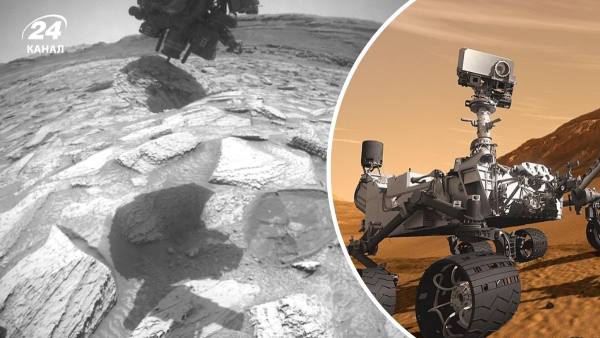
Martian rock “attacked” Curiosity rover / Channel 24 collage / NASA photo
The Curiosity rover encountered an unusual problem while drilling into rock on Mars. What was a routine operation suddenly turned into a complex technical challenge that NASA's team spent days solving.
NASA's Curiosity rover was drilling into Martian rock on Saturday, April 25, 2026. The rover was attempting to take a sample of the rock, which the mission team has dubbed “Atacama.” It was during the robotic arm's return from drilling that an unexpected problem occurred, NASA says.
What happened to the Curiosity rover?
The rock fragment didn't just break off from the surface, but completely hung on the protective sleeve around the drill. According to engineers, in the past, the upper layers of rock could indeed separate during drilling, but this has never happened in the entire history of Curiosity's work .
The situation was complicated by the size of the fragment. The stone weighed about 13 kilograms , was about 15 centimeters thick and about 45 centimeters long. For terrestrial conditions this might seem like a trifle, but on Mars, where all actions are performed remotely with signal delays, even such a problem turns into a complex engineering operation.
The mission team tried to free the drill from the rock. First, they used vibration to loosen the drill bit . The mission team hoped that the vibrations would help dislodge the rock, but the rock remained in place.
Then, on April 29, engineers repositioned the robotic arm and repeated the procedure. This time, only the dust was removed, leaving the fragment firmly attached to the storm.
How was it possible to “liberate” the Boer?
The final solution was found only on May 1. NASA specialists tilted the drill more strongly and simultaneously activated several mechanisms – rotation of the manipulator, vibration and launch of the drill itself . The result was unexpectedly fast: the stone fell off during the first attempt and split after falling to the surface of Mars.
The entire operation was monitored by the team using black-and-white security cameras mounted on the rover's chassis, as well as navigation cameras on the vehicle's mast. Despite the unusual situation, the mission managed to avoid damage to the equipment and continue the rover's work.
How NASA saved the Curiosity rover from an “attack” by a Martian rock – watch the video:
How does the Curiosity drill work and how is this drilling different from terrestrial drilling?
NASA's Curiosity rover's drill is part of a complex sample collection system described in a paper published on ScienceDirect. The tool is mounted on the rover's robotic arm, and its main task is not just to drill holes in rock, but to obtain powdered material from the inner layers of rocks for further analysis in the onboard SAM and CheMin laboratories. They are what help scientists study the chemistry of Mars and search for traces of ancient conditions suitable for life.
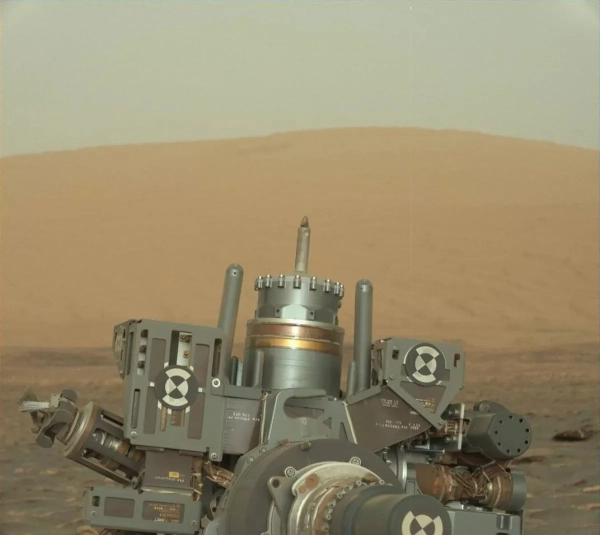
This is what the Curiosity rover looks like / NASA photo
Unlike conventional Earth-based drilling, Curiosity operates almost entirely autonomously, NASA explains. NASA engineers can't make real-time adjustments to the rover's movements due to signal delays between Earth and Mars. So the rover is equipped with a system of sensors that essentially give it a “sense of touch.”
During drilling, the system monitors the load on the tool and independently adjusts the movements of the robotic arm to avoid jamming or excessive pressure on the mechanism.
Another unique feature is the design of the drill itself. Inside the protective sleeve is a screw mechanism that transports the crushed material upwards into a special collection chamber, The Planetary Society reports. The samples are then sieved and fed to scientific instruments inside the rover.
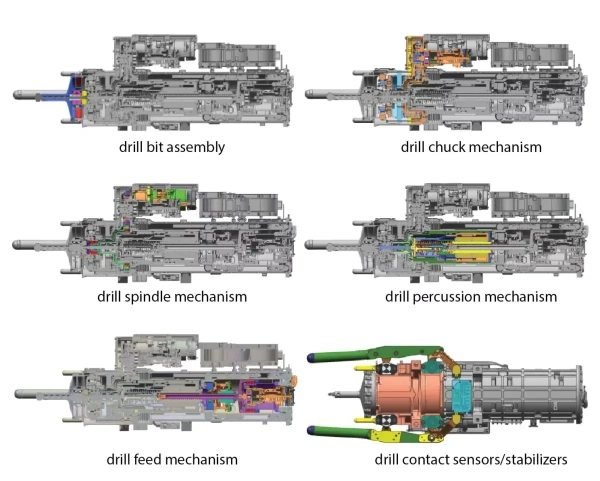
Design of the Curiosity rover's drill / Photo by The Planetary Society
The extreme conditions on Mars make even simple drilling a complex engineering operation. Low gravity, dust, temperature extremes, and the inability to physically repair in situ force NASA to use much more cautious algorithms than when drilling on Earth.
What risks do such incidents pose to missions to Mars?
Problems with the drill could be mission-critical . For Curiosity, drilling is one of the main ways to obtain scientific data. If the mechanism completely fails, the rover will lose the ability to explore the inner layers of Martian rock, where the most valuable traces of the planet's past may be preserved.
Similar incidents have happened before. In late 2016, the Curiosity rover's drill feed mechanism began to malfunction, effectively halting NASA's drilling for nearly a year and a half. Engineers had to develop new methods of operation during the mission, testing them remotely.
The risks aren't just about losing scientific capabilities. A malfunctioning drill could damage the rover's robotic arm or even its electronics. Back in 2012, experts warned in a Space.com article that a serious mechanical failure could potentially jeopardize the entire mission.
Space missions in general have a very high level of risk. According to a study of the history of Mars programs published on arxiv.org, a significant proportion of the vehicles sent to Mars over the past few decades have encountered partial or complete failures due to technical malfunctions, software errors, or difficult operating conditions.
How do decisions get made tens of millions of kilometers away?
The way Mars rovers are controlled is not at all the same as it is often shown in the movies. Due to the vast distance between Earth and Mars, a one-way signal can take anywhere from 4 to 24 minutes, depending on the position of the planets , ESA explains.
The average delay is about 12-13 minutes. This means that direct “manual” control of Curiosity is not possible.
In practice, NASA engineers work according to the principle of “command – wait – analyze”. First, the team on Earth analyzes telemetry and photos, and then forms a package of commands for the next Martian day. Only after receiving the response does it become clear whether the intended scenario worked.
That's why the story of the stuck rock turned into a real technical quest. Each attempt to shake off the fragment required separate planning, risk assessment, and several cycles of waiting for signals from Mars.
However, this feature is currently being addressed by specialists. In recent years, NASA has been actively developing the autonomy of Mars rovers. For example, in 2025, the Perseverance rover for the first time carried out a route planned by artificial intelligence without detailed manual control from Earth. Such technologies allow the vehicles to respond faster to dangers and work more efficiently in conditions of huge communication delays.