
Main points
- Metalenz introduced Polar ID technology, which allows for facial recognition without visible sensors thanks to optical metasurfaces.
- Polar ID promises to appear in smartphones and laptops by 2027, providing a high level of security without visible elements on the display.

This technology could make Android better than Apple / Depositphotos
The idea of a completely “clean” Android display – without notch – is getting closer to reality. New facial recognition technology promises to make facial recognition invisible – while maintaining a high level of security.
American company Metalenz has introduced a facial recognition system Polar ID , which could radically change the design of modern smartphones, writes Wired. Its main feature is the ability to hide most of the hardware components under the OLED display, getting rid of cutouts, “bangs” and holes.
How does invisible facial recognition work and when can we expect it?
The technology is based on optical metasurfaces , flat lenses with nanostructures that can manipulate light and direct it to sensors. Thanks to this, Polar ID uses a much more compact module than traditional facial recognition systems, including those such as Apple's Face ID.
The key element is light polarization analysis . The system doesn't just “see” a face, but determines how light reflects off its surface. This allows it to accurately distinguish a real person from fakes – for example, silicone masks or 3D models. This approach provides a level of security comparable to Apple's solution, but without the need for visible sensors.
Another important advantage is working in the dark . Unlike camera systems used, for example, in the Google Pixel, the new technology does not depend on lighting and provides stable recognition in all conditions.
How exactly does everything work?
Despite the fact that the sensors are hidden under the display, this has almost no impact on accuracy. In demonstrations, the difference in data collection quality between the open and “camouflaged” module was minimal.
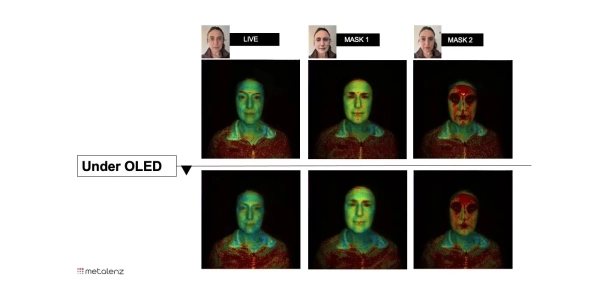
PolarID demonstrated excellent results during testing / Photo metalenz
This significantly distinguishes Polar ID from under-screen front cameras, which are already used, for example, in the Samsung Galaxy Z Fold, but suffer from a noticeable loss of image quality.
To integrate the technology into the display, it is only necessary to make a certain area of the OLED panel thinner. No other major changes to the design are expected.
When will this be available on smartphones?
The company has been working with Qualcomm for several years, and now the technology is actually ready for commercial launch. According to preliminary plans, the first devices with Polar ID could appear in 2027 – these will be smartphones and laptops. A full-fledged under-screen implementation is expected around 2028.
At the same time, the appearance of this development comes against the backdrop of delays at Google, which is also working on its own under-screen facial recognition system. An internal project called Project Toscana was planned for the Pixel 11, but according to the latest data, the company will not have time to implement this technology in the new generation of devices, writes 9to5google.
What is Project Toscana?
Project Toscana is the codename for Google's own next-generation facial recognition technology. It's seen as a major upgrade to Face Unlock for Pixel smartphones and even Chromebooks.
It is known that the system has already been tested on prototype devices – both on smartphones with a classic hole for the front camera, and on laptops, writes Privacy Guides. Test participants note that it works as fast as Face ID, and functions stably in various lighting conditions, including darkness.
The main difference between Project Toscana and Google's current solutions is the transition from a regular camera to full 3D biometrics. According to preliminary data, the technology uses infrared sensors, which allows you to create a three-dimensional face map and significantly increases the level of security, explains Android Authority.
This isn't Google's first attempt at a similar approach. Back in the Pixel 4, the company used a complex system of infrared cameras and sensors, but later abandoned it. Now Project Toscana essentially brings back the idea, but in a more compact form – without large cutouts in the display.
Will it be possible to surpass Apple?
Apple set a high standard for security with Face ID, but at the cost of a noticeable display. Meanwhile, most Android smartphones rely on either under-screen fingerprint scanners or less secure 2D recognition via the front camera.
Against this background, Polar ID looks like a compromise that has been missing for a long time: high security without compromising design. The same could be said about Project Toscana, but it is probably difficult to say for now.
If any of these technologies live up to expectations, it could set a new standard for the entire industry, and Apple would lose one of the important advantages of its devices.