
Main points
- The object (612533) 2002 XV93 on the outskirts of the Solar System has an atmosphere, although it is too small for it according to classical models.
- Astronomers are considering the possibility that the atmosphere was formed by a cometary collision or cryovolcanoes.
A small object on the outskirts of the solar system seems to defy the laws of physics / Freepik
Far beyond the orbit of Neptune, astronomers have discovered something that defies classical models of planetary science. An object that seemed too small to contain gases has shown evidence of its own atmospheric envelope. This is forcing scientists to reconsider the evolutionary history of distant worlds in our solar system.
Why is a discovery in the Kuiper Belt considered impossible?
Deep in space, beyond the orbit of Neptune, astronomers have discovered a tiny world that challenges our understanding of celestial bodies. The mysterious object, officially known as (612533) 2002 XV93, is only about 500 kilometers across. From an astrophysical perspective, it is too small for its weak gravity to hold on to an atmosphere for long, but observations suggest otherwise, according to a study published in Nature Astronomy.
Object 2002 XV93 belongs to the class of plutinos – small bodies that move in an orbit similar to that of Pluto. It is in resonance with Neptune and is located at a distance that is 40 times greater than the distance from Earth to the Sun.
At the time of the study, this “cosmic snowball” was more than 5.5 billion kilometers away. Such objects are considered a kind of fossil record of the early Solar System, as they preserve information about its original composition.
Such objects are notoriously difficult to study due to their remoteness and low reflectivity. However, in January 2024, a team of astronomers led by Ko Arimatsu of the National Astronomical Observatory of Japan (NAOJ) got lucky. They observed a rare phenomenon called a stellar occultation, when object 2002 XV93 passed directly in front of a distant star, momentarily obscuring its light.
The observations were made from three different locations in Japan. If this were just a bare rock, the star's light would disappear instantly and reappear just as abruptly. Instead, the scientists recorded a gradual fading and return of the light over a period of about 1.5 seconds before and after the star's total occlusion.
Comparison of coverage with and without atmosphere: watch the video
These data are consistent with the attenuation of light through the atmosphere,
– the researchers note in the article.
Scientists estimate that the atmosphere of 2002 XV93 is 5 to 10 million times thinner than Earth's and 50 to 100 times thinner than Pluto's. It is likely composed of methane, nitrogen, or carbon monoxide. The most striking thing is that such a thin shell should disappear in a few hundred to a thousand years. This means that it either just formed or is constantly replenished.
This discovery suggests that the traditional view that global dense atmospheres form only around large planets needs to be revised,
– commented Ko Arimatsu.
He adds that the finding was “really unexpected” and challenges the theory that atmospheres are the prerogative of only giant planets, dwarf planets or large moons.
Where does the atmosphere come from?
Scientists are currently considering two main scenarios:
- The first is a collision with a comet, which released gas, creating a temporary atmosphere.
- The second is the presence of active cryovolcanoes that emit volatile substances from the interior of the object.
Alan Stern, lead scientist for NASA's New Horizons mission, who was not involved in the study, said: “This is a remarkable event, but it is in dire need of independent verification. The implications are profound if confirmed.”
In the future, the James Webb Space Telescope will help to verify the composition of this mysterious shell. Although, as Phys.org writes, the telescope has previously observed this object and did not detect gases on it, it seems that new observations are needed.
You will also be interested to know: what is the Kuiper Belt?
The Kuiper Belt is a vast region in our Solar System beyond the orbit of Neptune. It is similar to the main asteroid belt, but much larger: tens of times wider and hundreds of times more massive. This space is filled with the remnants of material that formed during the formation of the planets about 4.5 billion years ago.
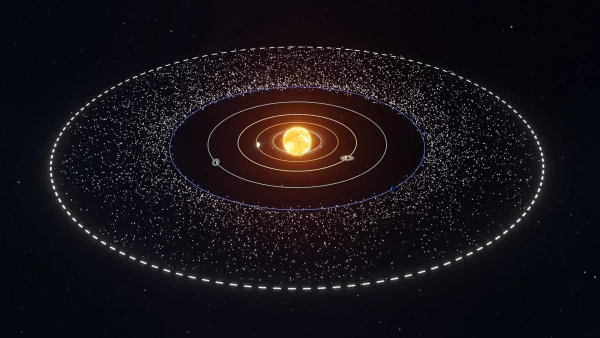
Kuiper Belt / Photo by Vito Technology
Unlike the asteroid belt, which is mostly made of rocks and metals, most objects in the Kuiper belt are icy bodies. They contain frozen water, ammonia, methane, and other compounds. This is where many short-period comets come from, which occasionally come close to the Sun.
The most famous inhabitant of this region is Pluto, once considered the ninth planet but now classified as a dwarf planet. In addition to it, the Kuiper Belt contains hundreds of thousands of other objects, as well as millions of tiny icy fragments. Studying this zone helps scientists better understand the early stages of the development of our solar system.