
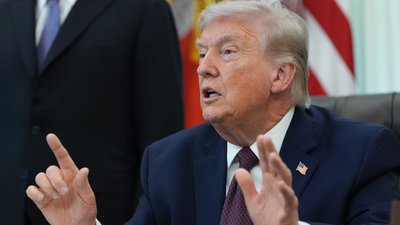
US President Donald Trump has announced a temporary pause in Operation Project Freedom, an initiative to navigate ships through the Strait of Hormuz. He said the decision was made at the request of Pakistan and other countries due to progress in negotiations with Iran. The naval blockade of Iranian ports remains in effect.
Trump wrote about this on May 6 on the social network Truth Social.
As Trump noted, the reasons for the decision were requests from Pakistan and other countries, military successes in the campaign against Iran, as well as “significant progress” in negotiations on a full and final agreement.
“We have mutually agreed that while the blockade will remain in full force and effect, Project Freedom (the movement of vessels through the Strait of Hormuz) will be suspended for a short period of time to see if an agreement can be finalized and signed,” he wrote.
Trump did not provide details about the terms of a possible agreement, its participants, or the duration of the pause.
Project Freedom is a U.S. operation to ferry commercial ships through the Strait of Hormuz, which has been blocked by Iran. Trump announced the operation on May 3, and the next day, American destroyers began escorting ships through the strait.
On the first day of the operation, two American-flagged ships passed through the Strait of Hormuz under US protection. According to the International Maritime Organization, about 2,000 ships remain blocked in the Gulf, with up to 20,000 sailors on board.
Negotiations between the US and Iran and Trump's blockade of the Strait of Hormuz
On April 11, trilateral talks between the United States and Iran were held in the Pakistani capital, Islamabad, mediated by Pakistan. Following the talks, Vice President Vance said that the parties had failed to reach an agreement on a lasting end to the war. The Iranian Foreign Ministry said at the time that this had been hindered by disagreements on “two or three key issues.”
Trump then announced that the US Navy would begin a blockade of the Strait of Hormuz on April 13 due to the failure of negotiations with Iran to agree on giving up its nuclear weapons. He said that the US military would intercept all ships that had paid Iran a toll to pass through the strait.
He also warned Iran that if its military began attacking American warships, the US Navy would “send the Iranians to hell.”
On April 18, Iran announced that it was restoring “strict control” over the Strait of Hormuz in response to the US naval blockade.
On April 20, Trump said that an extension of the two-week ceasefire with Iran was highly unlikely if the parties did not reach an agreement by the April 22 deadline.
On the evening of April 21, Trump wrote on Truth Social that he was again postponing a strike on Iran. He said he was doing so at the request of the Pakistani prime minister and because the Iranian government was “seriously divided” — and the ceasefire would remain in place until a “single Iranian offer” was made and negotiations were concluded “one way or another.” He said the US military would continue its naval blockade of Iran.
Iran's state broadcaster IRIB reported that Trump extended the ceasefire unilaterally, and Iran rejected the terms of negotiations proposed by the Americans.
Earlier, the Iranian Tasnim news agency reported that the Iranian negotiating team had told the American side that it would not come to the talks in Islamabad and did not see any prospects for participating in them.