
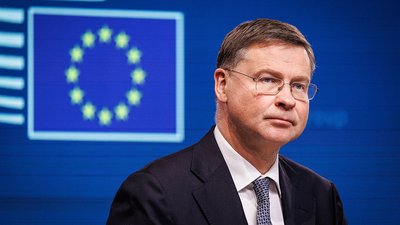
European Commissioner for Economic Affairs Valdis Dombrovskis said on May 5 that the tax reform is part of the negotiations on the conditions under which Ukraine will receive macro-financial assistance within the framework of a €90 billion EU loan.
He said this during a press conference following the meeting of EU finance ministers in Brussels.
Dombrovskis clarified that negotiations with the Ukrainian authorities are ongoing, so he is not revealing details yet.
“We are at a very advanced stage of negotiations with the Ukrainian authorities on the conditions on which our macro-financial assistance programme will be based. I cannot go into the details of these negotiations now, but domestic revenue mobilization is an important part of these negotiations, as is tax reform, but the precise mechanisms and elements are still being discussed,” the European Commissioner said.
According to him, the European Commission is coordinating with the Ukrainian side a memorandum of understanding that will define the terms of financing. The signing of this document will allow for the first payments within the framework of macro-financial assistance. In parallel, Brussels is coordinating actions with the International Monetary Fund and working on a loan agreement that should enter into force before the start of payments.
A third of the €90 billion loan is direct budget support in exchange for Ukraine implementing reforms, the rest is defense aid without additional conditions. The EU Council finally approved the loan after Hungary lifted the block. The parties are finalizing technical documents.
What is known about the initiative to introduce VAT for individual entrepreneurs?
In November 2025, Ukraine and the IMF agreed on the parameters of a new four-year, $8.1 billion extended financing program. The program included 16 structural benchmarks to be implemented by the government and the Verkhovna Rada, as well as four mandatory preconditions, without which the program cannot be launched.
In December 2025, the Ministry of Finance submitted for public discussion a draft law on mandatory VAT payment by individual entrepreneurs (IEOs) with annual income of over 1 million hryvnia. After a negative reaction, the Ministry of Finance began preparing a softened version, which provides for an increase in the threshold to 2-4 million hryvnia per year.
On February 14, Prime Minister Yulia Svirydenko, while talking to reporters, announced that the IMF had agreed to cancel prior actions for the new loan program. These included requirements for the introduction of VAT for individual entrepreneurs, customs duties on parcels and a tax for digital platforms, as well as the preservation of military levies.
On February 27, the IMF agreed on a new extended financing program for Ukraine. It is designed for four years: it is about $8.1 billion, which will partially cover the Ukrainian budget deficit.
On March 3, Ukraine received $1.5 billion from the IMF as the first tranche under a new four-year program under the Extended Fund Facility (EFF).
On March 10, the Verkhovna Rada did not support the bill on taxation of income from digital platforms — one of the requirements of the IMF program.
On April 19, Svyrydenko said that the IMF “understood” the sensitivity of the issue of introducing VAT for individual entrepreneurs. The Prime Minister said that the government and the IMF will work out alternative measures to ensure the revenue side of the budget for 2027.