
Main points
- The construction of temporary buildings, such as sheds, gazebos, and garages, does not require permits if they do not have foundations.
- Re-equipment and redevelopment of buildings without interfering with load-bearing structures and engineering systems does not require permits.
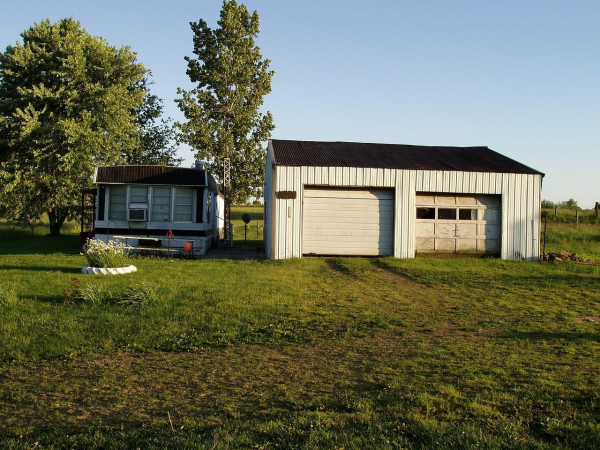
What to build on the site / Photo Pixabay
Often, owners of land plots designated for development build houses, garages, and other outbuildings on them. However, the legislation clearly states what can and cannot be built on personal plots.
What buildings can be built without obtaining permits?
Lawyer Iryna Honcharenko, in a comment to Channel 24 , said that when planning construction on a land plot of private ownership – a personal plot (for the construction and maintenance of a residential building, outbuildings and structures), a garden plot, a summer cottage – questions often arise about which objects have requirements for issuing construction permits.
This applies to the notification of the start of construction work and the construction passport for the development of a land plot, which can be built without the execution of relevant documents and which do not require commissioning.
Ukrainian legislation defines a list of objects (regarding individual (estate) residential buildings, garden houses, and summer houses) for the construction of which it is not necessary to obtain permits and which do not need to be put into operation, namely the construction of temporary buildings and structures on a land plot without installing foundations, in particular:
- canopies,
- gazebo,
- tents,
- cover,
- stairs,
- overpass,
- summer showers,
- greenhouses,
- garages,
- as well as wells,
- wells,
- backlash closets,
- toilets,
- cesspools,
- paving,
- fences,
- outdoor pools and covered pools,
- cellars,
- entrances to the cellars,
- gate,
- wicket,
- potholes,
- terrace,
- porches.
This applies to individual (manor) residential buildings, garden houses, and summer houses.
Re-equipment and redevelopment of a residential building and residential premises, as well as non-residential buildings, buildings, structures, premises therein, the implementation of which does not involve interference with enclosing and supporting structures and/or engineering systems of general use (with regard to objects that, by class of consequences (liability), belong to objects with minor (CC1), medium (CC2) and significant (CC3) consequences), do not require the execution of documents giving the right to perform construction work.

Iryna Honcharenko
Advisor at the law firm “Resultat”
Also, today, the construction of garages does not require the issuance of special documents, although without the installation of foundations. The construction of capital garages, that is, those that have a foundation and are not temporary structures, requires the issuance of a construction passport and notification of the relevant state architectural and construction control body.
What else doesn't require permits?
The installation of fences (fences) on personal plots, summer cottages and garden plots does not require the issuance of permits. However, their construction must comply with the requirements of building codes. The height of the fences must be no more than 2.0 m on the border of neighboring land plots and no more than 2.5 m on the border with the street to ensure regulatory insolation and ventilation of adjacent territories.
Important! Connection and connection to engineering networks in accordance with the technical conditions of individual (manor) residential buildings, garden and summer houses, outbuildings and structures, garages located on household, summer and garden land plots and land plots for the construction of individual garages also does not require the issuance of permits.
Iryna Honcharenko also reminds that without obtaining additional documents, it is allowed to equip buildings and structures with devices for separate metering of thermal energy, hot and cold water.
Please note! Replacing the roof of buildings and structures in accordance with building codes without interfering with the load-bearing structures, as well as replacing existing fillings of window, balcony and door openings, is also carried out without the need to obtain separate permits.
Thermal insulation works of residential buildings put into operation (walls, roofs, attics, technical, basement, and basement floors), which, by the class of consequences (liability), belong to objects with minor (CC1) and medium (CC2) consequences, do not require obtaining permits from the State Agency for the Protection of the Environment.
Also, the reconstruction and overhaul of internal systems do not require the issuance of permits: heating; ventilation; water supply and drainage, including pipelines; power and low-voltage systems that ensure the functioning of buildings and structures.
It is necessary to comply with the norms when constructing structures
The lawyer reminds that when constructing facilities that do not require permits, it is imperative to take into account the standards for the construction of sanitary facilities, which must be located away from both your own home and your neighbor's.
Thus, when placing houses in neighborhoods with established development, for house maintenance and routine repairs, the distance to the border of the adjacent land plot from the most protruding wall structure of the house must be at least 1 meter.
At the same time, the implementation of the necessary engineering and technical measures must be ensured to prevent precipitation from the roofs and eaves of buildings from falling onto the territory of adjacent land plots or mutually coordinated drainage in accordance with the requirements of DBN V.1.1-25,
– added Iryna Honcharenko.
- For a new manor house development, the distance from the boundary should be set at least 3 meters.
- Compost areas, yard latrines, garbage cans, storage facilities for fertilizers and pesticides should be located 20 meters from a residential building, summer kitchen, well, or well.
- The septic tank and filter well should be located 5-10 meters from the residential building/summer kitchen, depending on the performance.
Is it possible to plant a garden on agricultural land in Ukraine?
-
In Ukraine, it is allowed to grow perennial crops, such as orchards and vineyards, on agricultural land.
-
Perennial plantings and the land plot on which they are located are a single entity, and rights to them follow rights to the land plot.