
Main points
- Jupiter does not revolve around the Sun, but moves around a common center of mass (barycenter), which is located above the solar surface.
- This principle also applies to the Earth, which orbits around a common barycenter with the Sun and has its own barycenter with the Moon.
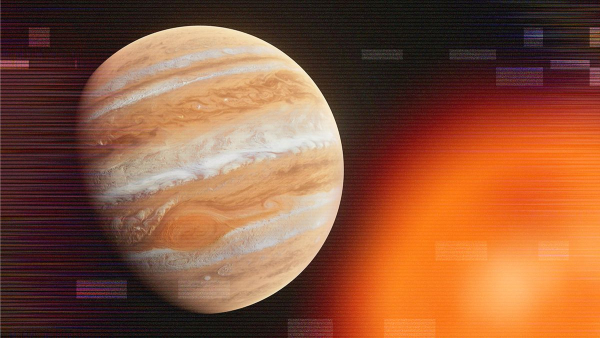
Cosmic dance of the masses: why Jupiter doesn't technically revolve around the Sun / Collage by Channel 24/Unsplash
For years, school textbooks have painted a simple picture: a stationary Sun at the center and planets orbiting it. But the real mechanics of space are much more complex. It turns out that the largest inhabitant of our solar system has such a large mass that it dictates its own rules of motion.
How does gravity make stars and planets orbit around invisible points?
When Galileo Galilei first pointed his homemade telescope at Jupiter in January 1610, he discovered moons that did not orbit Earth. This was the first serious evidence that our planet was not the center of all things. Ironically, however, modern science has discovered an even more interesting fact: Jupiter itself does not technically orbit the Sun. Instead, it moves around a certain point in open space, writes 24 Kanal .
To understand this phenomenon, it's worth understanding the concept of the center of mass, or barycenter. As NASA explains, every object has a point of equilibrium somewhere in the center of space, where all its material is concentrated. If we take a regular ruler, its center of mass will be exactly in the middle. But if we take an object where the mass is distributed unevenly, such as a sledgehammer, then the center of mass will shift closer to its heavy part. In space, when two objects are gravitationally bound, they actually rotate around a common center of mass, which is called the barycenter.
The Sun is incredibly massive, accounting for 99.86 percent of the total mass of the Solar System. The remaining 0.14 percent is made up of all the planets, moons, asteroids, and comets. But gravity is a two-way street. Just as the Sun pulls the planets toward it, each planet has its own, albeit small, influence on its star. Jupiter is a real giant, at 318 times the mass of Earth and containing about 70 percent of the mass of all objects in the system, excluding the Sun itself.
Because of such a colossal mass, the common center of mass of the Sun and Jupiter is not located in the middle of the star. It is located slightly above the solar surface. It is around this empty point in space that the gas giant actually rotates, writes IFLScience. At the same time, the Sun itself is forced to make small circular movements around this barycenter.
Demonstration of the barycenter in the Solar System: watch the video
What about the Earth?
The Earth also obeys these laws, although its influence is much more modest. Because our planet is very small compared to the sun, their common barycenter is deep inside the Sun, very close to its geometric center.
However, we too orbit around a common point, not around the center of the star itself. Moreover, the Earth has its own barycenter with the Moon, which is located about 5,000 kilometers from the center of our planet. Even Pluto and its five moons orbit around a point that lies beyond the dwarf planet itself.
Barycenter of the Solar System
The entire solar system has one common barycenter, the position of which is constantly changing. Its coordinates depend on which parts of their orbits the planets are in. When massive Jupiter and Saturn are on the same side of the Sun, the common center of mass of the system extends far beyond the solar surface. When they are located on different sides, the barycenter returns closer to the center of the star. Because of this, the Sun is constantly wobbled, performing complex movements in space.
What does it matter?
This cosmic wobble is of great importance to science. Because distant stars in other galaxies are so bright, it's almost impossible to see planets directly near them. However, astronomers can observe the star's subtle wobble, or movement back and forth.
By studying these barycentric oscillations, scientists are able to detect new worlds, called exoplanets, without even seeing them through telescopes.