
Main points
- In May 2026, Venus and Jupiter will be among the most interesting objects to observe.
- They will be joined by a meteor shower, an asteroid, a comet and two full moons.
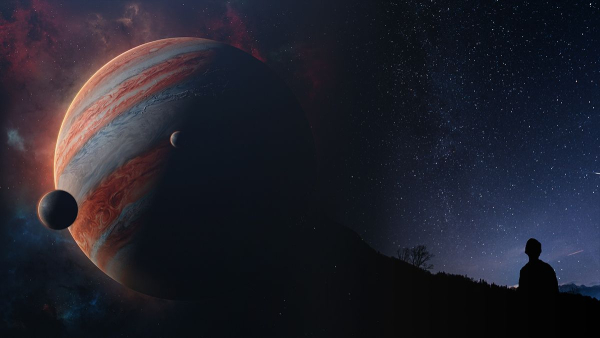
Main astronomical events of May / Collage of Channel 24/Unsplash
The May sky promises to be a veritable arena for large-scale cosmic spectacles. From the bright glow of the largest planets in the Solar System to rare eclipses on Jupiter's moons, this month opens up a wealth of opportunities for experienced astronomers and amateur observers.
What phenomena will be the main decorations of the moon's night sky?
According to Astronomy Magazine experts Martin Ratcliffe and Alistair Ling, Venus and Jupiter will be the main evening objects for your observations after sunset in May. But they won't be the only ones.
Venus
Venus will begin the month 14 degrees above the western horizon, shining at magnitude -3.9. The planet will become even brighter throughout May, moving from the constellation Taurus to Gemini. It will be especially spectacular on May 18, when the thin crescent Moon will be just 2 degrees north of it, illuminated by the glare of sunlight from Earth.
Jupiter
Jupiter, in turn, will remain visible until almost midnight in late May. The gas giant will demonstrate a series of double transits of its moons – Europa and Ganymede. As the authors of the material note, “observing details on Jupiter’s disk with a telescope requires good visibility while the planet is still at a sufficient altitude.”
The most interesting events will unfold on May 15-16 and 22, when the shadows of the two moons will simultaneously cross the giant planet's clouds. During the May 22 event, Europa's shadow, although appearing two minutes later than Ganymede's, will move faster and eventually overtake it.
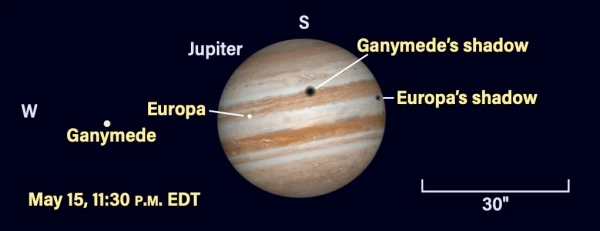
This is what the transit of Jupiter's moons over the parent planet will look like / Photo by Roen Kelly
Other planets
Other planets will not be left out either:
- Mercury will appear at the end of the month, reaching an altitude of almost 10 degrees above the horizon 30 minutes after sunset on May 30.
- Saturn and Mars will be visible in the predawn sky. Specifically, on May 13, Saturn will be 6 degrees below the Moon, and the next morning, May 14, Mars will shine next to the crescent Moon.
Comet
For telescope owners, May will be the time of the return of Comet 10P/Tempel (also known as Tempel 2). It will gradually brighten, approaching 9th magnitude. The comet will pass through the rich star fields of the southern constellation of Aquila, and is expected to have an asymmetrical appearance due to the influence of the solar wind on the dust coma, writes The Sky Live.
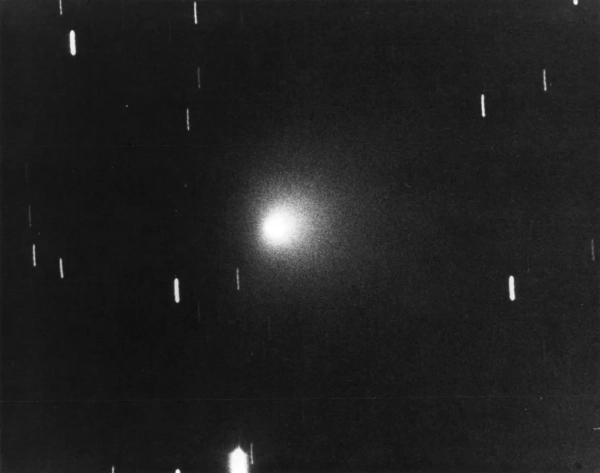
Comet 10P/Tempel / Photo by H. M. Jeffers
Meteor shower
Meteor enthusiasts will be able to observe the Eta Aquarids shower, which originates from the debris of Halley's Comet. The peak of activity will fall on the morning of May 6. Although up to 50 meteors per hour can theoretically be expected, this year the bright Moon will significantly interfere with observations, reducing the number of visible “shooting stars” to about ten per hour, Star Walk reports.
Lunar oscillations and asteroid searches
An interesting phenomenon in May is the lunar libration. Due to the peculiarities of its orbital motion, our satellite seems to “wobble”, which allows terrestrial observers to see a total of up to 59 percent of its surface. In early May, it will be possible to examine in detail objects near the north pole of the Moon, such as the Nansen and Peary craters.
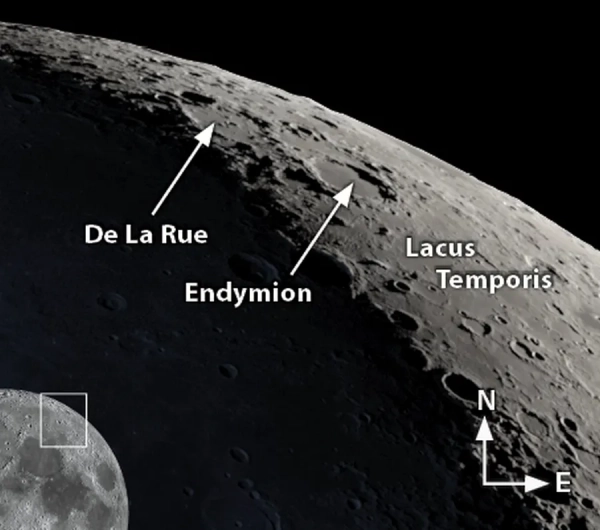
These areas on the Moon will be visible due to rare fluctuations / Image NASA/GSFC/ASU
Asteroids
For those who prefer to hunt for asteroids, the main target will be 13 Egeria. This main-belt asteroid body, about 201 kilometers in diameter, will pass near the bright star Spica in the constellation Virgo. Although it has a magnitude of only 10.1, the asteroid is easy to track during a three-hour session due to its noticeable movement against the background of distant stars, if you have a powerful enough telescope.
Two full moons in one month
Finally, the main highlight of May will be two full moons. We have already talked about the first one, which will take place on May 1, in detail in a separate article. The second, called the “Blue Moon”, is expected on the 30th – 31st.
A Blue Moon in modern astronomy and folklore is the second full moon in a calendar month, or the third full moon in a season that has four such events instead of the usual three.
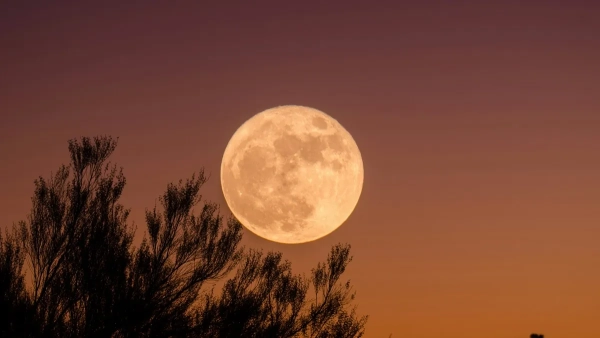
When the second full moon of May comes / Photo Ganapathy Kumar
The history of the term is quite interesting. The concept of a blue moon as the second full moon in a month was essentially forgotten for decades until, in the 1970s, Deborah Bird of EarthSky came across a 1946 copy of Sky and Telescope magazine in the University of Texas library. She then began using the term on her radio show StarDate, which helped popularize the term.
This definition was later solidified thanks to Margot McLune-Basta's book “The World Almanac of Records and Facts for Children”, published in 1985, and even the popular game “Trivial Pursuit”.
From an astronomical perspective, such events are cyclical. The phases of the Moon repeat themselves on roughly the same dates every 19 years, since 235 lunar months almost exactly equal 19 calendar years. For example, 19 years after 2024 – in 2043 – full moons will again occur on June 22, July 21, August 20, and September 18.
It is worth noting that our natural satellite will not change color, writes EarthSky. However, sometimes the Moon can indeed acquire a blue tint. This happens not because of calendar cycles, but because of the state of the Earth's atmosphere. When a large amount of dust or smoke appears in the air, for example, during powerful forest fires, particles of a certain size (slightly wider than 900 nanometers) begin to effectively scatter red light. In such cases, the Moon, shining through these particles, can look truly blue.