
Main points
- The Flower Moon will reach its peak phase on May 1, 2026 at 8:23 PM Kyiv time, being in the constellation Libra.
- There will be two full moons this month, with the first being a Micromoon and the second, on May 31st, called a Blue Moon.
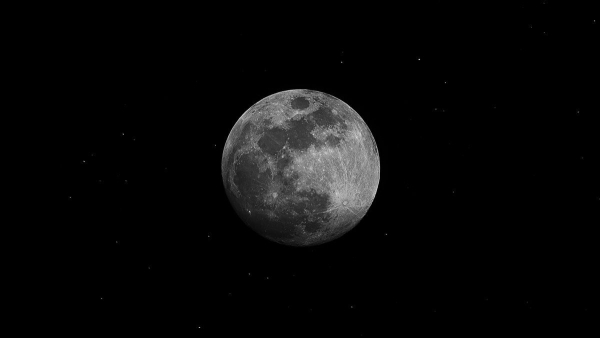
From Flower to Blue: May 2026 prepares a double surprise for observers / Unsplash
May 2026 begins with a bright astronomical event that has deep roots in the history and culture of many nations. The first full moon of this month, known by its picturesque name, promises to be an interesting spectacle, despite its specific physical characteristics and special position in the orbit.
What are the features of the Flower Moon?
The May 2026 full moon, traditionally called the Flower Moon, will reach its peak phase on May 1 at 5:23 p.m. UT. For residents of Ukraine, this moment will come at 8:23 p.m. Since the Moon is in its full phase for several days, it will also appear perfectly round on the nights before and after the peak, namely on April 30 and May 2, writes 24 Kanal .
From an astronomical perspective, the Moon will be in the constellation Libra on May 1. This year's event has several unique characteristics:
- First, May 2026 will be a double full moon month . Because the lunar cycle lasts about 29.5 days, which is shorter than most calendar months, the first full moon on May 1 will be followed by a second full moon on May 31. This phenomenon is called a Blue Moon in modern astronomy, and it occurs about once every 2 to 3 years, writes EarthSky.
- Second, the Flower Moon on May 1 will be a so-called Micromoon . This means that our natural satellite will be near apogee, the point in its orbit that is farthest from Earth. The distance to the Moon at this point will be about 406,000 kilometers, while during the opposite phenomenon, a Supermoon, it is reduced to 363,000 kilometers. Because of this distance, the moon's disk will appear about 5 percent smaller and 10 percent dimmer than the average full moon. Although this difference is difficult to notice with the naked eye, it becomes obvious in photographs when compared to other phases.
Where did the name come from?
As we have already explained in a separate article, the name “Flower Moon” comes from the traditions of the indigenous peoples of North America, in particular the Algonquin tribes, who associated the full moon with seasonal changes in nature. May is a time of intense flowering of wildflowers such as anemones, wild garlic, bluebells, lupines and violets.
Other cultures had their own names:
- The Cree tribes called it the Egg-Laying Moon or the Frog Moon;
- The Dakota and Lakota peoples used the names Planting Moon or Green Leaf Moon;
- In ancient England and among the Anglo-Saxons, the name Milk Moon (Rimilcemona) was common, which translates to “month of thrice milking,” because it was during this period that cows were milked three times a day due to the abundance of fresh grass.
- The Celts called this full moon the Hare, Mother, or Grass Moon, explains Star Walk.
When and how is it best to observe the Moon?
For the best observation, experts advise paying attention to the moment of moonrise. It is then that the satellite is low above the horizon and can acquire a golden or orange hue due to atmospheric effects, which creates ideal conditions for photography. However, for Ukraine, unfortunately, this time it is not relevant. The thing is that at 20:23 it will still be below the horizon. The moment of ascent will begin only at 20:53, as TheSkyLive maps show.
The moon will appear closer to the southeast and will completely go beyond the horizon only after 9 p.m. However, even at this moment, many Ukrainians will not see the satellite, as the view will be blocked by houses. So we will have to wait until it rises higher – until about 10 p.m. At that time, it will be dark enough for unobstructed observation.
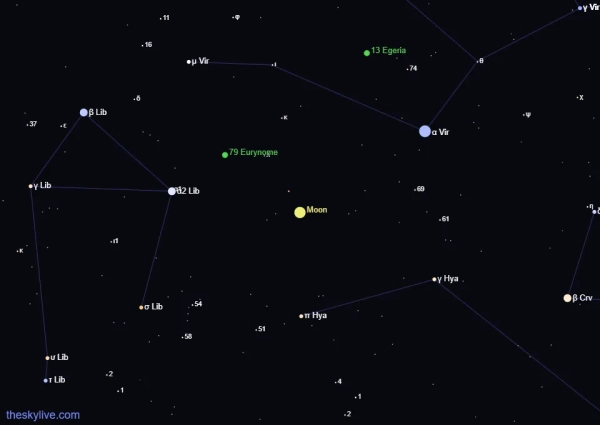
Moon position on May 1, 2026 / Image by TheSkyLive
Bright stars will be visible near the Moon: on April 30, it will pass near the blue Spica at a distance of about 2 degrees, and on May 4, it will approach the reddish Antares, which is called the “heart of the scorpion.”
How to take the best full moon photos: tips for photos, observations and choosing a location
Successfully capturing the night sky begins long before the shutter button is pressed. Astrophotography requires careful preparation, as the Moon is a dynamic and fickle object.
To track the phases and trajectory of the satellite, experts recommend using specialized applications such as PhotoPills or the Photo Ephemeris service.
You can use apps or websites to track the different phases of the moon. They show the times of moonrise and moonset for different locations around the world,
– explained Mara Leite, an award-winning landscape painter whose passion is astrophotography.
It is important to consider the level of light pollution. The best results can be obtained in areas where the brightness of city lights does not block the starry sky – in rural areas or at least at a distance from the city.
The choice of equipment plays a key role. While many people dream of lenses with a focal length of 1000 millimeters, decent shots can be obtained with telephoto lenses of 250-400 millimeters, explain professionals on Reddit. Using a tripod is a prerequisite, since even the slightest shaking of the hands at a high zoom will lead to blur. It is also recommended to turn off the image stabilization on the lens when working with a tripod and use a remote control or self-timer for 3-10 seconds, so that vibrations from touching the camera have time to fade.
One of the main secrets of exposure is the so-called “Looney 11 rule” (or the f/11 rule). Since the Moon is illuminated by direct sunlight, the intensity of which is almost the same as on Earth, the camera's automation often makes mistakes when trying to illuminate the dark sky around it. The basic settings according to this rule are: aperture f/11, and shutter speed – the inverse of the ISO value. That is, at ISO 100 the shutter speed should be 1/100 or 1/125 of a second, and at ISO 200 – 1/200 or 1/250 of a second.
However, shooting the full phase is not always the best solution for those who want to show relief. When the Moon is fully illuminated, the sun's rays fall frontally, which “melts” the shadows and makes the surface flat. The best time to photograph craters is during the first or last quarter phases, when side light creates deep shadows at the border of the illuminated and dark parts of the disk.
Shooting on the phone
If you take photos on your phone, forget about automatic mode:
- Android owners should use “Professional Mode” by setting the ISO to a minimum (50 – 100) and a shutter speed within 1/200 – 1/500 second.
- On the iPhone, you need to point the camera at the object, lock the exposure (AE/AF Lock) with a long press, and manually lower the brightness by dragging the “sun” icon down until the terrain details appear.
Finally, don't forget about composition. A single moon disk against a black background can look a bit dry. Using a foreground – trees, buildings, silhouettes of people or mountains – adds scale and context to the shot. Experienced photographers recommend taking shots during the “moonrise” on the horizon: at this moment, it not only appears larger due to the atmospheric illusion, but also acquires warm reddish hues.