
Main points
- Novolipetsk Metallurgical Plant ended the first quarter of 2026 with a loss of 5.9 billion rubles, which is almost five times more than in the same period last year.
- Russia's metallurgical industry faces serious challenges, such as falling domestic demand, reduced exports due to sanctions, and overproduction.
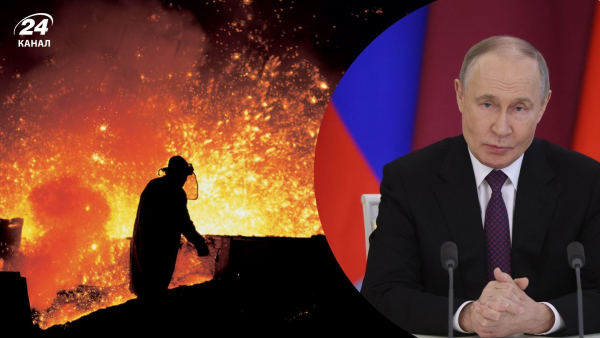
Russia's largest steel plant suffered losses of 5 billion / Collage by Channel 24, photo by Getty Images
One of the largest metallurgical players in Russia – Novolipetsk Metallurgical Plant – sharply worsened its financial results and ended the first quarter of 2026 with a loss. This indicates the decline of metallurgy as an industry.
Why did the Novolipetsk Metallurgical Plant suffer record losses?
According to the reports, the company lost 5.9 billion rubles, writes The Moscow Times.
For comparison, the loss for the same period last year was 1.23 billion rubles. That is, financial losses increased almost fivefold.
A year ago, the situation looked the opposite: in 2025, the plant received 86.7 billion rubles in profit. But already at the beginning of 2026, the indicators dropped sharply. Revenue fell by about 10% – to 145.6 billion rubles, and operating activities brought more than 6 billion rubles in losses.
This is a global enterprise: the plant, built back in the 1930s, is capable of producing up to 17 million tons of steel per year and is among the top 20 largest in the world.
Why is Russia's metallurgy dying?
Analysts note that the situation is worsening throughout Russia's metallurgical sector.
The Russian steel industry is entering a difficult period, and this trend could persist for many years. Without further state support, there is a risk of a return to the conditions of the early 2000s,
– says BCS analyst Kyrylo Chuiko.
It is known that metallurgists are currently under pressure: a drop in domestic demand – minus 15%; a reduction in exports due to sanctions – by about a third (minus 10 million tons); a general slowdown in the Russian economy; overproduction – capacity exceeds market needs by almost twice.
The production capacity of Russian metallurgists exceeds market needs by two times,
– says Pavel Shylyaev, General Director of the Magnitogorsk Combine.
What does this mean?
The situation appears systemic, not temporary:
- metallurgy is one of the basic sectors of the Russian economy;
- its fall signals a general cooling of the economy;
- without government injections, the industry may enter a protracted crisis;
- Companies are already cutting back on investments, halting renovations, and preparing for layoffs.
So, in fact, the market is entering a phase where even big players cannot operate “in the black” without support.
How is Russia's other metallurgical giant, Severstal, declining?
According to PJSC Severstal, one of the country's leading steel producers, the decline in steel consumption in Russia accelerated in the first quarter amid a slowdown in the economy, Bloomberg writes.
Severstal's financial performance has deteriorated sharply:
- revenue fell by 19% to 145.3 billion rubles;
- earnings before interest, taxes, depreciation and amortization fell by 54% to 17.9 billion rubles;
- Profitability dropped to 12% – one of the lowest levels in the company's history.
In fact, we are not just talking about a recession, but about a serious blow to business efficiency.
To stay afloat, the company is already forced to cut costs: investments, personnel costs, and maintenance are being reduced.
How important is metallurgy for Russia?
The Russian metallurgy industry is under pressure from the Central Bank's high key rate and the strong ruble. Loans are too expensive for businesses, and the strong ruble is limiting export revenues. About this in the commentary Channel 24 economist Ivan Us.

Ivan Us
Candidate of Economic Sciences, Chief Consultant of the National Institute for Strategic Studies
When we look at the Russian economy, the first is the oil and gas industry, but the second is metallurgy. This is very easy to understand if you look at the Russian Forbes list. Where are the main billionaires? It's either oil or metals. Mordashov – Severstal, Lisin – Novolipetsk Metallurgical Combine, Rashnikov – Magnitogorsk Combine.
Economist Ivan Us says that given the situation in the industry, the risks of further layoffs at large metallurgical enterprises are very high. The expert recalled that back in June 2025, at the St. Petersburg Economic Forum, Severstal CEO Alexander Shevelev suggested the possibility of a shutdown of metallurgical enterprises in Russia due to the current monetary policy.
Sanctions against Russia are cutting off traditional markets for metallurgical products. At the same time, significant pressure is exerted by the high key rate of the Russian Central Bank. It currently stands at 15% per annum.
According to expert Ivan Us, the key rate for the development of the metallurgical industry in Russia is too high and does not meet the needs of the economy. Sberbank Chairman German Gref stated that the optimal rate is 12%, while the chairman of the Russian Union of Industrialists and Entrepreneurs Alexander Shokhin estimated the required level at 7-8%.
The second problem is the ruble exchange rate. Now it has fallen a little, but it is still ±80 rubles per dollar. At the beginning of 2025, it was 100 rubles per dollar. It turns out that the ruble is strengthening, and politically it looks like a very good story. But metallurgists earn on exports, so if earlier for one million dollars they received 100 million rubles, now only 80. Why is this an important point: expenses in Russia are in rubles, and they earn in foreign currency, so they receive less resources for internal expenses, in particular – for salaries,
– Ivan Us concludes.
These two factors push enterprises to reduce production and costs, and in the long run, to close down.
What problems does Russian business have?
-
Tax hikes in Russia have left 50% of companies operating at a loss, with the Chamber of Commerce and Industry putting the figure at 65%. Changes in tax legislation, including an increase in VAT from 20% to 22% and a reduction in the income threshold for the simplified system, have had a negative impact on business, reducing tax revenues by 16% in the first quarter.
-
The financial performance of Russian companies deteriorated sharply in early 2026, with a combined net profit of 3.4 trillion rubles, down 33.1% from the previous year. Income from small businesses and the self-employed fell to about $7.5 billion in the first quarter of 2026.