
Main points
- The upper stage of the Falcon 9 rocket will collide with the Moon on August 5 near Einstein Crater.
- This incident highlights the problem of space debris, which could threaten future lunar missions.
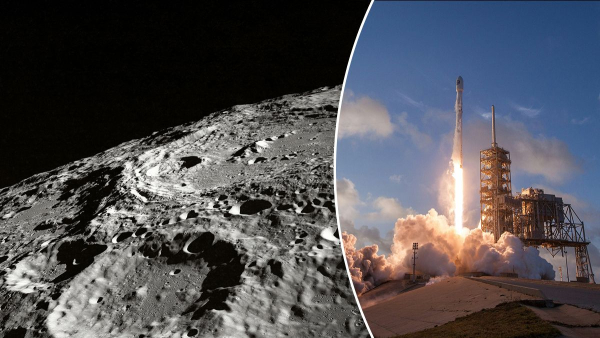
Uncontrolled flight: Elon Musk's rocket prepares to collide with the Moon / Collage by Channel 24/Unsplash
The debris of human technology that has long since served its purpose has been circling Earth and its natural satellite for years. One such object will soon end its journey with a loud collision, attracting the attention of astronomers around the world due to the unusual trajectory of its fall.
What is known about the upcoming collision?
The 45-foot-tall Falcon 9 rocket's upper stage will soon stop spinning erratically in space, according to new calculations by experts. The massive piece has been stuck in orbit since its launch in early 2025, when the rocket successfully carried two important spacecraft to explore the lunar surface, Live Science reports.
We are talking about the Blue Ghost lander, developed by the private company Firefly Aerospace, which successfully reached its target in March 2025, as well as the Japanese Hakuto-R lander from ispace, which lost contact during a landing attempt in June of the same year.
When and where will the rocket fall?
Bill Gray, a professional astronomer and developer of specialized software Project Pluto for tracking near-Earth objects, claims that the collision will occur on August 5. According to him, the object will fall on the border of the visible and far sides of the Moon, directly near the Einstein crater.
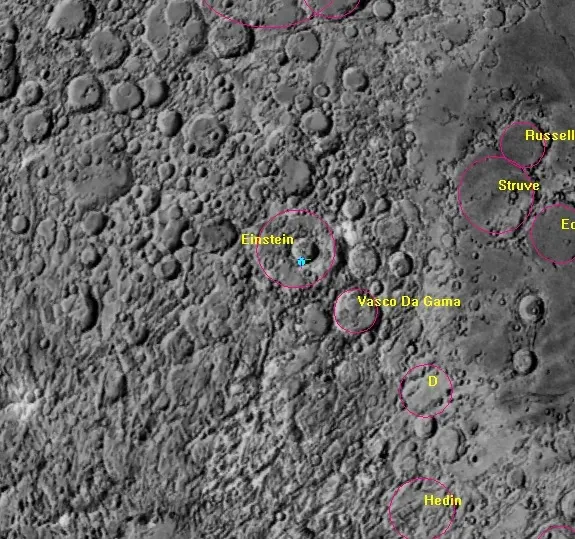
Rocket debris will likely fall into or near Einstein Crater on the Moon / Photo by Bill Gray
Over the past year, various asteroid tracking systems have captured this fragment more than 1,000 times as it orbited the Earth-Moon system. The object's speed during impact will be approximately 8,700 kilometers per hour, about 7 times the speed of sound on Earth.
Bill Gray notes that the movement of space debris is usually fairly predictable, as it is subject to the gravitational pull of the Earth, Moon, Sun, and other planets. While solar radiation pressure may slightly adjust the trajectory, it is unlikely to significantly change the time or location of the final collision.
It is worth noting that this is not the first such prediction by Gray. In 2022, he already predicted the fall of a rocket on the moon, being mistaken in time by only a few seconds, and in the impact location by a few kilometers. Interestingly, at first that object was also considered to be a Falcon 9 stage, but later it turned out that it was a Chinese rocket booster.
Earthling Negligence: Why This News Is Bad for Us
According to the researcher, this incident is a clear indication of the negligent attitude towards the disposal of used equipment. Although we have not yet started colonizing the Moon, we are already littering it.
The space debris situation is a growing concern for the international community. There is currently no permanent human infrastructure on the Moon that could be damaged by this debris, but that could change in a few years.
- The United States plans to increase the frequency of launches, preparing annual missions under the Artemis IV and V programs, which could launch as early as 2028.
- China, for its part, intends to land its first taikonauts on the lunar surface by 2030.
Due to the construction of permanent bases, especially in the South Pole area, the space around the satellite will become increasingly cramped, as has long been the case with Earth's orbit, where the amount of debris increases every year.
Experts say space agencies and private corporations need to change their approach to disposing of equipment. Instead of leaving spent stages in orbit around the Earth or the Moon, they should be sent to orbits around the Sun. This will minimize the risks to future crews and expensive equipment operating on the lunar surface.
Scientific interest: will it be possible to see the impact from Earth?
Although the rocket crash poses no direct threat to existing operational spacecraft, it is of some scientific interest. The value of the upcoming event lies solely in the opportunity to study the newly formed crater.
The impact itself will likely be too faint to be seen from Earth, even with large professional telescopes. However, detailed images of the impact site taken later could provide scientists with new information about the structure of the terrain in the area.