
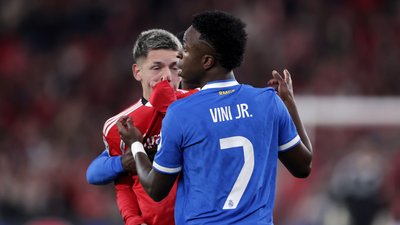
At the 2026 World Cup, players will be punished with red cards for covering their mouths with their hands during arguments with opponents, as well as for leaving the field in protest against referees' decisions, ESPN reports.
At a meeting of the International Football Association Board (IFAB) in Vancouver, two key amendments to the rules that will be in effect at this year's World Cup were unanimously approved.
What changes were approved?
- Sanctions for covering the mouth. Referees have the right to send off players who cover their faces with their hands or shirts during conflict situations with an opponent. This rule is introduced to facilitate the identification of discriminatory statements. The decision to impose sanctions is at the discretion of the head referee.
- Disciplinary measures for protests. Players who leave the field of play in protest of the decisions of officials, as well as team representatives who incite such actions, are subject to immediate expulsion. The team that initiated the termination of the match receives a technical defeat according to the regulations.
The rule review was preceded by an incident in a Champions League match between Real Madrid and Benfica in February 2026 (1-0). The Spanish club's striker Vinicius Junior claimed that he had been racially abused by the Lisbon player Gianluca Prestianni, who had covered his mouth with his hand during a conversation. UEFA subsequently banned Prestianni for six matches for discriminatory behavior of a homophobic nature.
Another reason was the events of the Africa Cup of Nations final, when Senegal's team left the field for 17 minutes due to a disagreement over a penalty in their match against Morocco. Although Senegal won the match, the CAF Appeals Committee later overturned the result and awarded the trophy to Morocco. Senegal is currently appealing this decision to the Court of Arbitration for Sport.
FIFA has also previously initiated a change to the rules regarding the accumulation of cautions: yellow cards will be cancelled after the group stage, rather than from the quarter-final stage, to minimize the risk of team leaders missing key games.