
Main points
- The Russian military in the occupied part of the Kherson region experienced a fuel shortage due to attacks on fuel infrastructure in Crimea.
- After the strike on the oil depot in Feodosia, supplies were complicated, which affected the mobility of troops, and the command ordered to save resources.
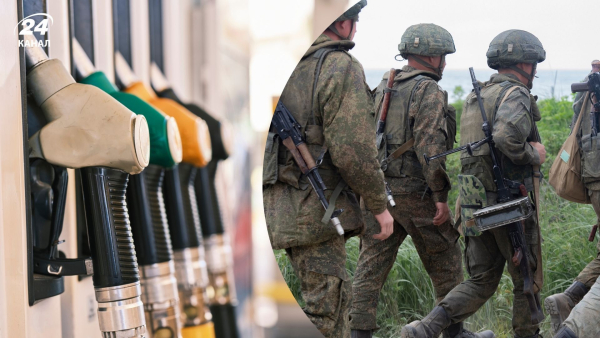
The occupiers are left without fuel / Collage by Channel 24 (Photo by Getty Images)
Russian military personnel in the temporarily occupied part of the Kherson region are experiencing a fuel shortage. The reason is said to be strikes by the Ukrainian Defense Forces on fuel infrastructure in occupied Crimea.
This was reported by the partisan movement “ATESH”, referring to its agents.
What is known about the Russian fuel crisis?
According to “ATE”, Russian army units in the Gola Prystan area faced an acute shortage of fuel and lubricants. The partisans claim that this was a direct result of a series of strikes on the occupiers' logistical facilities, in particular in Crimea.
According to their data, the strike on the oil depot in Feodosia was particularly noticeable. This facility played an important role in providing supplies to the Russian group in the southern direction. After the infrastructure was destroyed, fuel supplies became significantly more difficult, which affected the mobility of the troops.
One of the servicemen of the Russian group “Dnepr” reported a critical situation with fuel. According to him, the equipment is actually not being used due to a lack of resources, and the command has ordered to save fuel as much as possible. The military is being given minimal amounts, and there is no exact time frame for the resumption of supplies. The occupiers are trying to solve the problem through small fuel deliveries. However, such actions do not allow to fully cover the needs of the troops and only temporarily stabilize the situation.
“ATESH” emphasizes that attacks on fuel infrastructure have a tangible effect and affect the combat capability of Russian units. The partisans also stated that they continue to provide the Ukrainian Defense Forces with information about the supply routes and storage locations of the occupiers' fuel.
What other problems do the Russians have at the front?
Russia's attempted spring-summer offensive failed, and the troops were forced to regroup and even retreat on some sections of the front. According to Ivan Tymochko, a few months ago the Russian command was counting on a deep advance into Ukrainian territory and consolidation on new lines. However, these plans were thwarted by the Ukrainian Defense Forces, and now the occupiers are forced to change their approach.
Tymochko emphasizes that today Russia is trying to maintain at least the current level of intensity of hostilities, but there is no longer any talk of a large-scale offensive. Moreover, in some areas Russian troops are retreating, which indicates a loss of initiative.
He also notes that the situation is also affecting internal sentiment in Russia itself. According to him, even pro-Russian military bloggers admit the failure of the offensive, and the information space is filled with pessimistic assessments.
At the same time, Russia is trying to compensate for military failures with other methods – in particular, it is intensifying information influence and provocations inside Ukraine.
According to the expert, the current situation has several key features:
-
The Russian offensive was effectively thwarted.
-
Russian troops are forced to regroup in separate areas
-
fixed indentation
-
the intensity of attacks remains, but without breakthroughs
Despite this, Russia still has the resources to wage war and can maintain a certain level of activity on the front. However, as Tymochko notes, the possibilities for a large-scale buildup of forces are limited.