
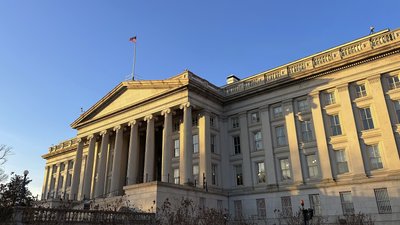
The US Treasury Department on April 28 imposed sanctions on 35 individuals and entities that operated Iran's shadow banking system. According to the agency, tens of billions of dollars were passed through the network to circumvent sanctions and finance terrorism.
This was reported on the website of the US Treasury.
The Economic Fury sanctions were imposed by the Office of Foreign Assets Control (OFAC) and target 35 companies and individuals who control Iran's shadow banking architecture.
These networks allow Iran’s armed forces, particularly the Islamic Revolutionary Guard Corps (IRGC), to access the international financial system, making payments for illicit oil sales, purchasing components for missiles and other weapons, and transferring money to Iranian-controlled groups.
“Iran's shadow banking system serves as a critical financial artery for its armed forces, enabling activities that disrupt global trade and fuel violence in the Middle East,” said US Treasury Secretary Scott Bessant.
He said the illicit funds from this network support the regime's terrorist operations and pose a threat to American personnel, allies in the region, and the global economy. Bessent warned that financial institutions that cooperate with these networks risk “serious consequences.”
OFAC has separately warned banks about the risks of doing business with companies that pay the Iranian government or the IRGC for passage through the Strait of Hormuz, saying such payments pose sanctions risks to any company or financial institution, both U.S. and foreign.
The US Department of State has focused on independent Chinese refineries that import and process Iranian oil. According to the US Treasury Department, some of them have used the US financial system to make dollar payments and purchase American goods. China has previously said it opposes “illegal” unilateral sanctions.
According to the US Treasury Department, Iranian banks, cut off from the international financial system, rely on private companies called “rahbars.” They operate thousands of offshore shell companies that process payments for Iranian imports and exports. The rahbars coordinate with Iranian money changers and front companies in various jurisdictions. This allows them to service Iran’s sanctioned trade, including for the IRGC, the General Staff of the Iranian Armed Forces, and the National Iranian Oil Company.
In total, since February 2025, OFAC has imposed sanctions on about 1,000 individuals, vessels, and aircraft associated with Iran as part of a “maximum economic pressure” campaign against Tehran.
Negotiations between the US and Iran and Trump's blockade of the Strait of Hormuz
On April 11, trilateral talks between the United States and Iran were held in the Pakistani capital, Islamabad, mediated by Pakistan. Following the talks, Vice President Vance said that the parties had failed to reach an agreement on a lasting end to the war. The Iranian Foreign Ministry said at the time that this had been hindered by disagreements on “two or three key issues.”
Trump then announced that the US Navy would begin a blockade of the Strait of Hormuz on April 13 due to the failure of negotiations with Iran to agree on giving up its nuclear weapons. He said that the US military would intercept all ships that had paid Iran a toll to pass through the strait.
He also warned Iran that if its military began attacking American warships, the US Navy would “send the Iranians to hell.”
On April 18, Iran announced that it was restoring “strict control” over the Strait of Hormuz in response to the US naval blockade.
On April 20, Trump said that an extension of the two-week ceasefire with Iran was highly unlikely if the parties did not reach an agreement by the April 22 deadline.
On the evening of April 21, Trump wrote on Truth Social that he was again postponing a strike on Iran. He said he was doing so at the request of the Pakistani prime minister and because the Iranian government was “seriously divided” — and the ceasefire would remain in place until a “single Iranian offer” was made and negotiations were concluded “one way or another.” He said the U.S. military would continue its naval blockade of Iran.
Iran's state broadcaster IRIB reported that Trump extended the ceasefire unilaterally, and Iran rejected the terms of negotiations proposed by the Americans.
Earlier, the Iranian Tasnim news agency reported that the Iranian negotiating team had told the American side that it would not come to the talks in Islamabad and did not see any prospects for participating in them.
Advisor to the Speaker of the Iranian Parliament, Mehdi Mohammadi, wrote on the social network X that Trump's extension of the ceasefire “does not make any sense, because the losing side cannot dictate the terms.” He added that he considers Trump's move an attempt to buy time for a surprise strike, and that the extension of the blockade is no different from bombing and should receive a “military response.”
Why the Strait of Hormuz is so important to the global oil market
The Strait of Hormuz is one of the planet's most important energy hubs, through which about a fifth of all global supplies of oil and liquefied natural gas pass.
Any instability in this narrow sea route instantly affects global markets, as demonstrated by the events of March 2026. Currently, due to the threat of strikes from Iran, shipping has been effectively blocked, forcing some companies to limit traffic in this area.
On March 13, a Turkish oil tanker managed to pass through the strait with cargo despite an Iranian blockade. The very next day, March 14, US President Donald Trump called on European and Asian countries to send warships to protect trade routes and said that the US Navy would begin escorting commercial tankers “very soon.”
By March 20, an international coalition had formed, including the United Kingdom, France, Germany, Italy, the Netherlands, Japan, and Canada. These countries formally condemned Iran's attacks on civilian infrastructure and expressed their readiness to guarantee safe passage for ships. The following day, March 21, the Iranian Navy escorted an Indian tanker through the strait.
On March 22, Tehran declared that the strait was open only to those not on the list of “enemies,” and Trump responded by threatening to destroy Iran's electricity grid if the blockade was not lifted within two days. On March 25, Iran solidified its position with a note to the UN Security Council, where it officially banned the passage of ships from the United States, Israel, and other “participants in the aggression,” allowing only “non-hostile” ships to pass through, subject to coordination with the Iranian authorities.
Despite these restrictions, the P. Aliki tanker carrying Saudi oil was able to pass through the strait along the Iranian coast on March 29. However, the overall shortage of resources became so acute that on March 31, Donald Trump addressed countries suffering from a shortage of jet fuel via the Truth Social network, effectively acknowledging the scale of the problem.
Previously, Suspilne wrote about why the Strait of Hormuz is so important for the global oil market, how to reduce dependence on it, and whether there are alternatives to the strait.