
Main points
- On April 28, Russia attacked Kyiv with strike drones, resulting in explosions, damage, and casualties.
- The military observer believes that the attack may have had a broader purpose than a single strike.
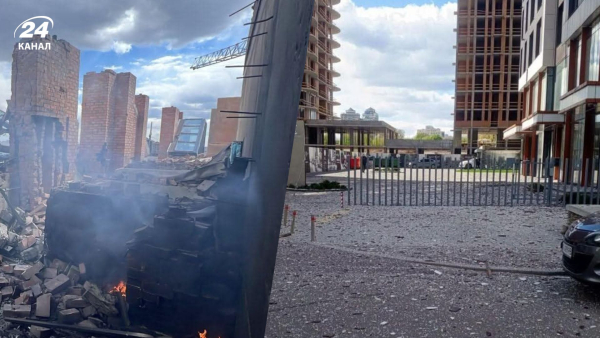
In the afternoon of April 28, Russia attacked Kyiv with strike drones, explosions were heard in several areas of the capital. Air defenses were operating in the city, and after the debris fell, damage, fires, and injuries were recorded.
Military commentator Vasyl Pekhno explained on Channel 24 that such a daytime raid was unlikely to be a random episode. According to him, Russia could have pursued a much broader goal than just a single strike on the capital.
A single daytime strike may not have been accidental
Pehnyo does not consider the appearance of Russian drones over Kyiv in the middle of the day to be an ordinary episode.
Attention! On the afternoon of April 28, Russia carried out an unusual attack on Kyiv with drones, causing explosions in the capital and air defenses to be activated. The Air Force warned of the movement of UAVs towards Kyiv at around 2:06 p.m., and explosions were heard in the city at approximately 2:18 p.m.
Such attacks are not like a massive raid, but they give the enemy another advantage: a single UAV is easier to fly through Ukrainian skies, it is less noticeable and can perform not only strike, but also reconnaissance missions.
We have seen drones used during this time of day, particularly over the capital, when they were conducting reconnaissance. Such incidents have occurred,
– said Pehnyo.
He recalled that after such reconnaissance, Russia had already launched combined strikes – with both drones and missiles. That is why he did not call the current attack random, although he warned against hasty conclusions about a specific scenario.
I don't want to be so unfounded now that this could be an element of preparation, but we need to take into account that the Russians are trying in every way to bite the capital and not only,
– the military observer emphasized.
According to him, Russia has not given up its intention to put pressure on Kyiv and will look for different ways to do this.
How did Russian drones break into the capital?
Pehnyo noted that the Russian drones flew too low during this attack, which may indicate not only an attempt to go unnoticed, but also the use of control through so-called mesh systems. This is a network of repeaters and towers that allow Russian UAVs to maintain control over long distances and approach targets where they are more difficult to detect by radar.
The Russians still have such an option as a mesh system for drone communication, which ensures direct guidance of Russian UAVs to certain objects to which the Russian operator directs such a drone,
– explained the military observer.
Such systems, according to him, operate not only from the occupied territories of Crimea, Donetsk and Luhansk regions.
Help! Mesh system is a communication network in which drones can connect to each other and work as signal repeaters. Thanks to this, “Shahed” is not tied to one ground channel or route, but can pass through several areas and, closer to the target, receive communication through another board in the air. For such a scheme, sometimes even one drone-repeater is enough. In this case, the operator does not manually control the drone throughout the flight, but only confirms the target on the final segment, after which the drone completes the attack according to the established algorithm. This is how Russia gets more opportunities for atypical strikes on distant cities.
To do this, Russia also uses infrastructure in Belarus, namely towers through which the signal can be relayed and the drone can be supported to fly all the way to the capital.
Thanks, for example, to Belarus and the existence of relay towers for Russian drones there, including the possibility of a single UAV flight to the capital in some places,
– said Pehnyo.
It is the low flight that gives such drones a chance to avoid detection by Ukrainian radar systems, although at the same time it makes their trajectory less stable and more dangerous for residential buildings.
By the way! Russia already used a similar atypical strike on Lviv on March 18, when one “Shahed” actually flew into the city. At that time, aviation expert Anatoly Khrapchinsky explained that such attacks could occur not through a regular massive raid, but thanks to a mesh system or other communication channels that allow the drone to maintain control over a long distance.
The current single daytime strike on Kyiv does not appear to be a coincidence, but rather another example of Russia testing unconventional routes and methods of pinpointing pressure on major cities. Such strikes should not be perceived as a one-time failure or improvisation, as Russia will continue to seek ways to conduct further reconnaissance and new attacks.
What is known about the consequences of the attack on Kyiv on April 28?
In the Shevchenkivskyi district, drone debris damaged an unfinished building. According to the State Emergency Service, the roof and facade of the building were damaged, and two minor fires broke out. Rescuers extinguished the fire.
Also, in the Shevchenkivskyi district, after falling debris, two cars collided, and one person was injured. As Vitaliy Klitschko reported, as a result of the explosion caused by the falling UAV, a passenger car hit a pedestrian. The injured person was hospitalized. Later, debris was found at another location in the same district.
In the Solomyanskyi district, drone debris fell on the territory of a cemetery. There, garbage caught fire on an area of 5 square meters, the fire was extinguished. Medics also provided assistance to another victim in this area.