
Main points
- Scientists have examined the fossil of Captorhinus aguti, which helped to understand the origin of the rib-breathing respiratory system, which is the ancestral form for modern reptiles, birds, and mammals.
- Using modern technologies, including neutron computed tomography, researchers have discovered the oldest known soft tissue and protein remains in fossils, changing the way we think about the preservation of soft tissue in the fossil record.
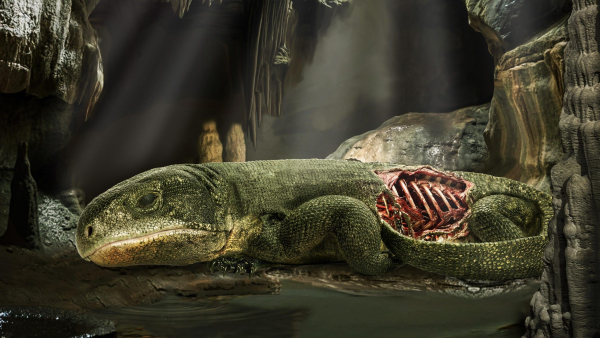
Scientists have learned when animals developed chest breathing / Nature
Scientists in the US have studied a unique fossil of a small, ancient reptile that is 289 million years old. It helped determine when the ancestors of modern mammals, birds and reptiles developed a respiratory system similar to that of humans – using ribs and a rib cage.
A tiny reptile called Captorhinus aguti, which lived in the early Permian period, has become a real sensation for paleontologists. Although it looked like a small lizard, it helped scientists understand when amniotes – the group that includes modern reptiles, birds, mammals and their common ancestors – developed the respiratory system that is still used today, writes SciTechDaily.
How did an ancient reptile change the way we think about the evolution of breathing?
The study, published in the journal Nature, found that the reptile had the earliest known example of so-called costal breathing, a mechanism in which the intercostal muscles expand the rib cage, allowing the lungs to fill with air.
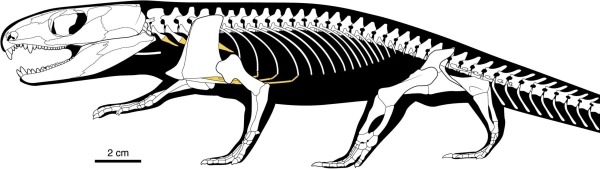
Illustrated diagram of a full-section skeleton in left lateral view / Photo by Nature
Study author Ethan Mooney explained that Captorhinus was extremely important for understanding the early evolution of amniotes. According to him, these small reptiles were among the first vertebrates to fully master life on land.
The fossil was found near Richards Spur in the US state of Oklahoma. This site has long been known for its exceptional preservation of fossil remains from the Late Paleozoic. It is here that one of the richest assemblages of terrestrial vertebrates from that time is found.
The special conditions – petroleum hydrocarbons and anoxic mud – allowed for the preservation of not only bones, but also soft tissues: skin, cartilage and even remnants of proteins. As a result, the fossil looks almost like a mummy – a three-dimensional body preserved in its final position, with a paw tucked under the body.
To study the specimen, scientists used neutron computed tomography at a specialized center in Australia. This method allowed them to see internal structures without damaging the fossil.
The image below shows the skeleton and cartilage, including the sternum and thoracic ribs (the arrow points to where the head should be).
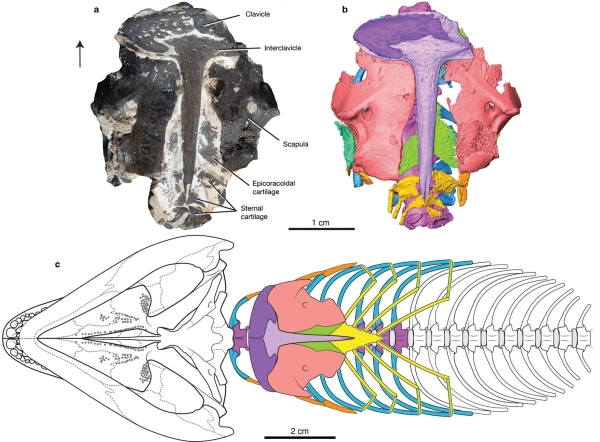
a) photo of the sample; b) digital image obtained using nCT technology / Photo by Nature
During analysis, the researchers noticed fine textured structures around the bones. They turned out to be remnants of skin that had been preserved around the body. The scales had a characteristic folded, “accordion-like” texture with concentric bands running from the body to the neck. It resembles the skin of modern worm-like lizards.
What new things have scientists learned about breathing?
The main discovery was not about the skin, but about the respiratory system. By studying three specimens of Captorhinus from this region, the scientists were able to reconstruct the structure of the thorax. One specimen preserved a segmented cartilaginous sternum, thoracic ribs, intercostal ribs, and the connection between the ribs and the shoulder girdle.
This allowed for the first time to fully reconstruct the respiratory system of an early amniote. This is costal aspiration breathing , where the expansion and contraction of the chest ensures the flow of air into the lungs.
Before this mechanism, amphibians used a different method: they breathed partially through their skin and also pumped air through their mouths and throats. This system still works in many amphibians today, but it significantly limits physical activity.
Costal breathing was a real breakthrough, as it allowed for more oxygen to be taken in and carbon dioxide to be expelled more efficiently. This made early amniotes much more active and better adapted to life on land.
Robert Rise noted that the system found in Captorhinus is likely an ancestral form of the type of breathing that reptiles, birds, and mammals, including humans, have today.
More interesting finds
Another equally important discovery concerned molecular remains. Using synchrotron infrared spectroscopy, the researchers found traces of original proteins in bones, cartilage, and skin.
These protein residues are the oldest ever found in fossils, about 100 million years older than previous similar findings known from dinosaur fossils.
Ethan Mooney emphasized that this discovery significantly changes the scientific understanding of the limits of preservation of soft tissues in the fossil state.
The specimens are now being studied at the Royal Ontario Museum in Toronto, where they are expected to shed light on how early vertebrates adapted to land and what evolutionary changes allowed them to become the ancestors of modern land animals.