
Main points
- Scientists from the UK and Austria have developed a new approach to creating molecular nanoribbons with atomic precision, which could become the basis for flexible electronics and quantum computers.
- The new technology uses donor-acceptor chemistry, which allows the electronic properties of a material to be pre-programmed, and could lead to more efficient solar cells, new sensors, and organic electronics.
Scientists have learned to assemble ultra-precise nanoribbons for new gadgets / Depositphotos
Researchers in the UK and Austria have developed a new approach to creating molecular nanoribbons with atomic precision, a technology that could form the basis for flexible electronics, smart clothing, compact Internet of Things devices, bioelectronics and even quantum computers.
Scientists from the University of Birmingham, the University of Warwick and the University of Vienna have announced the creation of a new “toolbox” for the development of next-generation electronic materials. These are molecular electronic nanoribbons that can be built with atomic precision directly on a metal surface. The results of the study were published on 23 April in the journal Nature Communications.
How can new technology change electronics?
The main feature of the work was the use of donor-acceptor chemistry . This approach allows you to pre-program the electronic properties of the material before it is assembled. To do this, the researchers alternate molecules that donate electrons with molecules that accept them, in a clearly defined sequence and length.
James Lawrence, who led much of the research while a postgraduate student at the University of Warwick, explained that the technique effectively creates a new set of tools for building electronic materials with atomic precision. He said that forming nanoribbons directly on a metal surface gives perfectly defined structures, which are difficult to achieve with traditional chemistry methods.
Professor Giovanni Costantini, from the School of Chemistry and the School of Physics and Astronomy at the University of Birmingham, said that while atomically precise nanoribbons have been studied before, this is the first time they have been created by directly combining donor and acceptor molecular building blocks.
It is control over the location of such blocks that allows us to predetermine the future electronic properties of the material and implement them with maximum accuracy.
As part of the project, scientists managed to obtain perfectly formed chains of three types: donor-only, acceptor-only, and mixed, writes Interesting Engineering. Using modern microscopy, the researchers were able to see individual atoms and chemical bonds, detect even the smallest defects, and measure the behavior of electrons inside these nanoribbons.
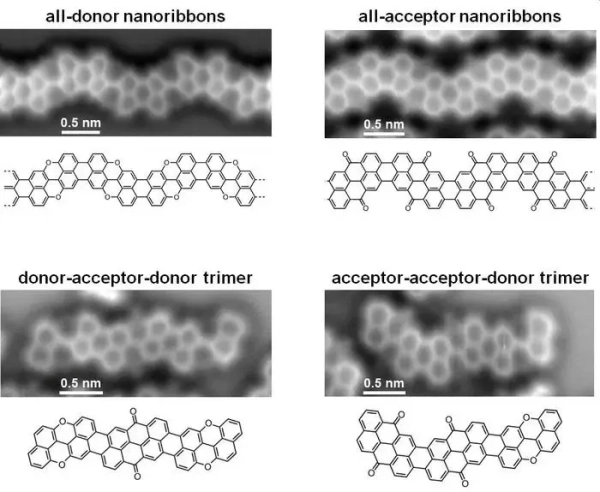
Photographic and schematic representation of an array of nanoribbons / Photo by James Lawrence
Davide Bonifaci from the University of Vienna explained that combining the donor-acceptor concept with the technology of forming structures on the surface made it possible to create long nanoribbons that are very difficult or impossible to obtain in a conventional chemical solution.
This approach also helps solve one of the main problems with graphene nanoribbons: Although graphene is considered a promising material for miniaturizing electronics, it performs poorly as a semiconductor, limiting its practical applications.
The study showed that increasing the length of the “all-D” or “all-A” ribbons enhances their properties as donors or acceptors, respectively. In mixed structures, the order of the molecules plays a key role, which shapes the unique characteristics of the material.
Why is this even interesting?
Based on these results, scientists created a theoretical model that allows them to design materials for specific tasks – from solar cells to medical implants.
Professor Gabriele Sosso from the University of Warwick stressed in the Eurekalert article that such nanoribbons demonstrate how atomic design can directly influence the real-world electronic properties of devices . At the same time, for further development of this direction it is important to consider the influence of the surface on which the material is formed and the local environment.
The next stage of the work will be to apply this technology to create more efficient solar cells and new high-precision sensors.
In the future, this could lead to the emergence of flexible organic electronics that can be literally printed or applied to the surface of materials, including fabric to create smart clothing.
The technology also paves the way for ultra-compact circuits for Internet of Things devices, as well as high-precision bioelectronic systems that can be used for implants in medicine and veterinary medicine.