
Main points
- On April 26, 2026, Earth could be affected by a G1-level magnetic storm due to a coronal mass ejection following an M1-class solar flare.
- Sunspots AR4420 and AR4419 are showing increased activity, which could lead to further emissions and potential impacts on Earth.
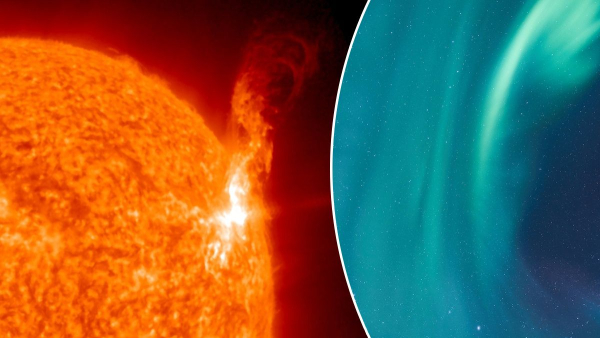
Class X solar flares and the threat to Earth: what to expect from the magnetic storm on April 26 / Collage of Channel 24/Unsplash/SolarHam
After a brief lull, the Sun has entered a phase of heightened activity, resulting in a series of powerful explosions on its surface. One of these flares caused an ejection of hot plasma that researchers predict could hit our planet as soon as this weekend.
What to expect from a magnetic storm and when will it occur?
According to the latest space weather monitoring data, the Earth may be affected by a G1-level magnetic storm on April 26, 2026. This is a weak level of storm that should not affect Ukraine. The reason for this forecast was a coronal mass ejection recorded after an M1-class solar flare that occurred on April 23, writes SolarHam.
The source of this disturbance is a sunspot in the AR4420 region, located in the northeastern quadrant of the Sun. The plasma flow is expected to cause only a tangential impact on the Earth's magnetic field, but this is sufficient to initiate a geomagnetic monitoring regime.
It's worth noting that AR4420 isn't fully turned toward us yet, so its ejection will only affect us partially. But it's gradually turning toward our planet, taking on a more direct position for possible further ejections. This means that if it flares up in the next week or two, the likelihood of a more direct impact increases.
Even larger outbreaks occurred on April 24
At the same time, another region – sunspot AR4419 – showed extraordinary activity on April 24. During a short period, two extremely powerful X-class flares occurred here:
- The first X2.5 flare occurred at 01:07 UTC.
- Seven hours later, at 08:13, the same area produced another powerful explosion of class X2.52, writes SpaceWeatherLive.
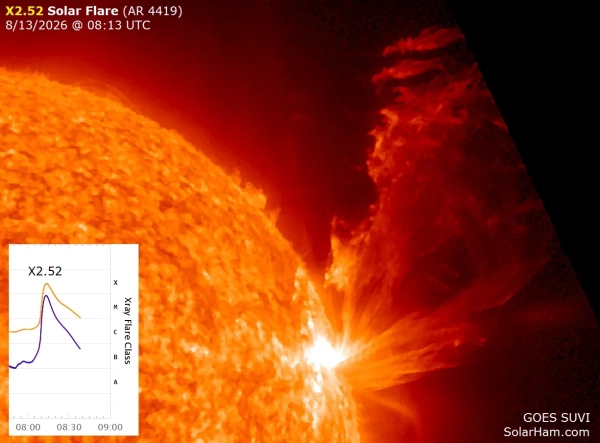
Class X2.52 flash / Photo SolarHam
Although these giant flares have been accompanied by significant coronal mass ejections, their direction does not currently pose a direct threat to Earth. As the AR4419 region moves toward the western edge of the solar disk, most of the solar material is directed northwest, beyond the Sun-Earth line.
However, scientists do not exclude the possibility of a weak tangential effect even from these events. The second most powerful flare was associated with radio emission of the second type, and the speed of plasma ejection is estimated at approximately 1293 kilometers per second. Such a rapid movement of matter and a significant coronal darkening indicate a large scale of the event.
Next will be
The magnetic configurations of both active zones are classified as Beta-Gamma-Delta, indicating their complexity and high potential for further powerful eruptions. As AR4419 moves beyond the visible horizon of the Sun, attention shifts to AR4420, whose impact on Earth's atmosphere may increase.
For residents of high latitudes, this period can be a time of bright auroras, so night sky watchers are advised to be vigilant over the weekend.
It is worth noting that from April 24 to 26, the impact of coronal holes CH1360 and CH1359 is also possible, writes solen.info. They usually cause events at the G1 level. But despite the fact that the storm predicted for April 26 also belongs to the weak category, the cumulative effect of several emissions can change the overall geophysical picture and increase, for example, to G2.