
Main points
- The Sun has experienced two powerful X-class flares accompanied by coronal mass ejections, but the bulk of the plasma is unlikely to affect Earth.
- The flare has already caused an R3 level radio blackout, causing disruptions to HF radio communications on the illuminated side of the Earth, but has not caused a geomagnetic storm.
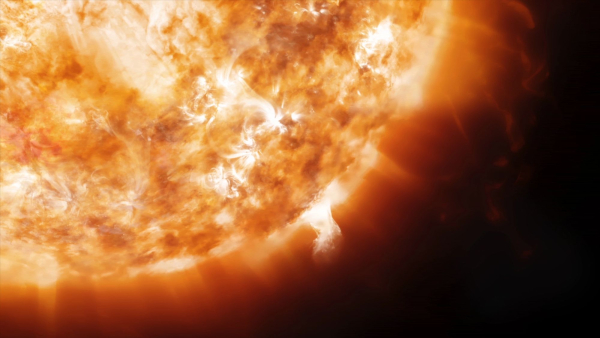
Two powerful solar flares in a day / Depositphotos
On the night of April 24, the Sun experienced a powerful X2.5-class flare, the second most powerful since the beginning of 2026. The phenomenon was accompanied by a large plasma ejection and a bright eruptive prominence. Later, the star erupted in another, even more powerful, flare, which reached the X2.52 level.
Astronomers recorded the first extreme-class flare, the maximum activity of which occurred at 04:07 Kyiv time or 01:07 UTC, writes 24 Channel . The peak activity of the second flare occurred at 11:13 Kyiv time (08:13 UTC).
What happened on the Sun?
The source of both flares was the active region AR 4419. It was there that a powerful release of energy occurred, which was accompanied by a spectacular eruptive prominence – a large-scale emission of incandescent solar plasma, clearly visible in images from space telescopes.
The second flare was also accompanied by a significant coronal mass ejection. In addition, SolarHam detected a Type II radio emission, which usually indicates the formation of a fast and powerful plasma front. According to preliminary estimates, the speed of this ejection is about 1293 km/s.
The images from the CCOR-1 coronagraph also clearly show the coronal mass ejection that occurred after the second flare.
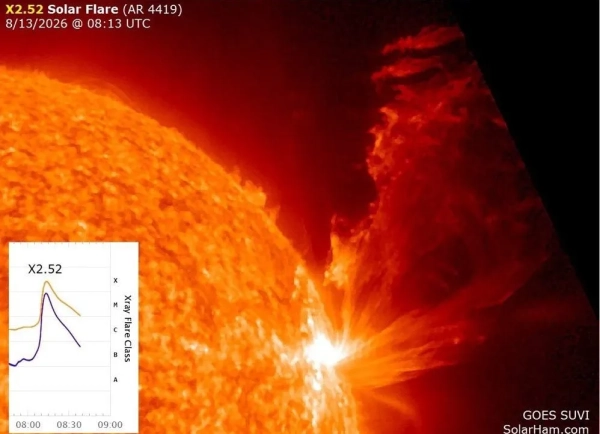
Coronal mass ejection on the Sun / Photo by SolarHam.com
The images also show significant coronal dimming, confirming the formation of a large CME. Despite the magnitude of the event, AR 4419's location near the western edge of the solar disk means that most of the plasma will likely be directed past Earth.
How might this affect Earth?
Such flares are among the most energetic manifestations of solar activity. They can be accompanied by coronal mass ejections – clouds of charged particles that, under certain conditions, can affect the Earth's magnetic field, causing magnetic storms, disruptions in radio communications, and problems with satellite operations.
And although the emissions were not directed directly towards Earth, scientists no longer rule out a so-called sliding impact – a situation where only the edge of the plasma cloud could touch our planet's magnetosphere. In this case, increased geomagnetic activity is possible, although serious consequences are not currently predicted.
The flare has already caused severe radio interference on Earth. Although the bulk of the plasma from the solar flare will likely pass by Earth, the explosion itself has already affected space weather. NOAA recorded a radio blackout of level R3 (Strong) on the international Space Weather Scales.
This refers to a severe disruption of shortwave radio communications that occurs almost immediately after a powerful X-class X-ray flare.
The radiation flux reaches the Earth in about eight minutes and affects the upper layers of the atmosphere, changing the conditions for the passage of radio signals.
As a result, large-scale disruptions of HF radio communications – the kind used by aviation, maritime transport, military services and radio operators – are possible on the sunlit side of the planet. NOAA notes that the loss of communication could last about an hour.
The operation of low-frequency navigation signals is also temporarily deteriorating, which may affect certain navigation systems.
Importantly, this is not a geomagnetic storm. The R3 radio eclipse is caused by the instantaneous X-ray emission from the flare, while magnetic storms depend on whether a coronal mass ejection reaches Earth. That is why even without a direct impact from the plasma cloud, the Sun has already had time to affect our planet.
What is happening to the Sun?
Scientists point out that the Sun is still in a phase of increased activity, so new strong flares are possible in the near future.
For comparison, an even more powerful X4.2-class flare was recorded on February 4, 2026, which became the strongest in this century. At the same time, researchers believe that the peak of the current solar cycle was already passed in the second half of last year and partly at the beginning of this year.
The Sun is probably gradually entering a phase of declining activity. This does not mean a complete lull – strong flares are still possible, but over time they will become less frequent.